Commercial kitchens across Australia are under growing pressure to improve productivity, maintain consistent food quality, manage labour challenges, reduce operating costs, and explore lower-emission cooking technology. For restaurants, clubs, pubs, aged care facilities, franchise groups, catering businesses, institutional kitchens, and high-volume food production sites, traditional manual cooking processes can become difficult to scale during busy operating periods.
Automated cooking technology is emerging as a practical response to these challenges. Rather than replacing chefs, modern cooking robots help automate repetitive, high-volume, process-driven cooking tasks so kitchen teams can focus on preparation, recipe development, supervision, quality control, plating, and customer service.
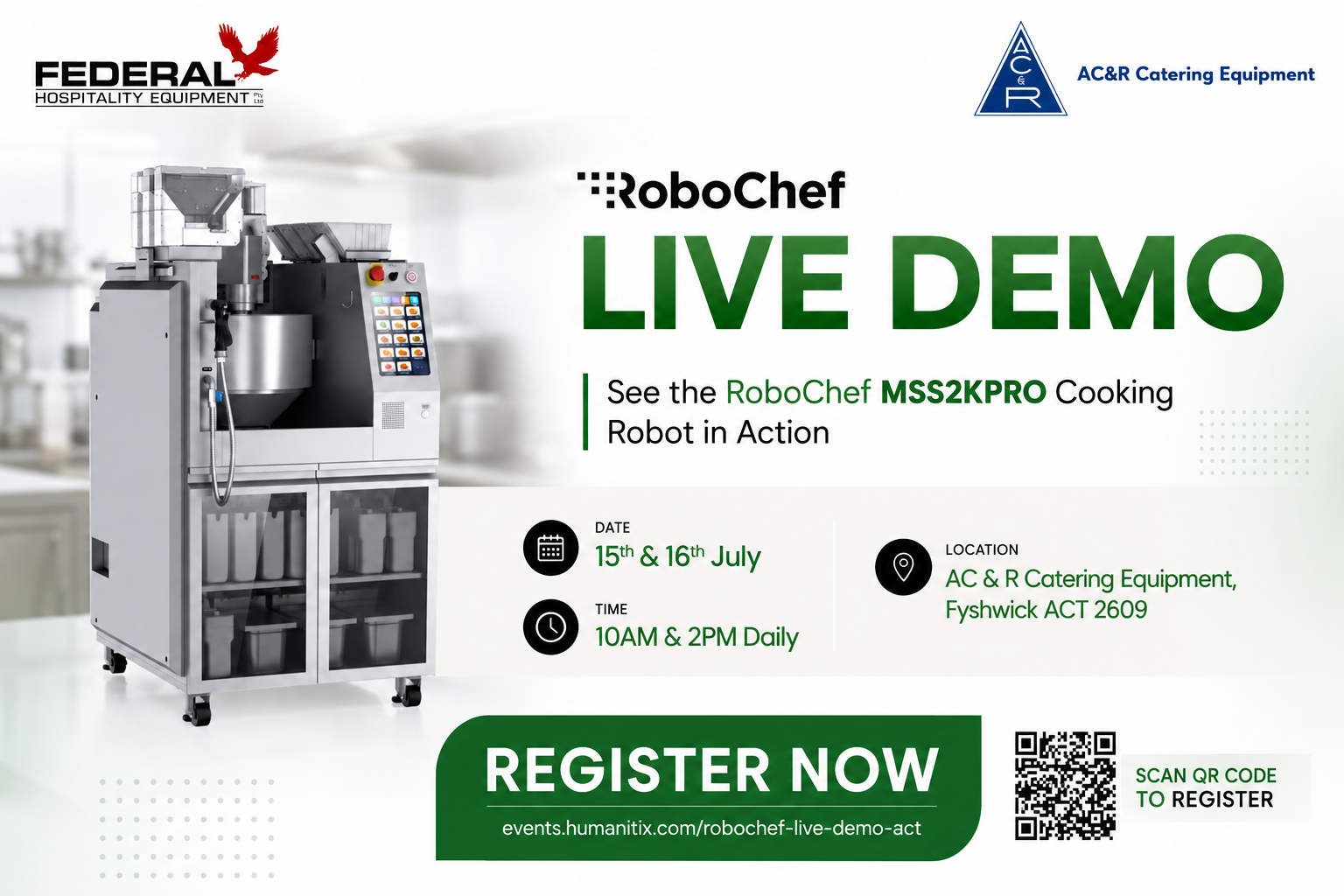
The RoboChef MSS2KPRO is an automated commercial cooking system that combines induction heating, intelligent recipe management, ingredient dispensing, sauce feeding, temperature control, and repeatable cooking execution. For foodservice businesses exploring kitchen automation, electrification, and improved production consistency, RoboChef represents a modern equipment solution built around productivity, precision, and operational resilience.
Key Takeaways
| Key Area | Why It Matters | How RoboChef Helps |
|---|---|---|
| Recipe consistency | Manual cooking can vary between shifts, locations, and operators. | Uses programmed cooking procedures for repeatable results. |
| Labour efficiency | Repetitive cooking tasks place pressure on kitchen teams. | Automates controlled cooking processes so staff can focus on higher-value tasks. |
| Kitchen throughput | Peak service requires speed without compromising quality. | Supports faster, more consistent batch production. |
| Energy performance | Traditional gas cooking can generate wasted heat and direct on-site emissions. | Uses electric induction technology for efficient cooking performance. |
| Scalability | Multi-site businesses need consistent recipes across different kitchens. | Supports standardised recipe execution. |
| Sustainability planning | Businesses are exploring electrification and lower-emission commercial kitchens. | Can align with kitchen modernisation and energy-efficiency strategies. |
Why Commercial Kitchens Are Looking at Automation
Kitchen automation is no longer limited to factories or large-scale food manufacturing. More hospitality businesses are now asking how automation can support everyday foodservice operations. The reasons are practical: labour availability can be inconsistent, training takes time, customer expectations are high, and food quality needs to remain reliable across busy service periods.
In many kitchens, the most time-consuming tasks are not always the most creative ones. They are repetitive, time-sensitive, high-volume processes that must be completed the same way every time. Stirring, heating, sauce feeding, timing, temperature control, and recipe sequencing can all consume staff attention during service. When those steps vary, the final product can vary as well.
Automated cooking robots help reduce that variability by turning repeatable cooking procedures into controlled processes. The chef or kitchen manager still determines the recipe, ingredients, standards, and finished product. The machine helps execute the process with greater consistency.
What Is the RoboChef MSS2KPRO?
The RoboChef MSS2KPRO is an automated commercial cooking robot designed for high-volume kitchens that require consistency, efficiency, and reduced manual workload. It combines automated cooking control with induction heating and recipe-based process management.
Unlike traditional cooking equipment that relies heavily on constant operator attention, RoboChef automates several important cooking stages, including ingredient dispensing, sauce feeding, cooking time control, temperature management, and programmed recipe execution.
This makes it particularly useful in commercial kitchens where the same menu items are prepared repeatedly throughout the day, across multiple shifts, or across multiple business locations.
Core RoboChef MSS2KPRO Capabilities
| Capability | Operational Purpose |
|---|---|
| Ingredient dispensing | Helps reduce manual handling and improve process control. |
| Sauce feeding | Supports consistent flavour profiles and repeatable recipe execution. |
| Temperature management | Helps maintain controlled cooking conditions. |
| Cooking time control | Reduces variation between operators and shifts. |
| Recipe automation | Allows standardised cooking processes to be repeated reliably. |
| Induction heating | Supports efficient electric cooking with reduced wasted heat. |
How RoboChef Improves Recipe Consistency
Consistency is one of the biggest operational challenges in commercial foodservice. Even with trained staff, food can vary depending on who is cooking, how busy the kitchen is, how carefully timing is followed, and whether temperature is managed correctly.
For a single-site restaurant, inconsistency can affect customer satisfaction. For a franchise group or multi-site hospitality business, inconsistency can affect the entire brand experience. Customers expect the same dish to taste, look, and feel the same regardless of location, day, or operator.
RoboChef supports consistency by following programmed cooking procedures. Once the recipe process is set, the system can repeat the same sequence with controlled timing and temperature. This is especially valuable for businesses that rely on standardised menu items, centralised production, or high-volume prepared meals.
Where Recipe Consistency Matters Most
| Business Type | Why Consistency Matters |
|---|---|
| Franchise operators | Customers expect the same menu experience across every location. |
| Multi-site hospitality groups | Standardised recipes reduce variation between kitchens. |
| Aged care facilities | Meal quality and texture consistency support resident satisfaction. |
| Institutional kitchens | Large-volume production requires predictable results. |
| Catering businesses | Event food must be delivered reliably at scale. |
How Automation Increases Kitchen Throughput
Throughput is the ability of a kitchen to produce food efficiently during service. In high-volume environments, throughput is often limited by manual cooking capacity, staff availability, pan space, timing, and supervision.
The RoboChef MSS2KPRO helps improve production capacity by automating repetitive cooking processes. Instead of relying on staff to manually monitor every stage, the system follows controlled cooking procedures and helps reduce bottlenecks caused by repetitive preparation.
| Kitchen Challenge | RoboChef Solution | Business Outcome |
|---|---|---|
| High customer demand | Faster automated production. | Better ability to manage peak periods. |
| Peak service pressure | Controlled workflow efficiency. | Reduced operational stress. |
| Production delays | Repeatable cooking processes. | More predictable output. |
| Staff shortages | Automation of repetitive tasks. | Improved labour productivity. |
| Recipe variation | Programmed recipe execution. | More consistent food quality. |
Labour-Saving Automation Without Removing Kitchen Skill
One of the most common questions about cooking robots is whether they replace chefs. In most commercial kitchens, the better answer is that automation changes how labour is used.
RoboChef can reduce the amount of staff time spent on repetitive, process-driven cooking tasks. This gives kitchen teams more opportunity to focus on preparation, quality checks, plating, ordering, cleaning, stock management, customer service, and menu development.
For businesses affected by labour shortages or rising wage pressures, this can be valuable. Automation can help stabilise operations when staffing levels fluctuate, while still allowing chefs and managers to control the menu and standards.
RoboChef Applications Across Foodservice Industries
The RoboChef MSS2KPRO can support a wide range of foodservice environments. Its value is strongest where food production needs to be consistent, repeatable, and scalable.
| Industry | Key Benefits |
|---|---|
| Restaurants | Improved consistency and reduced dependency on manual cooking tasks. |
| Clubs and pubs | Higher production capacity during busy lunch and dinner periods. |
| Catering companies | Scalable batch cooking with reliable results. |
| Aged care facilities | Standardised meal preparation for repeatable daily service. |
| Franchise operators | Consistent recipes across different locations. |
| Institutional kitchens | Efficient high-volume cooking for large groups. |
| Central production kitchens | Controlled batch preparation for distribution or multi-site service. |
Sustainable Commercial Cooking with Induction Technology
Commercial kitchens are increasingly exploring electric equipment as part of broader sustainability and electrification strategies. Traditional gas cooking has long been valued for power and responsiveness, but electric induction technology offers a different set of advantages.
The RoboChef MSS2KPRO uses electric induction cooking rather than traditional gas-powered heating. Induction transfers energy efficiently into the cooking vessel, reducing wasted heat and helping improve kitchen comfort. This can be especially useful in busy kitchens where excess heat contributes to staff fatigue and ventilation demands.
Induction Cooking Benefits
- Efficient energy transfer.
- Reduced wasted heat.
- Improved kitchen comfort.
- Support for electrification strategies.
- No direct on-site combustion emissions during operation.
- Controlled heating for repeatable cooking processes.
RoboChef MSS2KPRO vs Traditional Gas Cooking Equipment
One major advantage of RoboChef is its ability to support commercial kitchen electrification while improving energy efficiency. The comparison below is indicative and should be interpreted as a guide rather than a guaranteed result.
| Comparison Metric | Traditional Gas Wok Burner | RoboChef MSS2KPRO |
|---|---|---|
| Energy Source | Natural gas. | Electric induction. |
| Input Energy | 240 MJ/h. | 12 kW. |
| Approximate Power | 66.7 kW. | 12 kW. |
| Indicative Running Cost | A$9.60/hour. | A$4.20/hour. |
| Direct On-Site Emissions | Approx. 12.37 kg CO₂-e/hour. | 0 kg CO₂-e/hour. |
| Indicative Annual Energy Saving | — | Approx. A$9,720. |
Actual running costs and savings depend on energy tariffs, equipment utilisation, menu requirements, operating hours, site conditions, and installation requirements. However, the comparison shows why electric induction automation may be relevant for kitchens assessing energy efficiency, emissions reduction, and operational cost control.
How RoboChef Supports Electrification Strategies in the Australian Capital Territory
Across the Australian Capital Territory (ACT), many hospitality businesses are exploring sustainability initiatives that support energy efficiency, commercial kitchen electrification, and lower-emission operations. For businesses operating in Canberra, Fyshwick, Queanbeyan-adjacent service regions, and surrounding areas, kitchen modernisation is increasingly connected to both productivity and sustainability planning.
The RoboChef MSS2KPRO may be relevant during an ACT Sustainable Business Program assessment where kitchen electrification, lower-emission cooking technology, or operational efficiency improvements are being considered. By combining induction cooking with intelligent automation, RoboChef can support broader sustainability objectives while also delivering measurable operational benefits.
The ACT Sustainable Business Program is an initiative available within the Australian Capital Territory that supports eligible businesses exploring energy efficiency, electrification, and sustainability improvements. Hospitality operators considering automated induction cooking technologies such as RoboChef should determine whether their proposed kitchen upgrade aligns with current program objectives.
Important: Any support available through the ACT Sustainable Business Program is subject to eligibility assessment, current program requirements, funding availability, and formal approval by the relevant administering authority.
Is Automated Cooking Only for Large Kitchens?
Automated cooking is often associated with large-scale production, but the real question is not only business size. The better question is whether a kitchen has repetitive cooking processes that would benefit from consistency and automation.
A smaller restaurant with a high-volume signature dish may benefit from automation. A large institutional kitchen may benefit because of production volume. A franchise group may benefit because of standardisation across sites. A catering business may benefit because of batch consistency.
| Kitchen Scenario | Automation Suitability |
|---|---|
| Repeated menu items cooked daily | Strong use case. |
| High-volume batch production | Strong use case. |
| Highly customised one-off dishes | Lower suitability. |
| Multiple locations requiring consistency | Strong use case. |
| Labour shortages affecting production | Strong use case. |
Common Myths About Cooking Robots
| Myth | Reality |
|---|---|
| Cooking robots replace chefs. | They automate repetitive processes while chefs still control recipes, quality, and menu strategy. |
| Automation reduces food quality. | When correctly programmed, automation can improve consistency and reduce operator variation. |
| Cooking robots are only for factories. | They can also support restaurants, pubs, clubs, institutions, and catering businesses. |
| Automation is only about labour savings. | It can also support consistency, energy performance, throughput, and sustainability goals. |
| Electric cooking is always less powerful than gas. | Induction technology can deliver efficient, controlled heating suitable for many commercial applications. |
Why Attend the RoboChef MSS2KPRO Live Demonstration?
Seeing automated cooking technology in person gives operators a much clearer understanding of how the system works. A live demonstration allows businesses to evaluate cooking performance, understand system capabilities, ask technical questions, and explore whether the technology fits their kitchen.
The RoboChef MSS2KPRO live demonstration will be held at AC & R Catering Equipment in Fyshwick, Australian Capital Territory (ACT). This gives hospitality professionals from Canberra, Fyshwick, Queanbeyan and surrounding regions the opportunity to see automated commercial cooking technology operating in a real hospitality environment while discussing installation, workflow, and operational suitability with industry specialists.
Live Demonstration Details
| Event Detail | Information |
|---|---|
| Event | RoboChef MSS2KPRO Live Cooking Demonstration. |
| Dates | 15 & 16 July. |
| Session Times | 10:00 am and 2:00 pm daily. |
| Location | AC & R Catering Equipment, 10 Kembla Street, Fyshwick ACT 2609. |
Attendees can watch automated cooking in operation, understand how RoboChef improves kitchen efficiency, discuss installation and operational requirements, and speak with commercial kitchen automation specialists.
Commercial Buyer Checklist
- Identify repetitive cooking tasks in your kitchen.
- Confirm whether recipe consistency is a current challenge.
- Estimate labour hours spent on repeat cooking processes.
- Review production volume during peak service periods.
- Assess whether induction cooking suits your menu.
- Compare energy use against existing gas equipment.
- Check site electrical capacity and installation requirements.
- Review recipe programming and operational workflow.
- Consider staff training requirements.
- Ask about servicing, spare parts, and support.
- Evaluate sustainability and electrification objectives.
- Attend a live demonstration before making a final decision.
Why Choose Federal Hospitality Equipment?
Federal Hospitality Equipment supports Australian hospitality and foodservice operators with commercial kitchen equipment solutions designed for real operational environments. As automation becomes more relevant to modern kitchens, FHE helps businesses understand how technologies such as the RoboChef MSS2KPRO may support productivity, consistency, energy performance, and long-term kitchen planning.
Through the RoboChef live demonstration with AC & R Catering Equipment, operators can see the technology in action and ask practical questions about installation, workflow, menu suitability, energy performance, and sustainability considerations.
For businesses exploring labour-saving cooking automation, kitchen electrification, or high-volume recipe consistency, RoboChef offers a practical way to evaluate the next stage of commercial kitchen technology.
Conclusion
Commercial kitchen automation is becoming more relevant as businesses face labour pressure, rising operating costs, sustainability targets, and increasing expectations for consistency. The RoboChef MSS2KPRO shows how automated cooking technology can combine induction heating, recipe control, ingredient dispensing, and repeatable process management to support modern foodservice operations.
The strongest use cases are kitchens that prepare repeatable dishes at scale, manage high production demand, operate across multiple locations, or want to reduce manual cooking pressure. RoboChef should not be viewed as a replacement for culinary skill. It should be viewed as a tool that helps commercial kitchens produce consistent food more efficiently.
Businesses interested in automation, electrification, and future-ready kitchen operations can attend the live demonstration at AC & R Catering Equipment in Fyshwick, Australian Capital Territory (ACT), to see how RoboChef may fit their operating model.
Frequently Asked Questions
What is the RoboChef MSS2KPRO?
The RoboChef MSS2KPRO is an automated commercial cooking robot that combines induction cooking, ingredient dispensing, recipe automation, temperature control, and intelligent process management.
Who is RoboChef suitable for?
RoboChef is suitable for restaurants, clubs, pubs, catering businesses, aged care facilities, franchise operators, institutional kitchens, and high-volume food production environments.
Can RoboChef reduce labour requirements?
Yes. RoboChef can automate repetitive cooking tasks, helping improve labour productivity while allowing kitchen staff to focus on preparation, presentation, supervision, and service.
Does RoboChef replace chefs?
No. RoboChef supports chefs by automating repeatable cooking processes. Chefs still control recipes, menu development, quality standards, and final food presentation.
Does RoboChef support sustainability goals?
Yes. RoboChef uses electric induction cooking technology, which can support lower-emission kitchen strategies and reduce direct on-site emissions compared with gas cooking.
How does RoboChef improve consistency?
RoboChef follows programmed cooking procedures, helping reduce variation between operators, shifts, and locations.
What types of businesses benefit most from automated cooking?
Businesses with repeatable menu items, high-volume production, labour challenges, multi-site operations, or centralised food preparation can benefit strongly from automated cooking technology.
Can RoboChef help with energy savings?
Indicative comparisons suggest RoboChef may reduce energy costs compared with some traditional gas cooking equipment, but actual savings depend on usage, tariffs, operating hours, menu requirements, and site conditions.
Is RoboChef relevant to ACT sustainability initiatives?
It may be relevant for businesses operating in the Australian Capital Territory (ACT) that are exploring kitchen electrification or energy-efficiency improvements. Any program support is subject to eligibility assessment, program requirements, funding availability, and formal approval.
Where is the RoboChef live demonstration?
The demonstration is hosted at AC & R Catering Equipment, 10 Kembla Street, Fyshwick ACT 2609, in the Australian Capital Territory.
When are the RoboChef demonstration sessions?
The live demonstration is scheduled for 15 and 16 July, with sessions at 10:00 am and 2:00 pm daily.
Why should businesses attend the demonstration?
Attending allows operators to see RoboChef in action, ask technical questions, understand suitability for their kitchen, and evaluate automation benefits before making investment decisions.
Disclaimer
Energy usage, running costs, emissions reductions, savings estimates, and payback calculations are indicative only. Actual results may vary depending on equipment utilisation, energy tariffs, operating hours, menu requirements, site conditions, and installation requirements. Any support available through the ACT Sustainable Business Program is subject to eligibility assessment, current program requirements, funding availability, and formal approval by the relevant administering authority.