Ice is a critical operational component for many Australian businesses. Cafés, restaurants, bars, hotels, seafood retailers, healthcare facilities, and remote work sites all rely on a consistent supply of ice to support daily operations, customer service, food presentation, and food safety.
Australia’s climate creates additional challenges when selecting a commercial ice machine. Businesses in warmer regions such as Queensland, Western Australia, the Northern Territory, and parts of South Australia must account for higher surrounding temperatures, seasonal demand increases, ventilation conditions, and local water quality.
Choosing the right industrial ice maker is not simply about purchasing the machine with the highest output. You must evaluate daily demand, ice type, cooling configuration, storage capacity, installation requirements, water filtration, maintenance needs, and long-term running costs.
Quick Takeaways: Commercial Ice Machine Buying Checklist
| Decision Area | What to Consider |
|---|---|
| Daily Volume | Calculate how many kilograms of ice your business needs each day and select a unit with additional capacity for peak demand periods. |
| Ice Type | Choose the ice shape based on your application, whether it is beverages, seafood display, healthcare, or food preparation. |
| Cooling Configuration | Match air-cooled or water-cooled technology with your local climate, ventilation conditions, and operating environment. |
| Storage Capacity | Ensure the machine stores enough ice for peak service periods, not only average daily use. |
| Water Quality | Install filtration where required to reduce scale, improve taste, and support equipment reliability. |
This guide explains how Australian businesses can select the right professional ice production system, including floor-model variants, underbench ice machines, and modular ice makers, for reliable performance and long-term value.
Why Commercial Ice Machines Matter for Australian Businesses
A reliable ice supply supports more than beverage service. In many industries, ice is essential for product presentation, food preservation, cooling processes, and customer experience. Running out of ice during peak periods can slow service, reduce beverage quality, affect seafood displays, and interrupt daily operations.
| Business Type | How Ice Supports Operations |
|---|---|
| Cafés | Iced drinks, cold brew, smoothies, display cooling, and seasonal summer demand. |
| Restaurants | Beverage service, food preparation, ingredient cooling, and kitchen workflow. |
| Bars and pubs | Cocktails, spirits, soft drinks, premium presentation, and high-volume service. |
| Hotels | Guest service, events, banquets, room service, and food preparation. |
| Seafood retailers | Product display, temperature control, freshness, and visual presentation. |
| Healthcare facilities | Patient care, hydration support, and clinical applications where suitable. |
How Much Ice Does My Business Actually Need?
The answer depends on your industry, customer volume, operating hours, and peak service periods. A common mistake businesses make is selecting ice machines for sale based only on average daily usage. Your ice maker must handle busy periods, seasonal increases, and unexpected operational demands without running continuously at maximum capacity.
Use this simple calculation:
Example: A café serving 200 customers daily with an average requirement of 0.25 kg of ice per customer would need:
200 × 0.25 kg = 50 kg of ice per day
Businesses should select a unit capable of producing around 20–30% more than their calculated requirement to maintain a reliable supply.
Typical Daily Ice Requirements by Business Type
| Business Type | Typical Daily Ice Requirement |
|---|---|
| Small Café | 20–50 kg |
| Coffee Shop | 30–80 kg |
| Restaurant | 50–200 kg |
| Bar or Pub | 100–500 kg |
| Hotel | 200–1,000 kg+ |
| Healthcare Facility | 300–2,000 kg+ |
| Seafood Retailer | 100–1,500 kg+ |
A seafood market in Sydney, for example, may require significant flake ice output throughout the day to maintain product presentation. At the same time, a cocktail bar may prioritise premium cube ice rather than maximum volume.
What Is the Difference Between Ice Production and Ice Storage?
Ice production and ice storage are separate considerations. Production capacity tells you how much ice the machine can make in a day. Storage capacity tells you how much ice is ready to use at a given time.
A machine may produce enough ice over 24 hours but still fail during busy service if the storage bin is too small. This is especially important for bars, restaurants, hotels, and seafood retailers with concentrated peak demand.
| Factor | Meaning | Why It Matters |
|---|---|---|
| Production Capacity | How much ice the machine produces per day | Determines whether daily demand can be met. |
| Storage Capacity | How much ice is held and ready for use | Determines whether the business can handle rush periods. |
| Peak Demand | The busiest service window | Often more important than average daily usage. |
Which Ice Shape Is Right for My Business?
Different ice shapes are designed for different applications. The correct choice, sourced from the top ice machine suppliers and manufacturers, improves cooling performance, presentation, and customer experience.
| Ice Type | Best Used For | Main Benefits |
|---|---|---|
| Full Cube Ice | Restaurants, bars, hotels | Slow melting and premium appearance |
| Half Cube Ice | Fast food outlets, cafés | Efficient cooling and versatile use |
| Nugget Ice | Healthcare and beverages | Soft texture and easy consumption |
| Flake Ice | Seafood displays and food preparation | Excellent product coverage and presentation |
| Gourmet Ice | Premium bars and hospitality venues | High-end drink presentation |
Premium hospitality venues often select gourmet ice from specialist brands such as Hoshizaki or Manitowoc Ice because the shape, clarity, and melting rate support beverage presentation.
How Does Australia’s Climate Affect Ice Machine Performance?
Climate directly affects ice production. Ice makers are tested under controlled conditions, but Australian businesses often operate in much warmer environments. The surrounding air temperature can significantly influence output.
For example, a machine operating in Perth, Darwin, Brisbane, or Adelaide during summer may produce less ice than its advertised laboratory rating if the installation area becomes too hot.
The performance gap happens because ice machines in Australia must work harder when:
- The room temperature is high
- Ventilation is restricted
- Heat cannot escape efficiently
- Demand increases during summer periods
Manufacturers rate equipment based on ideal conditions. Your business environment determines real-world performance.
| Australian Operating Condition | Potential Impact | What to Check |
|---|---|---|
| High ambient temperature | Lower ice output than advertised | Operating temperature rating |
| Poor ventilation | Heat build-up and compressor strain | Clearance and airflow requirements |
| Summer trading spikes | Higher ice demand | 20–30% capacity buffer |
| Hot kitchens or back-of-house areas | Reduced efficiency | Installation position and cooling type |
Should I Choose an Air-Cooled or Water-Cooled Ice Machine?
The correct cooling system, such as under-bench or modular large variants, depends on your location, installation environment, and operating priorities.
Air-Cooled Ice Makers
Air-cooled systems use surrounding air to remove heat generated during operation. They are commonly chosen by Australian businesses because they reduce water usage and are usually simpler to install.
| Benefit | Impact |
|---|---|
| Lower water consumption | Reduced utility usage |
| Easier installation | Lower setup complexity |
| Lower operating cost | Better long-term efficiency |
| Common Australian choice | Suitable for most venues |
Water-Cooled Ice Makers
Water-cooled systems use water to cool the equipment supplied by the leading ice machine dealers and distributors.
| Benefit | Impact |
|---|---|
| Strong performance in extreme heat | Reliable output in demanding environments |
| Quieter operation | Useful for customer-facing areas |
| Stable production | Less affected by room temperature |
Air-Cooled vs Water-Cooled Comparison
| Feature | Air-Cooled | Water-Cooled |
|---|---|---|
| Water Usage | Low | High |
| Energy Efficiency | High | Moderate |
| Installation Cost | Lower | Higher |
| Hot Climate Performance | Good | Excellent |
| Maintenance Requirements | Easier | More Complex |
For most Australian businesses, air-cooled units provide the best balance between efficiency and performance. Water-cooled systems are better suited to very hot environments or locations where noise reduction is important.
How Much Ice Storage Capacity Do I Need?
Ice production and storage are separate considerations. When you buy an ice machine online, it may produce enough ice daily, but still fail during busy periods if the storage capacity is too small.
Consider:
- Peak serving times
- Customer traffic patterns
- Delivery schedules
- Emergency backup requirements
Self-Contained Ice Machines
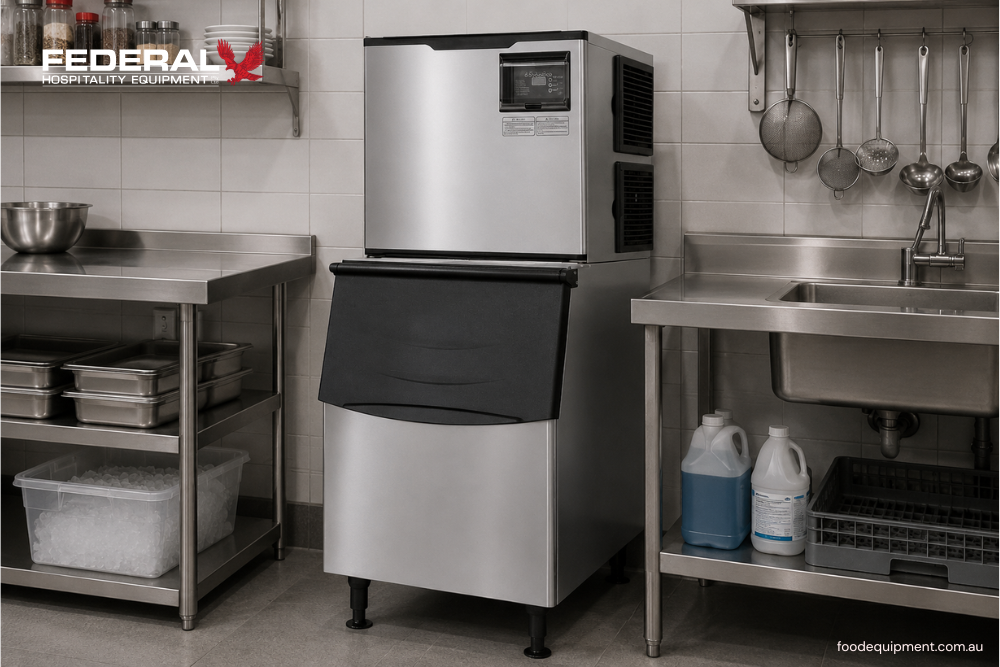
A self-contained unit produces and stores ice inside the same cabinet. These are suitable for smaller cafés, bars, and food outlets.
Modular Ice Machines
A modular ice machine is a larger production unit that requires a separate storage bin. These systems are designed for high-volume operations such as hotels, hospitals, and large hospitality venues.
| Setup Type | Best For | Key Advantage |
|---|---|---|
| Self-contained ice machine | Cafés, bars, small restaurants | Compact design with built-in storage |
| Modular ice machine | Hotels, hospitals, seafood retailers, large venues | High production with separate storage flexibility |
How Does Water Quality Affect Ice Machine Performance?
Water quality directly affects reliability. Hard water means water with high mineral content, particularly calcium and magnesium.
Many Australian regions, including parts of Adelaide and Western Australia, experience harder water conditions. Minerals in water can form deposits or scale inside equipment, reducing the ice maker’s performance over time.
Poor water quality can cause:
- Reduced ice output
- Cloudy ice appearance
- Higher maintenance requirements
- Shorter equipment lifespan
A filtration system improves reliability by reducing mineral deposits before they enter the machine.
| Filtration Benefit | Business Impact |
|---|---|
| Cleaner ice | Improved customer experience |
| Reduced deposits | Lower maintenance requirements |
| Better taste | Improved beverage quality |
| Consistent operation | Reliable daily performance |
How Do Maintenance and Cleaning Affect Long-Term Reliability?
Commercial ice machines work continuously in demanding environments. Regular cleaning and preventive maintenance help preserve output, reduce breakdowns, and maintain hygienic ice production.
Basic Maintenance Checklist
| Task | Recommended Frequency |
|---|---|
| Clean exterior surfaces | Daily |
| Check ice bin condition | Daily |
| Inspect water filter condition | Monthly |
| Check ventilation clearance | Monthly |
| Descale internal components | As required based on water quality |
| Schedule professional servicing | At least annually, or as recommended |
What Are the Common Mistakes When Buying a Commercial Ice Machine?
| Common Mistake | Potential Problem | Better Approach |
|---|---|---|
| Choosing based only on advertised output | Machine may underperform in hot Australian conditions. | Check real-world operating ratings and climate suitability. |
| Buying for average demand | Ice shortages during weekends, summer, or peak service. | Plan around peak demand and add 20–30% buffer capacity. |
| Ignoring ice type | Ice may not suit beverages, seafood, healthcare, or food preparation. | Match ice shape to application. |
| Overlooking storage capacity | Machine may produce enough ice daily but run short during service. | Match storage capacity to peak usage periods. |
| Not considering water quality | Scale build-up, cloudy ice, and increased maintenance. | Install appropriate filtration. |
| Ignoring ventilation | Reduced output and higher mechanical strain. | Confirm clearance and airflow requirements before installation. |
Commercial Ice Machine Buyer Checklist
- Calculate peak daily ice demand.
- Add 20–30% extra production capacity for busy periods.
- Choose the right ice type for your application.
- Confirm whether an underbench, self-contained, or modular system is suitable.
- Check Australian climate conditions and ambient temperature ratings.
- Confirm ventilation and installation clearance.
- Compare air-cooled and water-cooled configurations.
- Review storage bin capacity.
- Check local water quality and filtration needs.
- Compare total running costs, not only purchase price.
- Confirm servicing, spare parts, and warranty support.
Conclusion
Selecting the right commercial ice machine requires more than choosing the highest-output model. Australian businesses must consider daily demand, ice type, climate conditions, cooling configuration, storage requirements, water quality, maintenance needs, and operating costs.
The ideal solution is the one that delivers a reliable supply, supports efficient operations, and matches the specific needs of your venue. By evaluating these factors before purchase, businesses can invest in equipment such as an under-bench option that improves productivity, reduces downtime, and delivers dependable performance for years.
FAQs: Commercial Ice Machines in Australia
1. What size commercial ice machine do I need?
Start by calculating your daily ice usage based on customer numbers and average ice use. Then choose a machine with around 20–30% additional capacity to handle peak demand, summer trading, and unexpected increases.
2. Which ice type is best for bars and restaurants?
Full cube or gourmet ice is often preferred for bars and restaurants because it melts slowly and supports premium beverage presentation. Half cube ice may suit cafés and fast-service environments.
3. Are air-cooled ice machines suitable for Australian businesses?
Yes. Air-cooled ice machines are suitable for most Australian venues, provided there is adequate ventilation and the installation area does not become excessively hot.
4. When should a business choose a water-cooled ice machine?
Water-cooled machines may suit very hot environments, poorly ventilated locations, or customer-facing areas where quieter operation is important. However, they use more water and may cost more to install.
5. Do commercial ice machines need water filtration?
In many Australian regions, water filtration is strongly recommended. Filtration helps reduce scale, improve ice clarity and taste, lower maintenance requirements, and protect machine performance.
6. What is the difference between self-contained and modular ice machines?
Self-contained ice machines produce and store ice in one cabinet, making them suitable for smaller venues. Modular ice machines require a separate storage bin and are better for high-volume operations.