Commercial kitchens throughout Australia depend on efficiency, consistency, and intelligent use of available space. Whether you manage a busy Sydney café, a Melbourne CBD bistro, a Brisbane catering facility, a Perth hotel kitchen, or a regional hospitality venue, selecting the right salamander workbench directly affects food quality, workflow efficiency, and service speed.
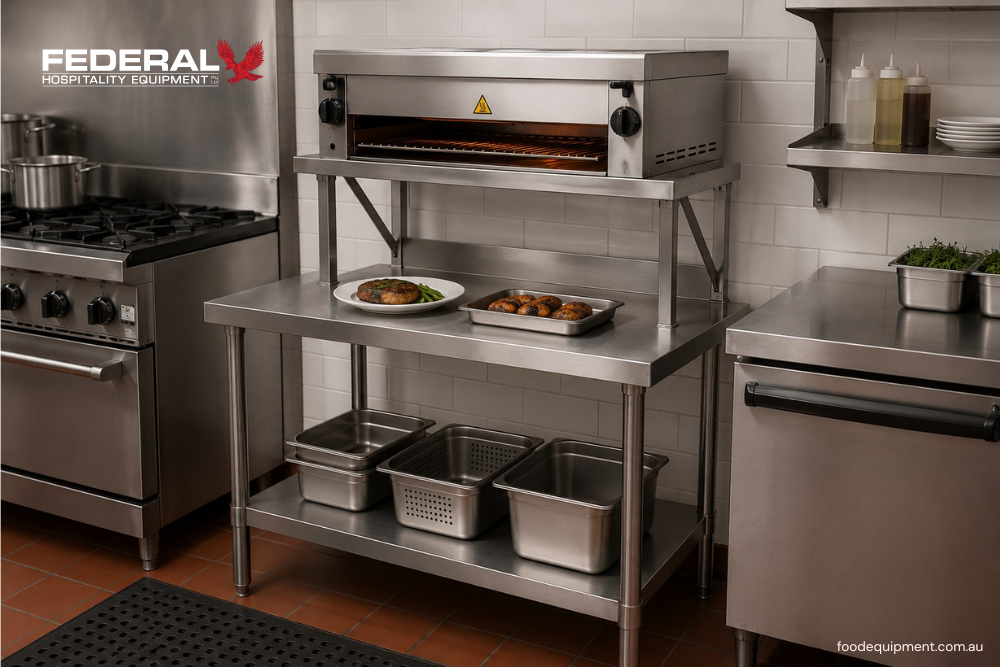
An integrated prep-and-grill bench combines a stainless-steel preparation surface with a powerful overhead grilling station. This design allows chefs to melt, brown, finish, toast, and reheat dishes while keeping food preparation and finishing tasks within a single workstation.
You must evaluate more than the initial purchase price when selecting equipment. Menu requirements, kitchen layout, heating performance, compliance obligations, energy consumption, cleaning access, and long-term maintenance costs all influence the best investment for your operation.
Key Takeaways
- Your menu determines the heating power and cooking style required.
- Kitchen space dictates the appropriate bench size and configuration.
- High-volume kitchens require larger cooking zones and greater throughput.
- Compliance with Australian gas, electrical, ventilation, and food safety requirements is essential.
- Total cost of ownership matters more than the initial purchase price.
- Easy-to-clean models reduce labour costs and support food safety compliance.
What Is a Salamander Workbench?
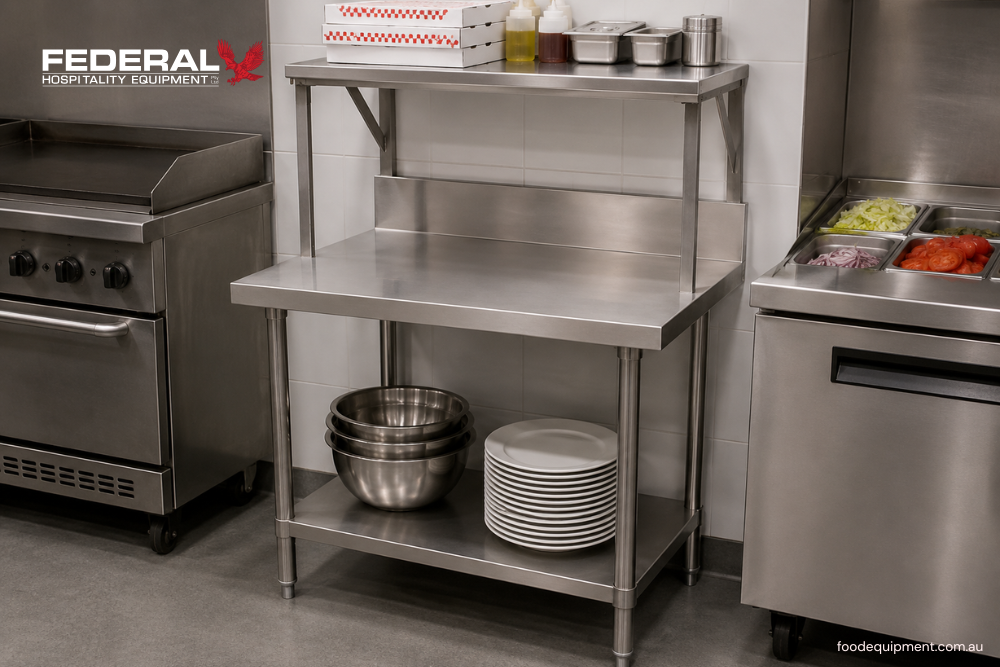
A salamander workbench, unlike other products such as benches with splashbacks, combines a commercial-grade stainless-steel workstation with a salamander grill mounted above the preparation area. The grill delivers intense direct overhead heat, making it ideal for melting cheese, browning dishes, finishing steaks, caramelising toppings, and reheating plated meals.
Unlike conventional grills that apply heat from below, a salamander applies concentrated heat from above. This enables chefs to achieve precise finishing results while maintaining product quality and presentation.
Common Applications in Australian Commercial Kitchens
| Food Business Type | Typical Applications |
|---|---|
| Cafés | Toasted sandwiches, breakfast dishes, cheese melts, open grills, and reheated pastries. |
| Restaurants | Steak finishing, seafood preparation, gratins, roasted vegetables, and plated meal finishing. |
| Hotels | Buffet preparation, room service finishing, breakfast service, and plated banqueting. |
| Catering Facilities | Rapid reheating, batch finishing, presentation control, and high-volume service support. |
| Takeaway Stores | Fast service, product consistency, toasted items, and finishing cooked menu items. |
Why Choosing the Right Salamander Workbench Matters
A salamander workbench can improve service speed by keeping preparation and finishing tasks in one practical area. Instead of moving food between multiple stations, chefs can assemble, finish, and plate items from a more efficient workstation.
For busy kitchens, this can reduce unnecessary movement, improve consistency, and help staff respond faster during peak service. However, a poorly chosen unit can create heat management issues, cleaning challenges, workflow interruptions, and higher running costs.
| Operational Area | How the Right Unit Helps |
|---|---|
| Food quality | Supports consistent browning, melting, toasting, and finishing. |
| Workflow | Combines preparation and overhead grilling in one station. |
| Service speed | Reduces movement between prep, grill, and plating areas. |
| Space efficiency | Uses vertical kitchen space by mounting the salamander above the bench. |
| Staff productivity | Helps chefs complete finishing tasks more quickly and consistently. |
| Long-term value | Supports better equipment utilisation and reduced operational bottlenecks. |
How Much Kitchen Space Do You Have Available?
Physical footprint should be assessed separately from cooking capacity. Many Australian hospitality venues operate within compact commercial premises where every square metre influences efficiency. The integrated prep-and-grill bench should fit naturally into existing preparation, cooking, and plating workflows.
Space Planning Considerations
| Factor | Why It Matters |
|---|---|
| Bench Length | Must suit available floor space and preparation requirements. |
| Bench Depth | Influences movement, accessibility, and safe working clearance. |
| Ventilation Clearance | Supports safe operation and heat management. |
| Positioning | Reduces unnecessary staff movement between stations. |
| Workflow Integration | Improves service efficiency and plating speed. |
A properly positioned unit, sourced from the top salamander workbench suppliers and manufacturers, optimises kitchen output by reducing travel time between preparation and finishing stations.
Kitchen Layout Questions Before Buying
| Question | Why It Matters |
|---|---|
| Will the bench block staff movement? | Prevents congestion during busy service. |
| Is there enough ventilation clearance? | Supports safe heat removal and equipment performance. |
| Can staff clean around and beneath the unit? | Improves hygiene and reduces daily labour. |
| Is the unit close to plating and service areas? | Improves workflow and reduces delays. |
| Does the bench height suit staff tasks? | Supports comfort and productivity during long shifts. |
How Important Are Ergonomics and Staff Safety?
Ergonomics and safety deserve independent consideration. Working height influences staff comfort during long service periods. Poorly positioned equipment can contribute to fatigue and reduce productivity during busy trading hours.
Operators should also ensure adequate clearance around the unit for cleaning, maintenance, ventilation, and safe access. Easy access improves workplace safety while simplifying routine servicing.
Ergonomic Features Worth Prioritising
| Feature | Benefit |
|---|---|
| Suitable working height | Reduces bending, reaching, and fatigue during preparation. |
| Adjustable grill height | Improves control over browning, melting, and reheating. |
| Accessible controls | Allows staff to operate the unit safely during service. |
| Clear service access | Reduces accidental contact with hot surfaces. |
| Stable construction | Improves safety when handling trays, plates, and hot food. |
Should You Choose a Gas or Electric Salamander?
Both gas and electric models are widely used in commercial kitchens throughout Australia. Gas units often deliver powerful heating performance and rapid recovery times. Electric units generally provide greater temperature precision and simpler installation.
Australian operators should also understand the distinction between Natural Gas and LPG when they buy salamander benches online. Urban locations often have access to Natural Gas networks, while rural properties, mobile operations, and remote hospitality venues may rely on LPG cylinders or bulk storage systems.
Gas vs Electric Comparison
| Feature | Gas Models | Electric Models |
|---|---|---|
| Heat Recovery Time | Excellent | Very Good |
| Temperature Precision | Good | Excellent |
| Installation Complexity | Higher | Lower |
| Energy Source | Natural Gas or LPG | Electrical Supply |
| Maintenance Requirements | Moderate | Generally Lower |
Pros and Cons at a Glance
| Option | Advantages | Limitations |
|---|---|---|
| Gas | Rapid heating, strong performance, and lower operating costs in some regions. | More complex installation requirements. |
| Electric | Precise control, easier installation, and simpler compliance. | Higher electricity costs in some locations. |
How Do You Choose the Right Capacity?
Capacity should focus on throughput requirements. A small workbench may create operational slowdowns during your busiest service periods. Conversely, an oversized unit increases energy consumption and occupies valuable floor space.
Capacity Selection Guide
| Kitchen Type | Recommended Capacity |
|---|---|
| Small Café | Compact cooking area |
| Mid-Sized Restaurant | Medium-capacity unit |
| Hotel Kitchen | Large-capacity unit |
| Catering Facility | High-volume model |
| Multi-Site Operation | Heavy-duty commercial unit |
As a practical benchmark, many medium-to-large Australian restaurants select gas-powered salamander workbenches in Australia with strong heating capacity to meet peak service demands.
What Australian Compliance Requirements Apply?
You should never treat compliance as a second thought. Gas installations must be completed by appropriately licensed professionals and should meet applicable Australian gas safety requirements. Electric models should comply with AS/NZS 3000 electrical installation standards. Ventilation systems must also meet relevant local council, building, and workplace safety requirements.
Australian Compliance Checklist
| Requirement | Purpose |
|---|---|
| Licensed gas installation | Supports safe Natural Gas or LPG connection. |
| AS/NZS 3000 compliance | Supports electrical safety. |
| Food safety requirements | Supports hygienic food handling and service. |
| HACCP principles | Supports risk management and operational control. |
| Ventilation assessment | Supports safe heat, smoke, and vapour management. |
| Fire safety review | Supports workplace protection and insurance obligations. |
Consulting qualified installers before purchase helps prevent costly compliance issues.
How Easy Is the Unit to Clean and Maintain?
Cleaning requirements directly influence long-term operating costs. Models featuring removable drip trays, accessible components, and smooth stainless-steel surfaces simplify daily cleaning routines while supporting food safety objectives. For further information, visit the leading salamander workbench dealers and distributors in your area.
Daily Cleaning Guide
| Task | Frequency |
|---|---|
| Empty drip trays | Daily |
| Wipe stainless-steel surfaces | After each service |
| Inspect heating components | Weekly |
| Check ventilation areas | Weekly |
| Schedule professional servicing | Annually |
Equipment that is easy to maintain experiences less downtime and lower ownership costs.
Why Should You Factor in Total Ownership Cost?
The initial purchase price represents only one component of the investment. A lower-cost model may appear attractive, but higher energy use, difficult cleaning, poor durability, and frequent repairs can make it more expensive over time.
Cost Factors Beyond Purchase Price
| Cost Category | Impact |
|---|---|
| Energy Consumption | Ongoing operating expense |
| Maintenance | Influences lifespan |
| Repairs | Affects downtime |
| Productivity Improvements | Enhances efficiency |
| Equipment Durability | Reduces replacement frequency |
Common Mistakes When Buying a Salamander Workbench
| Common Mistake | Potential Problem | Better Approach |
|---|---|---|
| Choosing only by price | May lead to higher operating costs, maintenance issues, or poor performance. | Compare heating performance, durability, cleaning access, and total ownership cost. |
| Ignoring kitchen layout | Can cause workflow bottlenecks and staff movement issues. | Measure the space and plan the unit around preparation, finishing, and plating flow. |
| Undersizing capacity | May slow service during peak periods. | Choose based on your busiest trading periods, not average demand. |
| Forgetting ventilation requirements | Can create safety, heat, and compliance problems. | Confirm ventilation and clearance requirements before purchase. |
| Overlooking cleaning access | Increases labour time and hygiene risks. | Prioritise removable trays, smooth surfaces, and accessible components. |
Buyer Checklist Before Purchasing
- Review your menu and identify common finishing tasks.
- Measure available bench and floor space.
- Confirm gas or electrical supply requirements.
- Check whether Natural Gas or LPG is available if choosing gas.
- Assess peak service demand, not just average daily output.
- Review ventilation, fire safety, and installation requirements.
- Check working height, reach distance, and grill adjustability.
- Compare cleaning access, drip trays, and stainless-steel surfaces.
- Review energy use and total ownership cost.
- Confirm warranty, servicing, and spare parts support.
Conclusion
Choosing the right salamander workbench for an Australian commercial kitchen requires a structured evaluation of menu requirements, available space, heating performance, capacity, compliance obligations, and long-term operating costs.
The most effective overhead grilling station aligns with your cooking style, supports expected throughput, complies with Australian requirements, and integrates seamlessly into existing kitchen workflows.
By focusing on operational performance, physical capacity, and long-term value, kitchen managers and owners can confidently invest in equipment that optimises kitchen output, maintains food quality, and supports sustainable business growth for years to come.
FAQs: Salamander Workbenches
1. What is a salamander workbench used for?
A salamander workbench combines a stainless-steel preparation bench with an overhead grill. It is used for melting, browning, finishing, toasting, reheating, and preparing plated meals in commercial kitchens.
2. Is a gas or electric salamander better?
Gas models often offer faster heat recovery and strong performance, while electric models usually provide more precise temperature control and simpler installation. The best choice depends on your kitchen layout, utilities, and service volume.
3. How do I choose the right size salamander workbench?
Choose the size based on menu requirements, available kitchen space, ventilation clearance, and peak service demand. The unit should support your busiest periods without wasting valuable floor space.
4. Why is cleaning access important?
Easy cleaning access reduces labour time, supports food safety, and helps prevent grease build-up around heating components and stainless-steel surfaces.
5. What compliance requirements should Australian kitchens check?
Australian kitchens should check gas installation requirements, AS/NZS 3000 electrical compliance, ventilation requirements, food safety obligations, HACCP procedures, and fire safety considerations.
6. Should I consider total ownership cost?
Yes. Energy consumption, maintenance, repairs, durability, productivity, and downtime can all affect the true long-term cost of the equipment.