Running a successful café in Australia requires efficient kitchen operations, consistent hygiene standards, and reliable sanitation equipment. A commercial under bench dishwasher is a critical component of café infrastructure, particularly in high-traffic hospitality environments where cups, plates, utensils, and glassware must be cleaned continuously throughout service hours.
Choosing the correct compact commercial dishwasher directly affects cleaning performance, water usage, staff workload management, food safety compliance, and long-term operating costs. A properly selected machine improves productivity, supports Australian hygiene regulations, and reduces avoidable technical issues.
Key Takeaways
| Priority Factor | Why It Matters |
|---|---|
| Fast Wash Cycles and High RPH | Supports continuous service during busy trading periods |
| Energy and Water Efficiency | Reduces long-term utility costs |
| Local Service Support | Reduces operational downtime and maintenance delays |
What Is an Under Bench Dishwasher?
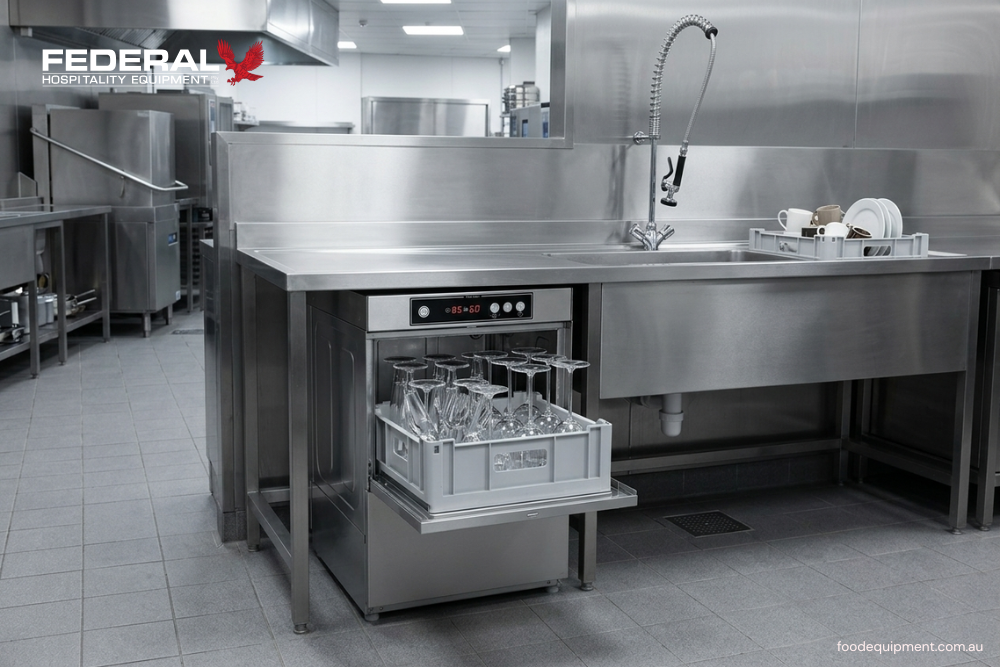
An under bench dishwasher is a compact hospitality dishwasher designed to fit beneath standard commercial kitchen benches. These machines are commonly used in cafés, bakeries, coffee shops, bars, and smaller hospitality venues where kitchen space is limited.
Unlike pass-through or conveyor dishwashers used in large commercial kitchens, professional glass and dish cleaning units are designed for moderate-volume operations while still meeting commercial sanitisation requirements.
Most commercial under-counter washers are capable of cleaning:
- Coffee cups and saucers
- Plates and bowls
- Glassware
- Cutlery
- Milk jugs
- Kitchen utensils
To comply with Australian hygiene requirements, the sanitisation cycle must typically achieve a final rinse temperature of at least 82°C.
Why Are Under Bench Dishwashers Popular In Australian Cafés?
Australian cafés frequently operate in compact hospitality environments where efficient equipment layout is essential. Compact commercial dishwashers provide an effective balance between cleaning performance, installation flexibility, and operational efficiency.
| Feature | Benefit for Australian Cafés |
|---|---|
| Compact Footprint | Fits within smaller commercial kitchens |
| Fast Wash Cycles | Maintains service efficiency during peak periods |
| Commercial Sanitisation | Supports Food Standards Australia New Zealand (FSANZ) hygiene compliance |
| Water Efficiency | Reduces water consumption compared to manual washing |
| Labour Efficiency | Improves staff productivity |
| Energy Efficiency | Lowers operational utility costs |
What Should You Consider Before Choosing a Dishwasher?
Before purchasing essential kitchen sanitation equipment, café owners must carefully evaluate their operational requirements. Dishwashing demand varies significantly depending on venue size, customer volume, menu complexity, and service style.
A small takeaway coffee kiosk may only require a light-duty compact dishwasher. In contrast, a high-volume brunch venue requires a heavy-duty machine, sourced from the top under bench dishwasher suppliers and manufacturers, capable of continuous operation during service periods. Wash cycle performance should be evaluated using both cycle duration and throughput measurements.
Important technical terms include:
- RPH (Racks Per Hour): Calculates how many shelves the equipment can clean each hour
- LPH (Litres Per Hour): Measures water consumption during operation
- Sanitisation Cycle: The final washing phase obtains cleanliness-safe temperatures
- HACCP Compliance: Refers to Hazard Analysis and Critical Control Points food safety procedures
| Café Type | Recommended Machine Type |
|---|---|
| Small Coffee Kiosk | Light-duty compact dishwasher |
| Medium Café | Standard commercial under-counter washer |
| High-Volume Brunch Venue | High-speed heavy-duty unit |
| Bakery or Dessert Venue | Larger rack-capacity model |
| Bar and Café Hybrid | Split up the glass cleaner and dishwashing mix |
Modern commercial units generally offer wash cycles between 60 and 180 seconds. Faster cycle speeds combined with higher RPH ratings improve operational efficiency during breakfast and lunch service periods.
How Important Are Water and Energy Efficiency?
Water and electricity costs significantly affect hospitality operating expenses across Australia. Energy-efficient pass-through dishwashing systems reduce utility consumption while maintaining cleaning performance.
Modern commercial dishwashers commonly include:
| Efficiency Feature | Operational Advantage |
|---|---|
| Low Water Consumption | Reduces monthly water bills |
| Heat Recovery Systems | Improves thermal efficiency |
| Insulated Boiler Systems | Retains heat more effectively |
| Smart Sensors | Optimises detergent and rinse usage |
| Energy-Saving Standby Modes | Minimises electricity consumption |
Café owners should also look for:
- WELS (Water Efficiency Labelling and Standards) benchmark
- WaterMark certification
- Energy-efficient rinse systems
These certifications provide measurable performance benchmarks when comparing suppliers.
How Do You Select the Ideal Size for Your Kitchen?
Selecting the correct dishwasher size is essential for maintaining operational efficiency without wasting kitchen space. Most under bench dishwashers in Australia are approximately 600mm wide, although dimensions vary depending on rack size and wash capacity.
Before purchasing, café owners should measure:
- Available bench clearance
- Plumbing access points
- Ventilation space
- Door opening clearance
- Operator movement areas
- Electrical outlet compatibility
Commercial machines may require either:
- Standard 10-amp power connections
- Higher-capacity 15-amp electrical connections
Verifying power requirements before installation prevents electrical compatibility issues.
Pre-Purchase Measurement Guide
| Measurement Area | Why It Matters |
|---|---|
| Width and Height Clearance | Ensures correct fit beneath benches |
| Rear Plumbing Space | Allows proper hose installation |
| Ventilation Clearance | Prevents overheating |
| Door Swing Area | Maintains operator accessibility |
| Drainage Access | Supports proper wastewater removal |
Why Does Water Quality Matter in Australia?
Water quality varies substantially across Australian regions, particularly in areas with hard water conditions. Mineral deposits lower the appliance efficiency and reduce product lifespan. You can gain further insights by contacting the best under bench dishwasher dealers and distributors.
Hard water causes:
- Scale accumulation on heating elements
- Blocked rinse arms
- Reduced sanitisation performance
- Glassware spotting
- Increased servicing requirements
Café owners operating in hard-water regions must install water filtration or softening systems to protect internal components and maintain warranty compliance.
Proper water treatment also improves rinse quality and cleaning consistency.
Should You Consider Noise Levels?
Many Australian cafés operate with open kitchen layouts where customer seating is positioned near preparation areas. Excessive dishwasher noise can interfere with customer comfort and communication.
Modern professional dishwashing units commonly include:
- Insulated side panels
- Low-noise wash pumps
- Vibration reduction systems
- Sound-dampening construction
Lower operating noise contributes to a more professional hospitality environment.
Under Bench vs Pass-Through Dishwashers: Which Is Better?
| Feature | Under Bench Dishwasher | Pass-Through Dishwasher |
|---|---|---|
| Space Requirement | Compact | Larger footprint |
| Best For | Cafés and small venues | High-volume restaurants |
| Wash Capacity | Moderate | High |
| Installation Cost | Lower | Higher |
| Water Usage | Lower | Higher |
| Operator Speed | Moderate | Faster throughput |
| Kitchen Size Suitability | Small kitchens | Large commercial kitchens |
For most cafés, compact hospitality dishwashers and their accessories provide sufficient capacity without requiring additional floor space.
Conclusion
Choosing the correct integrated dishwashing solution is a critical operational decision for Australian cafés. The ideal under bench dishwasher improves cleaning efficiency, supports hygiene compliance, reduces utility costs, and maintains consistent service performance during busy trading periods.
Café owners should evaluate:
- Wash cycle speed and RPH performance
- Water and energy efficiency
- Installation dimensions
- Water quality requirements
- Build quality and IP protection
- Local servicing availability
By focusing on these technical and operational factors, hospitality businesses can select a compact commercial dishwasher that delivers long-term reliability, regulatory compliance, and operational efficiency.
FAQs: Under Bench Dishwashers for Cafés
1. What is an under bench dishwasher used for?
An under bench dishwasher is used to clean cups, saucers, plates, bowls, glassware, cutlery, milk jugs, and kitchen utensils in cafés, bars, bakeries, and smaller hospitality venues.
2. Why are under bench dishwashers popular in cafés?
They are compact, efficient, easy to install beneath benches, and suitable for moderate-volume washing needs without taking up extra floor space.
3. What does RPH mean in commercial dishwashers?
RPH means racks per hour. It shows how many dishwasher racks a machine can clean in one hour, helping cafés choose the right capacity for busy service periods.
4. What final rinse temperature is needed for sanitisation?
Commercial dishwashers typically need a final rinse temperature of at least 82°C to support Australian hygiene and sanitisation requirements.
5. Why does water quality matter for dishwashers?
Hard water can cause scale buildup, blocked rinse arms, glassware spotting, reduced sanitisation performance, and increased servicing needs.
6. Should cafés choose under bench or pass-through dishwashers?
Most cafés benefit from under bench dishwashers because they are compact and efficient. Pass-through dishwashers are better suited to larger venues with higher dishwashing volumes.