Australia’s catering service industry operates in a highly competitive environment where efficiency, hygiene, durability, and regulatory compliance directly influence business performance. Commercial kitchens must support consistent food production while maintaining strict food safety standards and managing rising operational costs.
Whether operating a Sydney restaurant, a Melbourne café, a Brisbane catering business, or a Perth hotel kitchen, hospitality service operators face similar challenges: limited space, demanding service schedules, and ongoing hygiene requirements. Choosing equipment, such as workbench cabinets, that improves productivity while supporting compliance is therefore a key part of kitchen design.
Key Takeaways
| Benefit | Business Impact |
|---|---|
| Hygienic stainless steel surfaces | Supports food safety compliance and easier cleaning |
| Integrated storage and preparation space | Improves organisation and workflow efficiency |
| Space-saving design | Maximises available floor space |
| Durable construction | Reduces replacement and maintenance costs |
| Compliance-friendly design | Supports HACCP and Australian food safety requirements |
What Is the Anatomy of a Steel Workbench Cabinet?
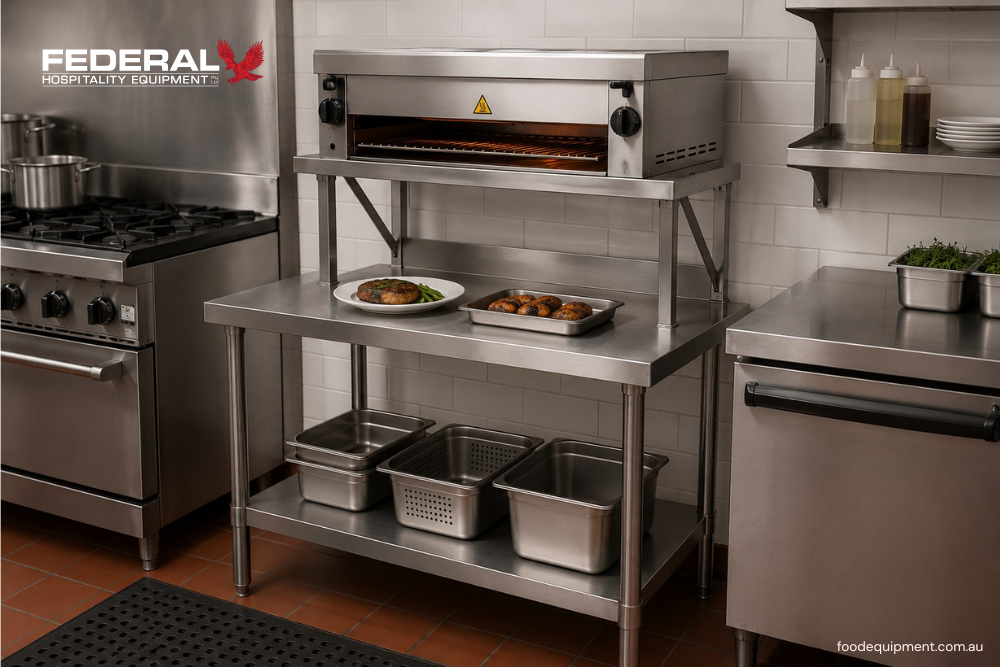
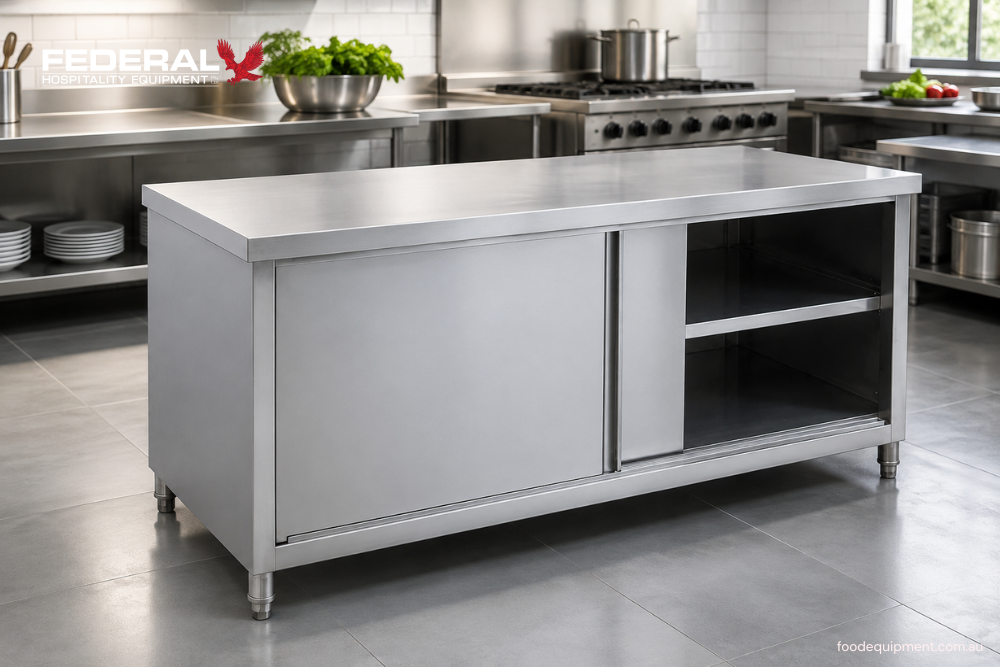
A steel workbench cabinet combines a stainless steel food-preparation surface with enclosed storage underneath. Unlike a standard worktable that provides only a preparation area, these integrated prep-and-store units combine workspace and storage within a single unit, similar to a sink cabinet.
Commercial kitchens use these workstations to store utensils, cookware, ingredients, cleaning supplies, and operational equipment while maintaining a clean and organised environment.
Typical components of a workbench cabinet for sale include:
| Feature | Purpose |
|---|---|
| Stainless steel worktop | Meal preparation and processing |
| Enclosed cabinet storage | Secure storage of kitchen items |
| Sliding or hinged doors | Easy access to stored equipment |
| Adjustable shelves | Flexible storage configurations |
| Splashback, typically 150mm high | Protects walls from water and food splashes |
| Heavy-duty frame | Supports demanding commercial use |
A splashback is the raised rear section of the workbench that prevents liquids and food debris from contacting walls, improving hygiene and reducing cleaning requirements.
Many Australian operators choose 304-grade stainless steel because it provides high-quality rust resistance and is widely used for food-contact applications.
Why Are Stainless Steel Workstations Important for Food Safety?
Food safety is a core requirement for Australian hospitality businesses. Operators must comply with regulations enforced through state food authorities and guidance developed by Food Standards Australia New Zealand (FSANZ).
Stainless steel is the industry standard for food-preparation environments because of its non-porous surface. Unlike timber or some composite materials, it does not absorb moisture, harbour bacteria, or develop hidden points of contamination. For further information, visit the top workbench cabinet suppliers and manufacturers in your area.
Composite materials are manufactured products made from multiple materials bonded together. While suitable for some applications, they generally do not provide the same hygiene performance as commercial-grade stainless steel.
Commercial kitchen cabinetry supports food safety by:
- Providing smooth, sanitisation-friendly surfaces
- Resisting moisture absorption
- Protecting stored equipment from contaminants
- Supporting documented cleaning procedures
- Reducing areas where bacteria can accumulate
These characteristics help operators maintain the hygiene standards expected during food safety inspections.
How Do Workbench Cabinets Improve Kitchen Organisation?
Disorganised kitchens reduce productivity and increase staff movement during service. When utensils, ingredients, and preparation tools are stored away from workstations, employees spend more time retrieving equipment and less time preparing food.
Integrated storage directly beneath the work surface keeps frequently used items within immediate reach. This arrangement creates a more organised workstation and supports faster task completion.
Organisational Benefits
| Kitchen Challenge | Workbench Cabinet Solution |
|---|---|
| Cluttered preparation areas | Provides dedicated storage below |
| Misplaced utensils and tools | Improves equipment organisation |
| Workflow interruptions | Keeps essential items nearby |
| Limited storage capacity | Maximises usable storage space |
| Excessive cleaning requirements | Reduces exposed surfaces |
In busy service environments, improved organisation after you buy workbench cabinets online contributes directly to faster preparation times and smoother operations.
Can Workbench Cabinets Help in Small Commercial Kitchens?
Commercial kitchen space is expensive throughout Australia, particularly in metropolitan areas where rental costs continue to rise.
Stainless steel workstations, such as mobile cabinets, maximise available floor space by combining preparation and storage functions within a single unit. Rather than installing separate preparation benches and storage cupboards, operators can consolidate both into a single workstation.
This design is particularly beneficial for:
- Cafés
- Quick-service restaurants
- Food trucks
- Catering kitchens
- Small hospitality venues
The result is a more efficient use of available floor space without compromising functionality.
Buyer’s Checklist: Sliding or Hinged Doors?
| Consideration | Sliding Doors | Hinged Doors |
|---|---|---|
| Narrow aisles | Excellent choice | May restrict movement |
| Maximum cabinet access | Moderate | Excellent |
| Space efficiency | High | Moderate |
| Cleaning accessibility | Good | Excellent |
| Small kitchens | Recommended | Situational |
Why Is Durability Important in Commercial Kitchens?
Commercial food-preparation appliances must survive moisture, cleaning agents, heat exposure, heavy cooking utensils, and continuous regular use. High-quality stainless steel workbench cabinets in Australia are specifically designed for these conditions.
Durability Comparison
| Environmental Factor | Stainless Steel Performance |
|---|---|
| Corrosion | Excellent resistance |
| Moisture exposure | Non-absorbent |
| Cleaning chemicals | Highly durable |
| Impact resistance | Strong structural integrity |
| Heat exposure | Suitable for commercial kitchens |
| Daily wear | Long operational lifespan |
Many models also include adjustable shelves capable of supporting substantial equipment loads, often ranging from 40kg to 80kg per shelf, depending on design specifications.
Maintenance and Care Guide
Ideal maintenance increases the service life of stainless steel appliances sourced from the leading workbench cabinet dealers and distributors.
Recommended practices include:
| Maintenance Task | Frequency |
|---|---|
| Wipe surfaces with warm, soapy water | Daily |
| Sanitise food-contact surfaces | After use |
| Remove grease build-up | Daily |
| Inspect hinges and door tracks | Monthly |
| Check shelf stability | Monthly |
Operators should avoid steel wool and abrasive cleaning products, as these can ruin the protective surface cover of stainless steel and enhance the risk of rust.
How Do Workbench Cabinets Support Hazard Analysis and Critical Control Point (HACCP) Systems?
HACCP is a practical approach to food safety management used to identify, monitor, and control food safety risks. Many Australian food businesses use HACCP principles alongside regulatory requirements to maintain safe food-handling practices.
Stainless steel workstations support HACCP implementation by:
- Facilitating effective cleaning and sanitation
- Reducing contamination risks
- Supporting documented hygiene procedures
- Protecting stored equipment from environmental exposure
These features help businesses maintain cleaner preparation environments and demonstrate food safety controls during inspections after they shop for workbench cabinets.
Additionally, many commercial kitchen fit-outs are designed in accordance with AS 4674, the Australian Standard that guides the design, construction, and fit-out of food premises.
How Do Stainless Steel Workstations Reduce Long-Term Operating Costs?
While the starting buying price may be higher than that of lower-grade options, stainless steel cabinets generally deliver greater long-term operational value.
Cost Comparison
| Factor | Stainless Steel Workstation | Lower-Grade Alternative |
|---|---|---|
| Lifespan | Long | Shorter |
| Maintenance costs | Low | Higher |
| Corrosion resistance | Excellent | Variable |
| Hygiene performance | High | Moderate |
| Replacement frequency | Infrequent | More frequent |
| Long-term value | Strong | Lower |
Conclusion
Steel workbench cabinets have become a standard component of Australian food service operations because they address several operational requirements within a single piece of equipment. They provide hygienic preparation surfaces, integrated storage, efficient use of floor space, and durable construction suitable for demanding commercial environments.
For hospitality businesses seeking stronger hygiene compliance, improved organisation, and long-term operational longevity, stainless steel workstations continue to deliver measurable value across a wide range of food service settings.
FAQs: Steel Workbench Cabinets in Australia
1. What is a steel workbench cabinet used for?
A steel workbench cabinet is used as both a food preparation surface and enclosed storage unit in commercial kitchens, cafés, restaurants, hotels, and catering operations.
2. Why is stainless steel preferred for workbench cabinets?
Stainless steel is non-porous, durable, easy to sanitise, moisture-resistant, and suitable for food-preparation environments that require frequent cleaning.
3. Are sliding doors or hinged doors better for small kitchens?
Sliding doors are often better for narrow aisles and compact kitchens because they save space, while hinged doors provide wider access where room is available.
4. How do workbench cabinets support food safety?
They provide smooth sanitisation-friendly surfaces, protect stored equipment from contaminants, reduce clutter, and support documented cleaning procedures.
5. How should stainless steel workbench cabinets be cleaned?
Use warm soapy water, mild sanitisers, and non-abrasive cloths. Avoid steel wool and harsh abrasive cleaners that can damage the stainless steel surface.
6. Are stainless steel workbench cabinets worth the investment?
Yes. Their durability, hygiene performance, corrosion resistance, and long lifespan often reduce replacement and maintenance costs over time.