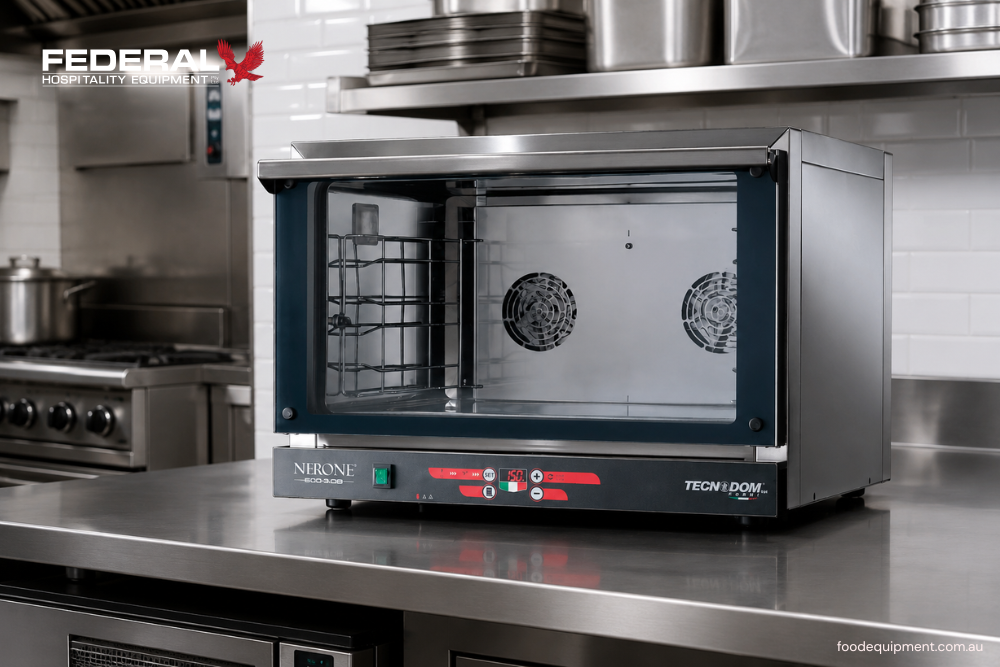
A commercial convection oven is one of the most important cooking assets in a professional kitchen. From cafés in Sydney and bakeries in Melbourne to restaurants in Brisbane and catering operations across Australia, the right oven directly affects cooking consistency, production capacity, labour efficiency, energy use, and daily workflow.
Unlike domestic ovens, commercial convection ovens are designed for continuous use, repeated door opening, large-batch production, and consistent cooking results across multiple trays. For hospitality businesses, choosing the wrong oven can create service bottlenecks, increase running costs, and reduce food quality during peak periods.
This guide explains the seven most important factors Australian foodservice businesses should consider before purchasing a commercial convection oven, including capacity, power source, airflow performance, construction quality, useful features, energy efficiency, and supplier support.
Key Takeaways
| Buying Factor | Why It Matters |
|---|---|
| Oven Capacity | Determines how many trays, racks, or batches can be cooked during peak service. |
| Gas or Electric Power | Impacts installation, running costs, temperature control, and site compatibility. |
| Heat Distribution | Controls cooking consistency, batch quality, and temperature recovery. |
| Build Quality | Affects durability, hygiene, maintenance, and equipment lifespan. |
| Operational Features | Improves staff productivity, recipe consistency, and workflow efficiency. |
| Energy Efficiency | Reduces long-term operating costs and supports profitability. |
| Supplier Support | Minimises downtime through servicing, spare parts, and technical guidance. |
Why the Right Commercial Convection Oven Matters
Choosing the correct oven configuration affects more than cooking speed. It influences how reliably your kitchen can produce consistent food during breakfast rushes, lunch service, dinner peaks, bakery production runs, and catering events.
A well-matched convection oven helps businesses:
- Improve cooking consistency across multiple trays.
- Reduce delays during peak production periods.
- Support wider menu flexibility.
- Lower food waste caused by uneven cooking.
- Improve staff confidence and repeatable results.
- Reduce energy waste through better heat retention and recovery.
For Australian hospitality businesses, a commercial convection or combi steam oven should be selected based on practical operating needs such as menu type, service volume, available utilities, kitchen layout, and future expansion plans.
1. How Do You Choose the Right Oven Capacity?
Select the size of convection oven for sale that aligns with your current production requirements while allowing room for future growth. Capacity determines how efficiently your kitchen can manage daily output.
An undersized oven can create bottlenecks during busy service periods. An oversized unit may consume unnecessary floor space, increase capital costs, and use more energy than required.
Understanding Tray Capacity and GN Compatibility
Commercial ovens are commonly measured by tray capacity, rack levels, and GN compatibility. GN stands for Gastronorm, the international sizing system used in professional kitchens to ensure trays, pans, containers, and equipment work together efficiently.
| Business Type | Recommended Capacity Consideration |
|---|---|
| Café under 30 seats | Compact 4-tray oven for pastries, sandwiches, breakfast items, and light cooking. |
| Bakery operation | Larger GN-compatible oven for bread, cakes, pastries, and baked products. |
| Restaurant around 100 seats | Higher-volume unit for roasting, reheating, batch preparation, and service backup. |
| Catering business | Multi-rack oven designed for large production volumes and repeatable batch cooking. |
2. Should You Choose a Gas or Electric Convection Oven?
Choose the power source that matches your site infrastructure, operating requirements, and installation capacity. Gas and electric convection ovens both have advantages, but the correct choice depends on your kitchen environment.
Electric convection ovens in Australia are widely used in cafés, bakeries, and restaurants for their precise temperature control and straightforward operation. Gas variants can provide high thermal output and may suit establishments with existing gas connections and heavier cooking needs.
Gas vs Electric Convection Oven Comparison
| Feature | Electric Convection Oven | Gas Convection Oven |
|---|---|---|
| Temperature Control | Excellent precision and consistency. | Strong performance, but may require more adjustment. |
| Heat Output | Reliable for most café, bakery, and restaurant applications. | High thermal output for demanding kitchens. |
| Installation | Requires suitable electrical capacity and phase compatibility. | Requires correct gas connection and ventilation. |
| Maintenance | Generally simpler. | May require specialised gas servicing. |
| Best For | Bakeries, cafés, restaurants, and precise cooking applications. | High-output kitchens with existing gas infrastructure. |
Installation Requirements to Check
- Electrical load measured in kW.
- Single-phase or three-phase power requirements.
- Gas consumption measured in MJ/h.
- Existing connection compatibility.
- Ventilation and clearance requirements.
- Delivery access through doors, hallways, and kitchen entries.
Electrical installations in Australia must comply with requirements such as AS/NZS 3000, commonly known as the Australian/New Zealand Wiring Rules. Planning these details before purchase helps prevent installation delays and unexpected costs.
3. Why Heat Distribution and Temperature Control Matter
Heat distribution is one of the most important performance factors in a commercial convection oven. The main advantage of convection technology is controlled hot-air circulation, which helps food cook more evenly across multiple trays.
A high-quality fan system distributes heat throughout the cooking chamber, reducing hot spots, improving batch consistency, and helping staff achieve repeatable results. For further information, visit the top convection oven suppliers and manufacturers in your area.
Performance Features to Compare
| Performance Feature | Business Benefit |
|---|---|
| Even airflow circulation | Supports consistent cooking results across trays. |
| Fast temperature recovery | Reduces delays after the oven door is opened. |
| Accurate thermostat control | Improves cooking reliability and reduces guesswork. |
| Stable heating elements | Supports batch consistency during long production periods. |
| Balanced fan performance | Helps prevent uneven browning or undercooked sections. |
What Happens When Heat Distribution Is Poor?
| Problem | Operational Impact |
|---|---|
| Uneven browning | Products may require rotation, increasing labour time. |
| Slow recovery | Cooking schedules become less predictable during service. |
| Hot spots | Some items may burn while others remain undercooked. |
| Inconsistent batch results | Customer experience and product quality may suffer. |
Cooking performance is especially important for bakeries and restaurants where customers expect the same quality across every order.
4. What Build Quality Should You Look For?
Choose a heavy-duty appliance built with commercial-grade materials designed for continuous operation. Stainless steel construction is the industry benchmark for commercial kitchens because it supports durability, rust resistance, hygiene, and easier cleaning.
A commercial cooking chamber should withstand high temperatures, frequent door operation, and daily sanitation routines.
| Construction Feature | Benefit |
|---|---|
| Stainless steel body | Supports long-term durability and hygiene. |
| Reinforced door hinges | Handles frequent opening and closing during busy service. |
| Quality heating components | Improves operational reliability and cooking performance. |
| Accessible internal parts | Simplifies servicing and reduces downtime. |
| Strong door seals | Helps retain heat and improve energy efficiency. |
A well-built unit, such as the titular model or conveyor ovens, reduces downtime and supports a longer service life.
5. Which Features Improve Kitchen Efficiency?
Focus on features that improve staff productivity, cooking accuracy, and cleaning efficiency. When you buy modern convection ovens online, many models include operational features that simplify daily kitchen tasks. These should be selected based on your workflow rather than unnecessary complexity.
Useful Operational Features
- Digital temperature controls.
- Programmable cooking cycles.
- Timers.
- Multiple rack positions.
- Automatic settings.
- Easy-clean interiors.
- Removable racks or tray supports.
Feature vs Business Benefit
| Feature | Business Benefit |
|---|---|
| Digital controls | Improves accuracy and reduces manual guesswork. |
| Programmable cycles | Helps staff repeat recipes consistently. |
| Timers | Reduces overcooking and improves workflow management. |
| Multiple rack positions | Improves flexibility for different menu items. |
| Easy-clean surfaces | Reduces labour time and supports hygiene routines. |
These features are particularly useful when producing the same menu items every day, such as pastries, roasted vegetables, baked goods, reheated meals, or batch-prepared products.
6. How Does Energy Efficiency Affect Running Costs?
Energy efficiency is a major driver of profitability in the Australian catering and hospitality market. Energy consumption directly affects operating expenses, especially for businesses that run ovens for extended periods.
When comparing models sourced from the best convection oven dealers and distributors, look beyond the purchase price and evaluate long-term operating costs.
Energy-Saving Features to Compare
| Feature | Benefit |
|---|---|
| Double-pane glass doors | Reduces heat loss during operation. |
| High-density mineral wool insulation | Improves heat retention and chamber stability. |
| Efficient heating systems | Reduces energy consumption. |
| Faster cooking cycles | Improves productivity and reduces operating time. |
| Strong door seals | Prevents unnecessary heat escape. |
Why Purchase Price Is Not the Full Cost
| Cost Area | Long-Term Impact |
|---|---|
| Energy use | Ongoing utility expense over the oven lifespan. |
| Maintenance | Impacts reliability and downtime. |
| Cooking speed | Affects labour efficiency and production capacity. |
| Durability | Influences replacement cycles and repair costs. |
An energy-efficient oven provides better value by lowering ongoing costs while maintaining cooking performance.
7. How Do You Choose a Reliable Supplier?
Select a supplier that provides technical support, spare parts availability, and ongoing service assistance. A commercial convection oven is a long-term operational asset, and supplier support plays an important role in maintaining kitchen productivity.
Supplier Support Checklist
| Support Area | Why It Matters |
|---|---|
| Warranty coverage | Reduces risk after purchase. |
| Installation assistance | Helps prevent setup errors and delays. |
| Replacement part availability | Minimises downtime when repairs are needed. |
| Service response capability | Supports faster recovery from equipment issues. |
| Technical guidance | Helps buyers choose the right unit for their kitchen. |
Reliable supplier support protects your catering hardware investment and helps minimise operational interruptions.
Common Mistakes When Buying a Commercial Convection Oven
| Common Mistake | Potential Problem | Better Approach |
|---|---|---|
| Buying only for current demand | The oven may be outgrown as the business expands. | Allow capacity for peak periods and future growth. |
| Ignoring utility requirements | Installation delays and unexpected expenses. | Check electrical phase, kW, gas MJ/h, and ventilation needs. |
| Choosing solely by price | Lower reliability and higher long-term costs. | Compare build quality, efficiency, and support. |
| Overlooking heat recovery | Slower production during busy service. | Assess airflow, thermostat control, and recovery speed. |
| Ignoring supplier support | Longer downtime when repairs are needed. | Choose a supplier with spare parts and service support. |
Commercial Convection Oven Buyer Checklist
- Confirm your peak production demand.
- Check tray capacity and GN compatibility.
- Decide whether gas or electric suits your site.
- Review electrical, gas, and ventilation requirements.
- Measure doorway access and installation space.
- Compare airflow performance and temperature recovery.
- Assess stainless steel construction and door quality.
- Review useful features such as timers and programmable settings.
- Compare energy-saving design features.
- Confirm warranty, servicing, and spare part availability.
Conclusion
Selecting a commercial convection oven requires careful evaluation of technical specifications, kitchen requirements, production demand, and long-term operating needs.
Australian cafés, bakeries, restaurants, and catering businesses should assess capacity, power source, airflow performance, construction quality, operational features, energy efficiency, and supplier support before making a purchase.
Selecting a professional variant, such as a microwave oven, based on these technical criteria helps ensure consistent cooking results, efficient workflow management, and reliable performance throughout the equipment lifecycle.
Frequently Asked Questions
What size commercial convection oven do I need?
The right size depends on your menu, tray requirements, production volume, and busiest service periods. Small cafés may suit compact 4-tray ovens, while bakeries, restaurants, and catering businesses often require larger GN-compatible or multi-rack models.
Is a gas or electric convection oven better?
Electric models are often preferred for precise temperature control and easier operation, while gas models can offer strong heat output for demanding kitchens with suitable gas infrastructure.
What does GN compatibility mean?
GN stands for Gastronorm, an international sizing system used for trays, pans, and containers in professional kitchens. GN-compatible ovens help kitchens standardise equipment and improve workflow.
Why is airflow important in a convection oven?
Airflow circulates hot air throughout the cooking chamber. Good airflow helps reduce hot spots, improve batch consistency, and maintain even cooking across multiple trays.
Are commercial convection ovens energy efficient?
Many modern commercial convection ovens include energy-saving features such as double-pane glass doors, quality insulation, efficient heating systems, and faster cooking cycles.
What features are worth paying extra for?
Useful features include digital controls, programmable cooking cycles, timers, multiple rack positions, removable components, and easy-clean interiors. These features support consistency and staff productivity.
Why is supplier support important?
Supplier support matters because commercial ovens are long-term business assets. Warranty coverage, spare parts, servicing, and technical guidance help reduce downtime and protect your investment.