
Running a commercial kitchen in Australia—whether it’s a bustling Sydney café, a Melbourne pizzeria, or a Brisbane catering company—means balancing speed, quality, and profitability. Labour costs are among the most significant expenses in foodservice, and operators constantly seek ways to optimise staff efficiency without compromising standards. Enter the commercial mixer, a piece of equipment that has quietly become a cornerstone of modern kitchen economics.
This blog explores in detail how commercial mixers reduce labour costs in busy Australian kitchens, weaving together industry insights, case studies, and practical strategies.
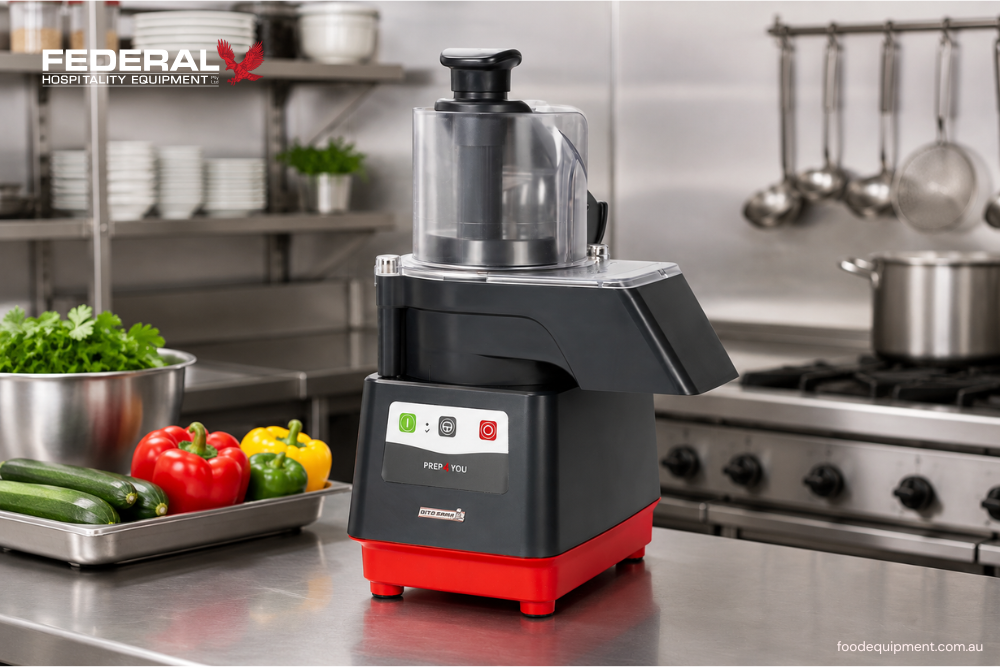
Powerful kitchen machines designed to handle bulk chopping, slicing, mixing, and pureeing with speed and precision. Please check out our Commercial Food Processors.
- The Labour Challenge in Australian Kitchens
- High wages: Australia has one of the highest minimum wages globally, making labour costs a significant portion of operating expenses.
- Staff shortages: Post-pandemic, many kitchens struggle to find skilled staff, leading to increased reliance on equipment.
- Demand for consistency: Customers expect uniform quality, which requires precision and repeatability.
In this environment, every minute saved in prep translates directly into reduced labour costs and higher margins.
- How Mixers Cut Prep Time?
Commercial mixers slash prep time by automating repetitive tasks:
- Dough kneading: What takes 20 minutes by hand can be done in under 5 minutes with a spiral mixer.
- Whipping and beating: Egg whites, cream, and batters reach perfect consistency faster.
- Bulk production: Large-capacity bowls enable kitchens to prepare dozens of portions in a single batch.
- Batch Efficiency: Commercial mixers for sale enable chefs to prepare large quantities in a single batch, eliminating the need for multiple small batches. For example, a bakery in Sydney can prepare 50kg of dough in a single spiral mixer cycle, rather than kneading multiple 5kg batches by hand.
- Multi-Tasking Power: While the mixer runs, staff can focus on other tasks—chopping vegetables, prepping sauces, or plating dishes. This parallel workflow reduces bottlenecks during peak service hours.
- Versatility Across Menu Items: Mixers aren’t just for dough—they handle mashed potatoes, sauces, whipped cream, and even shredded meats with attachments. This versatility means fewer manual prep stations and faster turnaround across diverse menu items.
- Consistent Speed: Unlike manual mixing, which slows down as fatigue sets in, mixers maintain the same speed and efficiency from the first batch to the last. This consistency ensures kitchens can meet demand spikes without slowing down.
- Attachment Shortcuts: Extensions such as cutters, graters, and grinders reduce prep time for vegetables, meat and cheese. A catering company in Brisbane reduced salad prep time by 40% using mixer attachments instead of manual chopping.
- Programmable Settings: Modern mixers come with preset programs for dough, batters, or creams. Staff select the program, reducing training time and eliminating guesswork.
- Reduced Supervision: These products don’t require constant monitoring—staff can set timers and walk away. This autonomy frees up chefs to focus on creative or customer-facing tasks. You can get further information by contacting the leading commercial mixer dealers and distributors in your area.
- Easy Cleaning = Faster Turnaround: Stainless steel bowls and detachable parts make cleaning quick, reducing downtime between batches. Faster cleaning cycles allow more prep to be completed in less time.
- Streamlined Workflow: By centralising mixing tasks on a single machine, kitchens reduce clutter and movement. Staff spend less time walking between stations, which speeds up overall prep.
- Reducing Labour Intensity and Fatigue
Manual mixing is physically demanding. By offloading this work to machines:
- Staff avoid repetitive strain injuries.
- Kitchens reduce sick leave and turnover.
- Employees can focus on higher-value tasks like plating, customer service, or menu innovation.
This shift not only saves money but also improves staff morale.
- Consistency = Less Waste = Lower Costs
Mixers ensure uniformity in dough, batters, and sauces. Consistency reduces:
- Rejected batches due to uneven mixing.
- Customer complaints that lead to refunds or reputational damage.
- Ingredient waste directly impacts food costs.
Consistency is a hidden labour saver when it comes to commercial mixers in Australia—less time spent remaking dishes means more efficient use of staff hours.
Essential prep tools that save time by quickly chopping, slicing, and dicing produce with precision. Please take a look at Vegetable Cutters and Slicers.
- Case Study: Australian Kitchens in Action
- Sydney café: By introducing a 20L planetary mixer, the café reduced the number of cake prep staff from 3 to 2 during the morning rush.
- Brisbane hospitality company: A spiral mixer enabled them to prepare bulk dough for programs, lowering labour hours by 30%.
- Melbourne pizzeria: Prep time halved, enabling faster service and reducing overtime costs.
- Financial Impact: ROI of Mixers
Let’s break down the numbers:
- Average wage of a kitchen hand in Australia: AUD $25/hour.
- Mixer saves 2 hours of manual labour per day, equivalent to AUD $50/day.
- Over a year (300 working days), that’s AUD $15,000 saved.
- A quality commercial mixer costs between AUD $3,000 and $10,000, so ROI is achieved within months.
- Beyond Mixing: Attachments & Versatility
Modern products – sourced from the leading commercial mixer suppliers and manufacturers – come with attachments that further reduce labour:
- Vegetable slicers for bulk prep.
- Meat grinders for in-house mince.
- Pasta rollers for fresh pasta production.
Each attachment eliminates the need for extra staff or manual tools, compounding labour savings.
- Training & Safety Benefits
- Mixers simplify training—new staff can quickly learn standardised processes.
- Safety guards reduce accidents, lowering downtime and compensation claims.
- Clear SOPs around mixer use streamline operations.
Other Benefits
Simplified Training for New Staff
- Intuitive controls: Most mixers feature straightforward dials, timers, and preset programs, making them easy to learn.
- Reduced skill dependency: Staff don’t need years of baking experience to achieve consistent results—mixers standardise the process.
- Faster onboarding: New hires can be productive within hours, not weeks, lowering training costs.
Enhanced Safety Features
- Guarded bowls and interlocks: Prevent accidents by stopping the operation when the guard of your spiral or planetary mixer is lifted.
- Emergency stop buttons: Enable staff to quickly halt the machine if needed.
- Stable design: Heavy-duty bases prevent tipping or slipping, even during high-volume mixing.
Lower Risk of Injuries
- Reduced manual strain: Kneading dough or whipping cream by hand can cause repetitive strain injuries. Mixers eliminate this risk.
- Less fatigue: Staff conserve energy, reducing mistakes and accidents caused by exhaustion.
- Safer handling of attachments: Modern designs ensure attachments lock securely, minimising hazards.
- Mixers in Cloud Kitchens & Catering
Cloud kitchens and catering businesses thrive on efficiency. When you buy commercial mixers online, it allows them to:
- Scale production without scaling staff.
- Maintain consistency across multiple outlets.
- Handle unpredictable demand spikes with ease.
Risks & Considerations
- Upfront cost: High-quality mixers require investment.
- Maintenance: Regular servicing is essential to avoid downtime.
- Overreliance: Kitchens must balance automation with skilled staff to maintain creativity.
Versatile handheld tools designed for blending, pureeing, and emulsifying large batches with ease. Please browse our Commercial Stick Blenders.
Conclusion
Commercial mixers are more than machines—they are labour cost reducers, consistency enforcers, and productivity multipliers. In busy Australian kitchens, where wages are high and demand is relentless, mixers deliver measurable ROI by cutting prep time, reducing fatigue, and enabling staff to focus on customer-facing tasks.
For operators, the message is clear: investing in the right commercial mixer is not just about mixing—it’s about transforming your labour economics.