
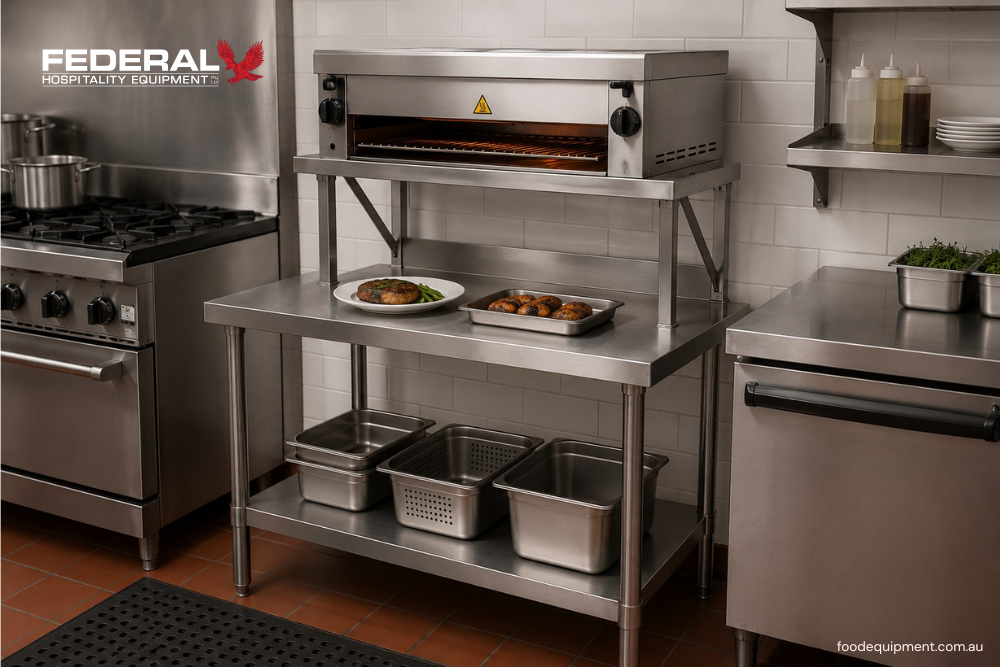
In Australia’s high-volume hospitality environments, kitchen efficiency depends on more than just cooking appliances. Preparation stations, storage systems, and workflow layout directly influence service speed, hygiene compliance, and labour efficiency. Support infrastructure plays a critical role in maintaining consistent kitchen operations. A salamander bench, also known as a stainless steel grill stand or broiler workstation, provides a stable, heat-resistant platform for salamander grills in commercial cooking environments.
Choosing the right overhead heat equipment support improves preparation efficiency, reduces service delays, supports food safety compliance, and maximises usable kitchen space. Effective kitchen planning requires careful evaluation of material grade, load capacity, ventilation clearance, storage configuration, and workflow positioning.
Key Takeaways
- Select food-grade 304-grade stainless steel for durability, hygiene compliance, and corrosion resistance.
- Match bench size to your kitchen layout to maintain at least 900mm of staff walkway clearance.
- Check whether the workstation supports a total functional weight above 150kg in high-capacity pantries.
- Position the unit between cooking and plating zones to reduce unnecessary staff movement.
- Choose welded construction for industrial-grade strength and long-term durability.
Salamander Bench Fundamentals
A salamander bench is a commercial kitchen workstation specifically designed to support a salamander grill, which is an overhead high-heat broiler used for browning, melting, caramelising, or reheating food rapidly.
Unlike standard kitchen benches, equipment like stainless steel support stations and dishwasher benches are engineered for:
- Continuous high-temperature exposure
- Heavy equipment weight
- Frequent cleaning and sanitisation
- Grease and moisture resistance
- High-volume commercial service
These units are widely used in restaurants, cafés, hotels, pubs, catering facilities, bakeries, mining camps, and institutional kitchens throughout Australia.
Why Does Choosing the Right Bench Matter?
The wrong salamander bench for sale creates serious operational problems in commercial kitchens.
A poor-quality unit will:
- Cause structural failure under heavy loads
- Increase corrosion and maintenance costs
- Restrict staff movement
- Reduce preparation efficiency
- Create workflow delays during peak service
- Increase grease accumulation near cooking equipment
- Reduce long-term operational reliability
The right stainless steel prep station improves hygiene standards, accelerates service preparation, and supports safer kitchen operations.
How Do You Measure Your Kitchen for a Salamander Bench?
Incorrect measurements create installation problems, workflow restrictions, and ventilation risks. Before purchasing a stainless steel grill stand, measure your available space carefully.
Step-by-Step Kitchen Measurement Guide
Step 1: Measure available wall space
Measure the full installation width, including surrounding appliances such as:
- Fryers
- Combi ovens (multi-function steam and convection ovens)
- Chargrills
- Refrigerated preparation counters
- Service window preparation areas
Step 2: Measure walkway clearance
Maintain at least:
- 900mm for staff walkways
- 150mm cleaning clearance
- 50mm to 100mm rear ventilation spacing
Insufficient clearance reduces staff efficiency and increases heat buildup.
Step 3: Check standard bench dimensions
Most Australian commercial kitchen workstations use:
- 600mm to 700mm depth
- 900mm working height
These dimensions align with standard hospitality kitchen layouts.
Step 4: Confirm load capacity
A salamander bench in Perth and Melbourne, combined with cookware, trays, and active plating activity, routinely exceeds 150kg in high-volume environments.
Weak flat-pack units will fail under continuous heavy use.
Recommended Salamander Bench Sizes by Business Type
| Business Type | Recommended Size | Ideal Configuration |
|---|---|---|
| Small Café | 900mm to 1200mm | Undershelf storage |
| Restaurant | 1200mm to 1800mm | Splashback and cupboards |
| Fast Food Outlet | 1200mm to 1500mm | Easy-clean surfaces |
| Hotel Kitchen | 1800mm+ | Industrial-grade welded frame |
| Catering Business | Mobile units | Lockable industrial wheels |
What Stainless Steel Grade Should You Choose?
Material quality directly affects hygiene compliance, corrosion resistance, and equipment lifespan.
What does food-grade stainless steel mean?
Food-grade stainless steel indicates non-porous steel surfaces created for safe meal preparation and hygiene. These surfaces of your work tables or mobile benches control bacterial accumulation and endure repeated exposure to detergents, grease, moisture, and heat.
Australian hospitality venues commonly follow hygiene requirements outlined under:
- Food Standards Australia New Zealand (FSANZ) Standard 3.2.3
- State-based food premises regulations
- Local council requirements from authorities such as Brisbane City Council or the City of Sydney
304 vs 316 Stainless Steel Grades
The numbers "304" and "316" refer to SAE (Society of Automotive Engineers) stainless steel classification grades.
| Steel Grade | Features | Best Use |
|---|---|---|
| 430 Grade | Lower-cost corrosion resistance | Light-duty kitchens |
| 304 Grade | Premium food-grade durability | Restaurants and cafés |
| 316 Grade | Superior salt and moisture resistance | Coastal venues |
What Separates 304 and 316 Stainless Steel?
304-grade stainless steel for the titular product, sourced from the best salamander bench suppliers and manufacturers, is the preferred choice for most Australian commercial kitchens because it combines hygiene performance, corrosion resistance, and durability.
316-grade stainless steel has additional molybdenum, which boosts resistance to salt corrosion in coastal climates.
Welded vs Flat-Pack Construction
Construction quality directly affects structural strength and operational lifespan.
What is industrial-grade construction?
Industrial-grade construction typically uses 1.2mm to 1.5mm stainless steel thickness combined with reinforced welded joints.
Pros and Cons of Welded vs Flat-Pack Units
| Construction Type | Advantages | Limitations |
|---|---|---|
| Welded Construction | Higher strength, improved stability, longer lifespan | Higher upfront cost |
| Flat-Pack Construction | Lower purchase price, easier transport | Reduced durability under heavy loads |
Welded stainless steel grill stands provide superior structural integrity in high-volume kitchens where constant movement, heat exposure, and heavy equipment place ongoing stress on the frame.
Which Features Improve Efficiency and Storage?
The best commercial grill stands combine workflow efficiency with practical storage functionality.
High-value features include:
- Adjustable undershelves
- Enclosed storage cupboards
- Reinforced shelving
- Heat-resistant drawers
- Stainless steel splashbacks
- Adjustable feet
- Rounded easy-clean corners
- Lockable industrial wheels
- Modular storage systems
Splashbacks reduce wall damage caused by grease and heat exposure, while adjustable shelving improves storage flexibility as menu requirements change. When you buy Salamander benches online, you get both.
Fixed vs Mobile Salamander Benches
Businesses should select a workstation style that matches their operational layout.
| Feature | Fixed Unit | Mobile Unit |
|---|---|---|
| Stability | Excellent | Moderate |
| Flexibility | Limited | Excellent |
| Cleaning Access | Moderate | Excellent |
| Best for Permanent Kitchens | Yes | Yes |
| Best for Catering Operations | No | Yes |
| Mobility | No | Yes |
Mobile broiler workstations are commonly used in catering environments and event kitchens where layout flexibility is essential. Fixed units remain the preferred choice in permanent hotel and restaurant installations where maximum stability is required.
How Do You Maintain Your Bench for Long-Term Performance?
Routine maintenance protects stainless steel surfaces of splashback benches and extends equipment lifespan.
Daily Maintenance Checklist
| Maintenance Task | Purpose |
|---|---|
| Wipe surfaces after service. | Prevent grease buildup |
| Sanitise food-contact areas | Maintain hygiene compliance |
| Inspect welded joints | Detect structural wear |
| Clean undershelves and cupboards | Remove debris accumulation |
| Dry surfaces after cleaning | Reduce corrosion risk |
| Check wheel locks on mobile units. | Maintain operational safety |
Consistent cleaning prevents premature surface deterioration and supports long-term compliance with food safety requirements. You can gain further insights by contacting the leading salamander bench dealers and distributors in Australia.
Common Mistakes When Buying a Salamander Bench
| Mistake | Operational Impact |
|---|---|
| Choosing low-cost flat-pack units | Reduced structural lifespan |
| Ignoring ventilation spacing | Excessive heat accumulation |
| Underestimating total equipment weight | Structural failure |
| Selecting low-grade steel | Corrosion and rust damage |
| Poor storage planning | Increased kitchen clutter |
| Incorrect sizing | Workflow restrictions |
Prioritise durability, hygiene compliance, and operational compatibility over short-term purchase savings.
Conclusion
Choosing the right salamander bench requires more than selecting a stainless steel workstation that fits available space. Your kitchen requires a durable support system that can withstand continuous exposure to heat, heavy operational loads, and demanding service conditions. A properly selected broiler workstation improves workflow efficiency, supports Australian food safety compliance, reduces service delays, and delivers long-term operational reliability.
By carefully evaluating steel grade, construction quality, ventilation spacing, storage configuration, and kitchen layout, you can invest in a commercial kitchen support station that delivers consistent performance for years in demanding Australian hospitality environments.
FAQs: Choosing the Right Salamander Bench
1. What is a salamander bench used for?
A salamander bench is used to support a salamander grill or overhead broiler in commercial kitchens. It provides a stable, heat-resistant workstation for browning, melting, reheating, and finishing dishes.
2. What size salamander bench should I choose?
The right size depends on your kitchen layout and business type. Small cafés may suit 900mm to 1200mm benches, while restaurants and hotel kitchens often require larger welded units.
3. Which stainless steel grade is best for salamander benches?
304-grade stainless steel is suitable for most Australian commercial kitchens because it offers durability, corrosion resistance, and strong hygiene performance. Coastal venues may consider 316-grade stainless steel.
4. Is a welded salamander bench better than flat-pack?
Welded construction is generally stronger and longer-lasting, making it better for high-volume commercial kitchens. Flat-pack units may suit lower-use environments or businesses with transport limitations.
5. Why is ventilation spacing important?
Ventilation spacing helps reduce heat buildup around the salamander grill and bench. Poor spacing can affect staff comfort, equipment performance, and long-term safety.
6. Should I choose a fixed or mobile salamander bench?
Choose a fixed bench for permanent kitchens where stability is most important. Choose a mobile bench for catering operations, event kitchens, or layouts that change regularly.