Choosing the right commercial fridge size for a café is not simply a matter of buying the largest refrigerator that fits your budget. The right refrigeration setup needs to hold enough ingredients and beverages for your busiest trading periods while fitting comfortably into the kitchen and supporting the way your staff prepare and serve food.
A small coffee shop selling pastries and a limited selection of sandwiches has very different refrigeration requirements from a busy brunch café storing milk, eggs, bacon, fresh produce, sauces, prepared ingredients, desserts and bottled drinks. Even two cafés with similar seating capacities can require different refrigeration if their menus, supplier schedules and preparation methods are different.
That is why commercial fridge sizing should begin with your menu, maximum stock level, delivery frequency, food preparation volume, beverage sales and available kitchen space.
Federal Hospitality Equipment Australia offers several commercial refrigeration configurations, including upright fridges, workbench fridges, compact workbench fridges, bar fridges and wine fridges, with refrigeration options including Thermaster, FED-X and Fagor. Choosing between them should depend on how your café actually operates rather than capacity alone.
There is no single fridge size that suits every café. A small café with a limited menu may be able to use compact workbench or underbench refrigeration, while a busy breakfast or lunch café may need an upright fridge combined with refrigerated workbench storage. Larger cafés may require multiple refrigeration units. Calculate your maximum normal refrigerated stock, delivery frequency, menu requirements and available kitchen space before deciding.
How Do You Select the Right Commercial Fridge Size for a Café?
The first mistake to avoid is choosing refrigeration according to café size alone. The number of seats matters, but it does not tell the whole story.
Start by looking at what actually needs refrigeration. Consider milk and other dairy products, fresh produce, meat, sauces, prepared fillings, desserts, cakes, bottled drinks and any ingredients prepared in advance.
Then consider how quickly that stock moves through your business and how frequently suppliers replenish it.
A 30-seat café receiving fresh ingredients every morning may require less bulk refrigerated storage than another 30-seat café receiving major deliveries only twice a week.
Your menu also makes a significant difference. A coffee-focused café serving pastries and a small selection of sandwiches generally has lower food-storage requirements than a brunch café producing eggs, bacon, salads, sandwiches, burgers and prepared meals throughout the day.
| Café Type | Typical Operation | Possible Refrigeration Approach |
|---|---|---|
| Small Café | Coffee, pastries, sandwiches and light meals | Compact workbench or underbench refrigeration |
| Medium Café | Breakfast, lunch, drinks and prepared foods | Upright fridge combined with workbench refrigeration |
| Large Café | Extensive menu and high daily food volume | Multiple upright and/or workbench refrigerators |
| Café with High Drink Sales | Bottled and canned beverages with frequent customer demand | Dedicated bar or display refrigeration |
| Café Serving Wine | Food, beverages and wine service | Dedicated wine refrigeration plus food refrigeration |
These should be treated as planning examples rather than fixed rules. The correct refrigeration capacity depends on the individual café's stock and workflow.
What Size Commercial Fridge Does a Small Café Need?
A small café does not automatically need a large upright commercial refrigerator. If the menu is relatively compact and fresh deliveries are frequent, smaller refrigeration can sometimes use the available space more effectively.
A compact workbench fridge can be particularly useful because it performs two jobs within the same footprint: chilled storage below and preparation space above.
For example, Federal's current compact workbench category includes the Thermaster Stainless Steel 4-Drawer Compact Workbench Fridge GNS900-4D alongside FED-X compact models such as the XGNS450B, XGNS900B and XGNS1300B.
This configuration can make sense in a café where every square metre matters. Instead of installing a separate refrigerator and preparation bench, the refrigerated workbench allows ingredients to remain directly beneath the food-preparation area.
That can also reduce unnecessary movement. Staff preparing sandwiches, salads or breakfast items can access chilled ingredients without repeatedly walking to an upright refrigerator elsewhere in the kitchen.
When Does a Café Need an Upright Commercial Fridge?
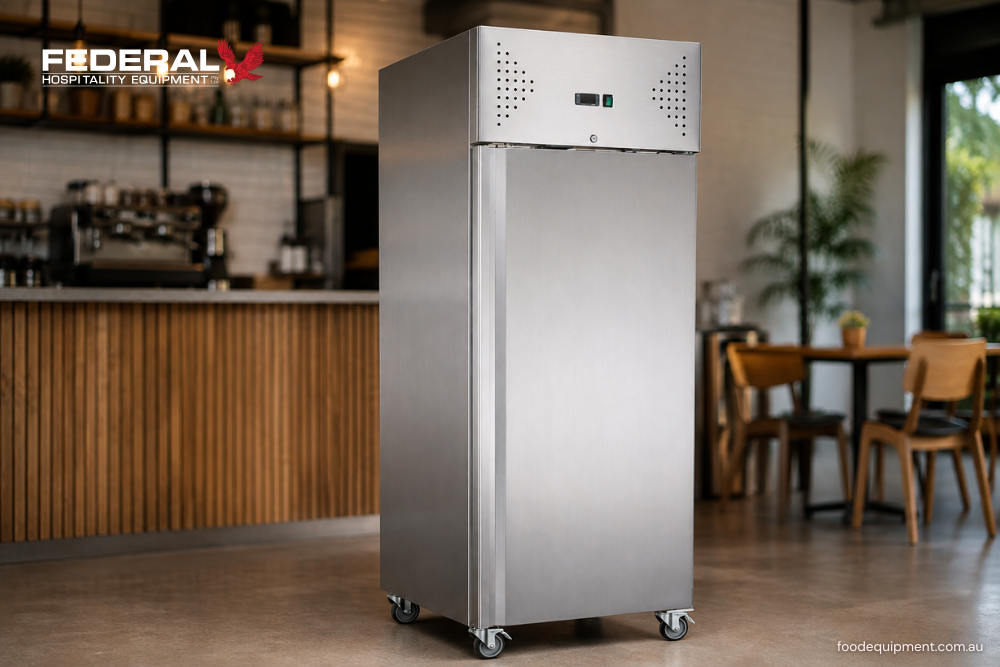
As refrigerated stock volume increases, an upright commercial fridge becomes increasingly useful.
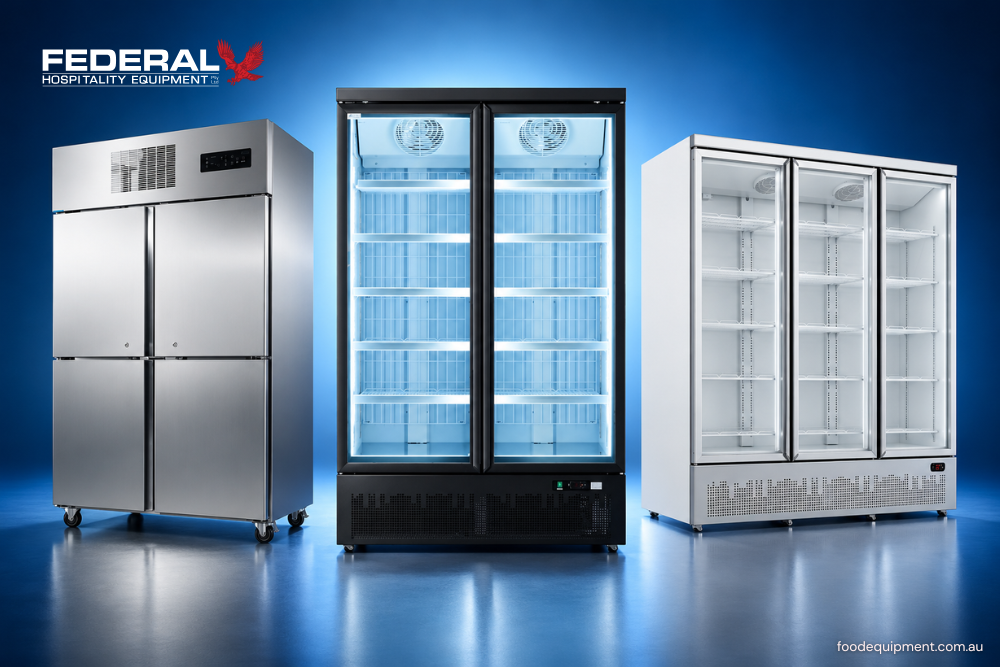
The main advantage is vertical storage. Rather than extending refrigeration across a long section of the kitchen, an upright cabinet provides substantial storage while using a relatively concentrated area of floor space.
This makes upright refrigeration particularly useful for bulk ingredients, backup stock and products that do not need to sit directly beneath a preparation station.
Single-Door Upright Fridges
A single-door commercial fridge may be appropriate for a smaller café that requires more refrigerated storage than an underbench unit can provide but does not have the stock volume to justify a larger cabinet.
It can also work as supplementary refrigeration where the café already has a refrigerated preparation bench.
Double-Door and Larger Upright Fridges
A busy café with a broader menu may need more capacity. Double-door or larger configurations can make it easier to organise dairy, fresh produce, prepared foods and other refrigerated ingredients.
The goal, however, should not be to buy the biggest cabinet available.
An overcrowded fridge can make stock difficult to organise and may restrict internal airflow. At the opposite extreme, an unnecessarily large refrigerator consumes valuable kitchen space without providing much practical benefit if a significant portion remains unused.
No. The ideal commercial fridge should provide enough capacity for your maximum normal stock plus sensible spare room without being unnecessarily large. Too little space can lead to overcrowding and poor organisation, while an oversized unit can occupy valuable kitchen space that could be used more effectively.
Should a Café Choose a Workbench Fridge?
For many Australian cafés, a workbench refrigerator can be one of the most practical forms of commercial refrigeration because it combines refrigerated storage with a stainless-steel working surface.
This can be especially useful around sandwich, salad and breakfast preparation stations.
Instead of retrieving ingredients from a separate upright refrigerator, staff can keep frequently used items immediately beneath the work area. This creates a shorter path between storage, preparation and service.
Federal's current workbench range includes both Thermaster and FED-X refrigeration. Examples include the Thermaster GN3100DT Dual-Temperature GN Counter Refrigerator and FED-X chef-base refrigerated drawer benches in different capacities.
When Is Workbench Refrigeration Most Useful?
It can be particularly valuable when ingredients are repeatedly accessed throughout service. A sandwich station, for example, may require cheese, vegetables, prepared fillings and sauces dozens of times during a lunch period.
Keeping those products at the preparation station can make the workflow more direct and reduce unnecessary staff movement.
| Refrigeration Type | Main Benefit | Typical Café Application |
|---|---|---|
| Compact Workbench Fridge | Combines chilled storage and preparation space in a compact footprint | Small cafés and kitchens with limited space |
| Workbench Fridge | Creates a larger refrigerated preparation station | Sandwich, salad and breakfast preparation |
| Upright Fridge | Provides high vertical storage capacity | Bulk ingredients and back-of-house storage |
| Bar Fridge | Keeps drinks conveniently accessible | Front or back-of-house beverage service |
| Display Refrigeration | Stores chilled products while keeping them visible | Grab-and-go drinks and packaged products |
| Wine Fridge | Provides dedicated wine storage | Cafés with wine or licensed beverage service |
Does a Café Need a Separate Beverage Fridge?
Not every café needs separate beverage refrigeration, but it can become valuable when bottled and canned drinks represent a significant part of sales.
Using the main food-storage refrigerator for large quantities of drinks can consume space needed for milk, dairy, fresh produce and prepared ingredients.
A dedicated beverage or bar fridge separates these two functions. Drinks remain accessible to staff without repeatedly opening the refrigerator used for kitchen ingredients.
Federal's current bar-fridge range includes Thermaster models such as the DC-122Q and underbench LG-208HC Two-Door Bar Fridge/Cooler. The current range also includes FED-X bar refrigeration.
What About Display Refrigeration for Grab-and-Go Cafés?
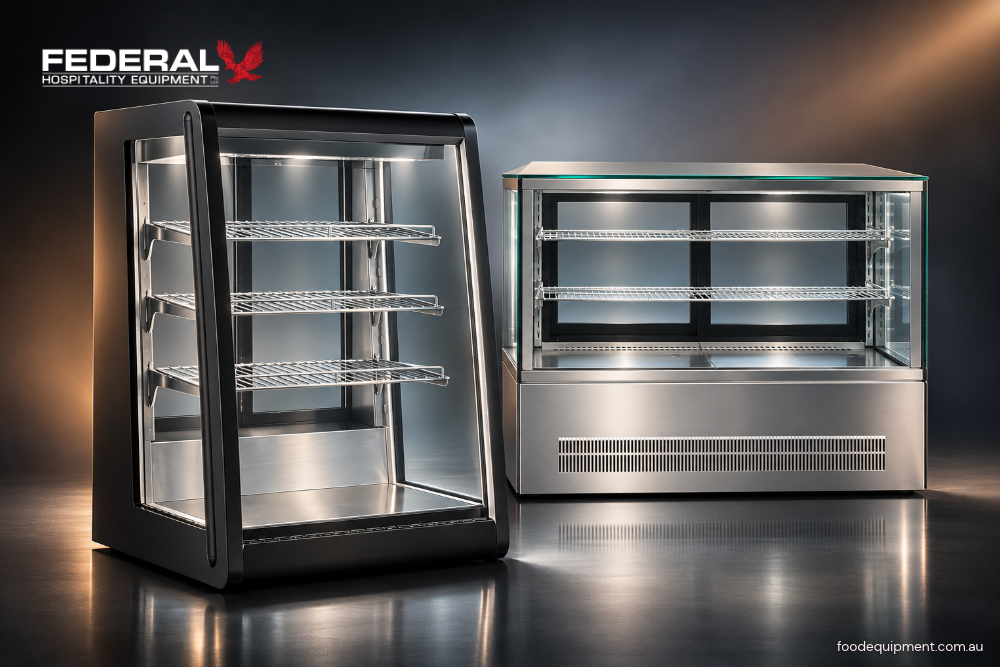
A café selling bottled beverages, packaged foods and other grab-and-go products has another consideration: customers may need to see the products before making a purchase.
In this situation, customer-facing display refrigeration can serve a different purpose from back-of-house food storage.
Rather than treating all refrigeration as one system, it can be useful to separate production refrigeration from retail refrigeration.
The kitchen refrigerator supports preparation and ingredient storage, while the display unit supports merchandising and customer access.
This distinction can prevent valuable back-of-house refrigerator capacity from being consumed by retail beverages and packaged products.
How Much Commercial Fridge Capacity Does Your Café Actually Need?
The most practical way to estimate capacity is to look at your maximum normal stock level rather than your average stock level.
Imagine opening the refrigerator after receiving a normal major delivery before a busy weekend. How much milk, cheese, yoghurt, butter, meat, vegetables, sauces, desserts, prepared food and other chilled stock needs to fit inside?
That gives you a much more useful picture of required capacity than looking at what remains in the fridge near the end of an average trading day.
Step 1: List Everything That Requires Refrigeration
Separate stock into practical categories such as dairy, fresh produce, proteins, sauces, prepared ingredients, desserts and beverages.
Step 2: Calculate Peak Stock
Estimate the maximum quantity of each category normally held after deliveries and before your busiest trading periods.
Step 3: Consider Delivery Frequency
A café receiving fresh deliveries every day may not need as much backup capacity as a business that receives stock only once or twice per week.
Step 4: Allow Sensible Spare Capacity
Your calculation should provide room for busy weekends, public holidays, seasonal demand and normal fluctuations in stock.
The objective is not to leave half the refrigerator empty. It is to avoid filling every available space so tightly that organisation and airflow become difficult.
| Factor | Usually Points Towards Less Capacity | Usually Points Towards More Capacity |
|---|---|---|
| Menu | Limited food menu | Extensive breakfast and lunch menu |
| Deliveries | Frequent or daily deliveries | Several days between deliveries |
| Food Preparation | Low preparation volume | High preparation volume |
| Beverage Sales | Limited | High beverage turnover |
| Seating | Small café | Medium or large café |
| Storage Style | Short-term stock | Bulk stock |
| Business Growth | Stable operation | Expanding menu or customer volume |
This peak-stock approach follows the central recommendation in the original source: size the refrigerator around maximum normal stock rather than simply using average daily inventory.
How Does Delivery Frequency Affect Café Fridge Size?
Delivery frequency is easy to overlook when selecting commercial refrigeration, yet it can significantly change how much storage a café requires.
Suppose two cafés use approximately the same quantity of milk, vegetables and other chilled ingredients every week. One receives deliveries six days per week while the other receives two deliveries.
The second café needs to hold considerably more stock between deliveries even though its weekly consumption may be similar.
This is why copying another café's refrigeration setup based purely on seating capacity can lead to the wrong result.
They can. Cafés receiving frequent fresh deliveries generally need to hold less backup stock than businesses receiving deliveries only once or twice a week. Fridge capacity should therefore be calculated using both consumption and replenishment frequency.
How Does Your Menu Affect Commercial Fridge Size?
Your menu is one of the strongest indicators of how much refrigeration you need.
A coffee-and-pastry operation may mainly require milk storage, a modest amount of sandwich ingredients and some chilled beverages.
A full brunch café can be very different. Eggs, dairy products, vegetables, meats, sauces, prepared fillings, desserts and other ingredients can quickly increase storage requirements.
The number of refrigerated menu components also influences organisation. Having sufficient total capacity is important, but staff also need to find ingredients quickly during service.
A café with a complex menu may therefore benefit from splitting refrigeration by function rather than placing everything into one very large cabinet.
Is One Large Fridge Better Than Several Smaller Fridges?
Not necessarily. Total capacity matters, but where that capacity is located can be equally important.
One large upright refrigerator can provide efficient bulk storage. However, if staff need to walk across the kitchen every time they prepare a sandwich or breakfast order, the layout may create unnecessary movement.
A combination can sometimes work better: an upright fridge for bulk and backup stock, a workbench fridge at the preparation station and a separate bar or display fridge for beverages.
This approach divides refrigeration according to function.
How Much Kitchen Space Should You Allow for a Commercial Fridge?
Capacity is only half of the sizing decision. The refrigerator also has to physically fit into your premises.
Before ordering, measure the intended installation position carefully. Check width, depth and height rather than relying on a single measurement.
Then measure the entire delivery route.
This includes:
- building entrances;
- doorways;
- corridors;
- corners and turning areas;
- lifts where applicable;
- kitchen entrances; and
- the final installation position.
A commercial refrigerator can fit perfectly into its planned position and still be extremely difficult—or impossible—to move through a narrow doorway or corridor.
You should also account for door opening, ventilation requirements, power access, cleaning access and future servicing.
- Measure available width.
- Measure available depth.
- Check total unit height.
- Check door-opening clearance.
- Measure all delivery doorways.
- Check narrow corridors and corners.
- Confirm ventilation requirements.
- Confirm suitable power access.
- Allow practical access for cleaning.
- Allow access for future servicing.
How Can the Right Fridge Improve Café Workflow?
Commercial refrigeration should support the way staff work rather than force staff to work around the refrigerator.
Consider a busy breakfast café. If milk is near the coffee station, frequently used ingredients are beneath the preparation bench and backup stock is organised in an upright refrigerator, each refrigeration unit has a clear role.
Now compare that with a kitchen where all chilled stock is stored in one refrigerator at the opposite end of the room. Staff may spend a surprising amount of time walking back and forth during service.
That is why fridge selection is partly a capacity decision and partly a workflow decision.
Which Commercial Fridge Brands Does Federal Hospitality Equipment Australia Offer?
Federal Hospitality Equipment Australia's commercial refrigeration range includes established commercial refrigeration options such as Thermaster and FED-X, while the original café-fridge source also identifies Fagor within Federal's refrigeration offering.
Thermaster Commercial Fridges
Thermaster is strongly represented across Federal's commercial refrigeration categories, including upright, workbench, compact workbench and bar refrigeration. Federal describes Thermaster as commercial refrigeration designed for Australian hospitality applications, including restaurants, cafés, bars, supermarkets and convenience stores.
For café operators, this breadth can be useful because different refrigeration requirements can be addressed within the same wider brand range rather than treating every storage need identically.
FED-X Commercial Refrigeration
FED-X is another important part of Federal Hospitality Equipment's current refrigeration offering. The FED-X Series includes commercial bench refrigerators and other professional refrigeration configurations.
Current compact workbench options include the FED-X XGNS450B, XGNS900B and XGNS1300B, while the broader range includes refrigerated chef bases and multi-door bench refrigerators.
Fagor
Fagor is also identified in the original Federal café-refrigeration source alongside Thermaster and FHE-X/FED-X as part of the brand choice available to Australian operators.
What Commercial Fridge Configuration Is Best for Different Café Sizes?
Small Café
A compact workbench or underbench refrigerator may provide sufficient storage where the food menu is limited and deliveries are frequent. Combining chilled storage with a working surface can also make efficient use of limited space.
Medium Café
A combination of upright and workbench refrigeration may be more practical. The upright fridge can hold bulk and backup ingredients while the workbench unit keeps frequently used products near the preparation station.
Large or High-Volume Café
Multiple refrigeration zones may be required. This could include upright storage, refrigerated preparation benches and dedicated beverage or display refrigeration.
Café with Strong Grab-and-Go Sales
Consider separating customer-facing drinks and packaged products from back-of-house ingredient refrigeration.
Café Serving Wine
Dedicated wine refrigeration can separate wine storage from the main refrigerator used for food and everyday ingredients.
What Mistakes Should You Avoid When Choosing Café Refrigeration?
1. Buying Based Only on Litres
Two refrigerators with similar stated capacities may have different dimensions, shelving arrangements and practical applications. Think about how your stock will actually fit and be organised.
2. Choosing Based on Average Stock
Your refrigerator needs to cope with normal peak stock levels, not just an average trading day.
3. Ignoring Delivery Frequency
Less frequent deliveries usually mean more stock needs to be held between supplier visits.
4. Buying Too Small
Insufficient capacity can result in overcrowding and make ingredients difficult to organise.
5. Buying Unnecessarily Large
Extra capacity has little value if it remains unused while the cabinet consumes valuable kitchen space.
6. Ignoring Workflow
A refrigerator in the wrong position can increase staff movement even if its storage capacity is technically adequate.
7. Forgetting Beverages
High drink sales can quickly consume space intended for food ingredients. Dedicated beverage refrigeration may be more practical.
8. Forgetting the Delivery Route
Always make sure the refrigerator can physically reach its installation location.
9. Failing to Plan for Growth
If you expect the menu, seating or customer volume to increase, include reasonable future demand in your planning.
What Should You Check Before Buying a Commercial Fridge for Your Café?
- What refrigerated ingredients are on the menu?
- What is the maximum normal stock level?
- How frequently do suppliers deliver?
- How much milk and dairy storage is required?
- How much fresh produce and prepared food is stored?
- Do drinks require separate refrigeration?
- Would an upright fridge or workbench fridge better suit the workflow?
- Could compact refrigeration save valuable space?
- What are the exact installation dimensions?
- Can the refrigerator pass through every doorway and corridor?
- Is there sufficient door clearance?
- What ventilation does the model require?
- Is suitable power available?
- Can staff access the refrigerator easily during service?
- Is there room for reasonable future growth?
Why Consider Federal Hospitality Equipment Australia for Café Refrigeration?
Federal Hospitality Equipment Australia supplies a broad commercial refrigeration range for cafés, restaurants and other Australian foodservice businesses.
Its commercial-fridge categories currently include bar fridges, upright fridges, wine fridges, workbench fridges and compact workbench fridges, making it possible to select refrigeration according to the role it needs to perform within the business.
Federal is an Australian-owned commercial food, catering and restaurant equipment supplier serving Australia and New Zealand, with more than 50 years in commercial kitchen and catering equipment.
For café operators, the important point is not simply having a large selection available. It is being able to compare different configurations—from compact preparation refrigeration to upright bulk storage and dedicated beverage refrigeration—according to the requirements of the individual café.
Conclusion: What Size Commercial Fridge Is Right for Your Café?
There is no universal litre capacity or refrigerator size that can be recommended for every Australian café.
The right commercial fridge should be determined by what you sell, how much stock you hold at your busiest point, how often deliveries arrive, how much food you prepare, how important beverage sales are, where ingredients are used and how much physical space your kitchen provides.
For a small café, compact workbench refrigeration can provide chilled storage while maximising limited preparation space. A medium café may benefit from combining a workbench refrigerator with an upright fridge, while larger operations may require multiple upright, workbench and dedicated beverage units.
The original source reaches the same practical conclusion: start with the menu and maximum stock level, then consider delivery frequency, food preparation, beverage sales, available space and future growth.
By selecting the right capacity and configuration from the beginning, your refrigeration can support better organisation and a more efficient café workflow rather than simply occupying valuable kitchen space.
Frequently Asked Questions
What size commercial fridge does a small café need?
There is no fixed capacity for every small café. A café with a limited food menu and frequent deliveries may be able to use compact workbench or underbench refrigeration, while a business holding more fresh ingredients may also need upright storage.
How do I calculate commercial fridge capacity for a café?
Calculate the maximum normal quantity of refrigerated food and beverages you hold after deliveries and before busy trading periods. Consider delivery frequency and allow sensible spare capacity for weekends, seasonal demand and business growth.
Is a workbench fridge good for a café?
Yes. A workbench fridge can be particularly useful because it combines chilled ingredient storage with a preparation surface, helping keep frequently used products close to the food-preparation station.
When does a café need an upright fridge?
An upright commercial fridge becomes useful when the café needs more bulk chilled storage. Vertical cabinets can provide substantial storage without requiring the same horizontal footprint as a long refrigerated bench.
Is one large commercial fridge better than several smaller fridges?
Not always. A combination of upright bulk storage, workbench refrigeration near preparation areas and separate beverage refrigeration can sometimes create a more efficient workflow than placing everything in one large refrigerator.
Does a café need a separate drinks fridge?
If bottled and canned beverages represent a significant part of sales, separate bar or display refrigeration can improve organisation and keep drinks from consuming valuable food-storage capacity.
What is the difference between an upright fridge and a workbench fridge?
An upright fridge primarily provides vertical storage capacity. A workbench fridge combines refrigerated storage with a preparation surface, making it useful for ingredients that staff need frequently during service.
Should I choose a single-door or double-door commercial fridge?
A single-door unit may suit smaller stock requirements, while a double-door or larger refrigerator may be more practical for a busy café holding multiple ingredient categories. Choose according to actual peak stock rather than door count alone.
How does delivery frequency affect commercial fridge size?
Frequent deliveries can reduce the amount of backup stock that needs to be stored. Cafés receiving deliveries less often may require additional refrigeration capacity to hold several days of ingredients.
Should I buy extra fridge capacity for future growth?
Allowing reasonable spare capacity can be useful where you expect higher customer numbers, an expanded menu or greater food preparation, but avoid buying a substantially oversized refrigerator without a realistic need.
What should I measure before buying a commercial fridge?
Measure the installation area and the complete delivery route, including doorways, corridors and corners. Also check door clearance, ventilation, power access and space for cleaning and servicing.
Which commercial fridge brands does Federal Hospitality Equipment Australia offer?
Federal's refrigeration offering includes Thermaster and FED-X, while the original Federal café-refrigeration source also identifies Fagor among the available brand options.
Does Federal Hospitality Equipment sell compact workbench fridges?
Yes. Federal's current compact workbench range includes Thermaster and FED-X options in different configurations.
Does Federal Hospitality Equipment sell commercial bar fridges?
Yes. Federal's commercial refrigeration range includes bar and beverage fridges alongside upright, workbench, compact workbench and wine refrigeration.
What type of commercial fridge is best for a busy brunch café?
A busy brunch café may benefit from combining an upright fridge for bulk stock with workbench refrigeration near food-preparation areas. Dedicated beverage refrigeration may also be useful where drink sales are high.