A busy commercial kitchen depends on movement. Ingredients need to travel from storage to preparation areas, cookware moves between workstations, clean equipment returns from the wash area, and trays, plates and supplies may need to be transported repeatedly throughout service.
When staff carry these items individually, small trips can quickly become a significant part of the working day. A commercial stainless steel trolley provides a practical alternative by allowing multiple items to be moved together on a mobile platform.
For Australian restaurants, cafés, bakeries, hotels, catering businesses and other foodservice operations, stainless steel trolleys combine several useful characteristics: mobility, durability, easy-clean surfaces, practical carrying capacity and flexible storage.
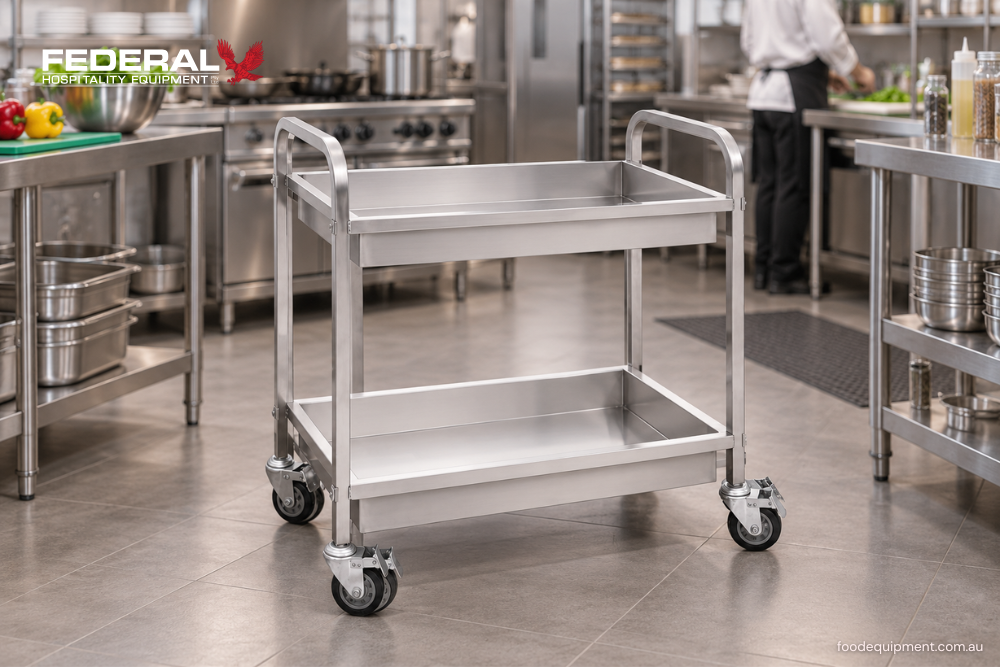
Federal Hospitality Equipment Australia offers commercial stainless steel trolley options including the YC-102, YC-103 and YC-102D. These models use SUS430 stainless steel and solid shelf and frame construction designed for everyday commercial use.
Stainless steel trolleys are well suited to commercial kitchens because they provide a durable, mobile and easy-to-clean way to move ingredients, cookware, trays, stock and equipment between work areas. They can reduce repeated manual carrying, improve kitchen organisation and provide temporary mobile storage without permanently occupying another workstation.
Why Are Stainless Steel Trolleys Popular in Australian Commercial Kitchens?
Commercial kitchens place very different demands on equipment from a domestic environment. A trolley may travel between storage, preparation, cooking, dishwashing and service areas many times during a single trading period.
That means the trolley needs to be practical for repeated movement while also fitting into an environment where cleaning and organisation are everyday priorities.
Stainless steel is particularly useful in this setting because it provides a durable, relatively low-maintenance surface that is straightforward to clean. Combined with shelves and castors, it creates a mobile work tool that can support numerous kitchen tasks.
| Benefit | Why It Matters in a Commercial Kitchen |
|---|---|
| Stainless Steel Construction | Provides practical durability for frequent commercial use |
| Easy-Clean Surface | Supports regular kitchen cleaning routines |
| Mobile Design | Makes moving supplies and equipment between work areas easier |
| Solid Shelves | Provides practical carrying and temporary storage space |
| Compact Footprint | Can be useful in kitchens where permanent floor space is limited |
| Different Configurations | Allows operators to select a trolley according to the intended task |
How Can a Stainless Steel Trolley Improve Kitchen Workflow?
One of the biggest advantages of a commercial trolley is that it allows several items to move together.
Consider a kitchen employee who needs to move containers, ingredients and cookware from storage to a preparation station. Without a trolley, that person may need to make several trips. With an appropriately sized trolley, multiple items can potentially be moved at once.
The same principle applies throughout the kitchen. Clean equipment can be transported from dishwashing back to production, supplies can be moved from storage to service areas, and catering equipment can be repositioned where it is needed.
This does not mean a trolley automatically makes every kitchen more efficient. It needs to be incorporated into a sensible workflow. But when movement between stations is frequent, mobile transport can reduce unnecessary carrying and help staff organise repetitive tasks.
Yes. A trolley can help staff move multiple items between storage, preparation, cooking, service and washing areas in one trip instead of carrying them individually. Its usefulness depends on selecting the right size, capacity and shelf configuration for the task.
Can Stainless Steel Trolleys Reduce Unnecessary Carrying?
A trolley does not eliminate manual handling, because staff still need to load and unload it. However, it can reduce the need to carry individual items over longer distances through the kitchen.
This can be especially useful when moving multiple lightweight items or a collection of supplies that would otherwise require several trips.
For example, a trolley might be used to transport:
- ingredients from storage to preparation areas;
- pots, pans and cookware;
- clean utensils and kitchen equipment;
- plates and service items;
- containers and foodservice supplies;
- baking equipment;
- catering supplies;
- stock during restocking; and
- equipment during event setup or pack-down.
Operators should always follow appropriate workplace manual-handling practices and stay within the trolley's published load limits.
Why Is Stainless Steel Suitable for Foodservice Trolleys?
Commercial foodservice equipment needs to withstand regular handling and cleaning. Stainless steel suits this environment because it provides a smooth, durable surface that can be incorporated into routine cleaning procedures.
The FHE trolley models covered here use SUS430 stainless steel, which Federal Hospitality Equipment identifies as a material commonly used within catering equipment.
The trolley's solid shelves and frames contribute to its practical commercial construction, while the stainless-steel finish suits the appearance of many professional kitchens where benches, sinks, cabinets and shelving are also manufactured from stainless steel.
Are Stainless Steel Trolleys Hygienic?
Stainless steel is practical for foodservice environments because its smooth surface is straightforward to clean and does not absorb liquids in the same way as porous materials.
This can make cleaning spills and food residue more manageable as part of the kitchen's normal cleaning routine.
However, stainless steel should not be described as automatically hygienic simply because of the material. A trolley still needs to be cleaned correctly and regularly according to the manufacturer's recommendations and the business's cleaning procedures.
How Should You Clean a Stainless Steel Kitchen Trolley?
Cleaning requirements should always follow the manufacturer's recommendations and the business's food-safety procedures.
As a general operational principle, spills should be dealt with promptly rather than being allowed to remain on the trolley throughout service. Shelves should be cleared so all surfaces can be cleaned properly, and the trolley should be checked for residue around joins, frames and wheels.
If a trolley is being used for different tasks during the day, appropriate cleaning between uses becomes particularly important.
How Much Can a Commercial Stainless Steel Trolley Carry?
Load capacity varies between models, which is why it should be checked before purchase rather than assuming every trolley can carry the same amount.
Federal Hospitality Equipment's published information lists different capacities for its current stainless-steel trolley configurations.
| FHE Model | Configuration | Published Capacity | Typical Application |
|---|---|---|---|
| YC-102 | 2-shelf stainless steel trolley | 80 kg | General stock and equipment movement |
| YC-103 | 3-shelf stainless steel trolley | 120 kg | Higher-volume transport and mobile storage |
| YC-102D | 2-shelf stainless steel trolley | 80 kg | General transport and mobile storage |
These published capacities demonstrate why the intended load needs to be considered alongside shelf configuration and physical trolley size. Product specifications should always be confirmed before purchasing because specifications can change.
What Is the Difference Between a 2-Shelf and 3-Shelf Trolley?
The most obvious difference is the amount of vertical carrying and storage space.
A 2-shelf trolley can provide a straightforward configuration for general movement of stock, cookware and supplies. The greater vertical clearance between shelves can also be useful depending on the size of the items being transported.
A 3-shelf trolley adds another level, allowing more items to be separated or organised vertically. This can be useful when staff regularly need to transport a larger number of smaller items.
More shelves are not automatically better. The correct configuration depends on what the business actually needs to move.
Choose a 2-shelf trolley for general transport where simpler loading or greater space between levels suits the items being moved. A 3-shelf trolley can provide additional vertical carrying space for businesses transporting more items. Always compare trolley dimensions, shelf spacing and load capacity before choosing.
What Is the FHE YC-102 Stainless Steel Trolley?
The Federal Hospitality Equipment YC-102 is a two-shelf stainless steel trolley designed for general commercial kitchen transport.
Its published capacity is 80 kg, making it an option for moving everyday stock, supplies and suitable kitchen equipment where a two-level configuration is preferred.
For cafés, restaurants and other hospitality businesses, this type of configuration can provide useful mobile storage without adding another permanent workstation to the kitchen.
What Is the FHE YC-103 Stainless Steel Trolley?
The FHE YC-103 uses a three-shelf configuration and has a published capacity of 120 kg.
The additional shelf creates more vertical carrying space, making the trolley suitable where a business needs to organise or transport a greater number of items.
This can be useful for higher-volume movement between storage, preparation, service or other working areas, provided the trolley dimensions and capacity suit the kitchen.
What Is the FHE YC-102D Stainless Steel Trolley?
The FHE YC-102D is another two-shelf stainless-steel trolley option with a published 80 kg capacity.
Like other commercial mobile carts, it can be considered for general equipment movement and temporary mobile storage where a two-level configuration suits the workflow.
Before choosing between individual models, compare current specifications and dimensions against the actual intended use.
Does a Bigger Stainless Steel Trolley Mean a Better Trolley?
No. Larger capacity can be useful, but only if the trolley can move comfortably through the kitchen.
A large trolley in a narrow kitchen can obstruct staff movement, make corners difficult to negotiate or create congestion around preparation and cooking areas.
The best trolley is therefore not necessarily the one with the greatest capacity. It is the one that carries the required load while fitting comfortably within the available circulation space.
How Do Stainless Steel Trolleys Help in Small Commercial Kitchens?
Floor space is particularly valuable in compact commercial kitchens. Adding permanent shelving, cabinets or benches can reduce the amount of space available for staff movement.
A mobile trolley offers a different approach because it can provide temporary storage or carrying space and then be moved elsewhere when the task is complete.
A café, for example, might use a trolley during restocking or preparation and then reposition it once service begins. A restaurant could use the same concept to transport cookware or supplies between storage and production.
This flexibility can make mobile equipment useful where the kitchen needs to adapt throughout the day.
Can a Stainless Steel Trolley Be Used as Mobile Storage?
Yes, within the trolley's intended use and capacity.
The shelves provide temporary storage space that can move with the task. This can be particularly useful when supplies are needed in different areas at different times.
However, a trolley should not automatically replace permanent shelving or cabinets. Permanent storage remains more appropriate for items that need a fixed, organised location.
The value of the trolley is its mobility.
Where Can a Commercial Kitchen Trolley Be Used?
A stainless steel trolley is not restricted to one section of a kitchen. Depending on the business and intended task, it can support movement between several areas.
| Kitchen Area | Possible Trolley Use |
|---|---|
| Dry Storage | Moving supplies towards preparation areas |
| Cool Room Area | Transporting suitable ingredients and containers |
| Preparation | Holding or moving equipment and supplies required for a task |
| Cooking Area | Transporting cookware and suitable kitchen items |
| Dishwashing | Returning clean equipment and supplies to production areas |
| Service | Moving suitable plates, cups and service items |
| Events & Catering | Supporting setup, transport and pack-down |
Are Stainless Steel Trolleys Only for Restaurants?
No. Their usefulness extends across many foodservice environments because the basic need—moving equipment and supplies efficiently—is not unique to restaurants.
Cafés
Cafés can use mobile trolleys for cups, supplies, ingredients, utensils or restocking between storage and preparation areas.
Restaurants
Restaurants may use trolleys for moving cookware, ingredients, equipment and service supplies between different kitchen zones.
Bakeries
Bakeries can benefit from mobile equipment where trays, ingredients and production supplies regularly move between storage and preparation areas.
Hotels
Hotel foodservice operations often involve larger facilities and movement between preparation, storage and service areas, making mobile transport equipment useful in appropriate applications.
Catering Businesses
Catering operations may use trolleys during preparation as well as event setup and pack-down, where equipment and supplies need to be moved efficiently.
Pubs and Clubs
Food and beverage operations within pubs and clubs can use stainless-steel trolleys for kitchen, storage and service-support tasks.
Institutional Kitchens
Larger institutional foodservice environments can also use mobile carts where stock and equipment need to move regularly between working areas.
What Is the Difference Between a Stainless Steel Trolley and a Gastronorm Rack?
Although both are mobile pieces of commercial kitchen equipment, they are designed around different transport requirements.
A general stainless-steel trolley uses solid shelves that can carry a range of suitable items. A gastronorm rack is designed specifically around gastronorm containers or trays and typically provides multiple rails or levels.
Federal Hospitality Equipment's broader commercial trolley and rack range includes stainless-steel service trolleys as well as gastronorm racks and other specialist transport equipment.
The correct choice depends on what is being moved.
When Is a Gastronorm Rack Better Than a General Trolley?
If a kitchen frequently moves multiple gastronorm pans or compatible trays, a dedicated rack can provide more efficient vertical organisation than placing those containers on solid trolley shelves.
For general stock, cookware, supplies and mixed equipment, a conventional shelf trolley may provide greater flexibility.
This is another reason to select mobile equipment according to the task rather than assuming one trolley style can perform every transport function.
Why Are Castors Important on a Commercial Kitchen Trolley?
Mobility is one of the main reasons for using a trolley, so its wheel and castor arrangement is an important consideration.
A trolley that is awkward to manoeuvre can reduce the benefit of having mobile storage in the first place.
When comparing commercial carts and racks, consider how frequently the equipment will move, the kitchen floor surface, aisle widths and whether the particular model includes braking or locking features where required.
Specialist rack configurations within Federal Hospitality Equipment's broader range include designs with castors and brakes for transporting food containers.
Can Stainless Steel Trolleys Improve Kitchen Organisation?
They can support better organisation when they are given a clear role.
For example, a kitchen might designate one trolley for restocking preparation areas, another task-specific trolley for clean equipment, or use a mobile unit during a particular production process.
This can prevent supplies from being placed randomly on preparation benches while allowing the trolley to move with the task.
However, mobile equipment can create clutter if it has no defined purpose or storage position. A trolley should therefore form part of the kitchen plan rather than simply becoming another place to leave miscellaneous items.
How Do Stainless Steel Trolleys Support Busy Service Periods?
During peak service, staff movement becomes more frequent and working areas become busier. Having supplies in the wrong place can result in repeated trips to storage or other parts of the kitchen.
A trolley can be prepared before service with appropriate supplies and positioned near the area where those items will be required.
After service, it can be moved away, unloaded and cleaned.
This ability to change location according to the stage of the working day is one of the practical differences between a trolley and fixed shelving.
Its flexibility. A trolley can transport multiple items, provide temporary storage near a working station and then be moved when it is no longer required. This can be particularly useful in commercial kitchens where tasks and space requirements change throughout the day.
Are Stainless Steel Trolleys Durable Enough for Commercial Kitchens?
Commercial trolleys are intended for repeated foodservice use rather than occasional household movement.
The FHE trolley range discussed here uses SUS430 stainless steel together with solid shelves and frames. This construction is designed around everyday commercial handling.
Durability still depends on appropriate use. Operators should observe published load capacities, avoid using the trolley for applications it was not designed for and maintain the equipment according to the manufacturer's recommendations.
Correct selection is equally important. A trolley repeatedly used for loads beyond its intended capacity is not being used as designed, regardless of its construction material.
How Do You Choose the Right Commercial Stainless Steel Trolley?
Start with the task rather than the trolley.
Ask what needs to be moved, how much of it is normally transported, how often the trolley will travel through the kitchen and where it needs to go.
| Kitchen Requirement | What to Consider |
|---|---|
| Moving General Supplies | A compact 2-shelf trolley may be appropriate |
| Carrying More Items | Consider a 3-shelf configuration |
| Heavier Loads | Check the manufacturer's published load capacity |
| Tight Kitchen Layout | Measure trolley width, aisles and turning space |
| Frequent Movement | Consider mobility and castor configuration |
| Foodservice Use | Prioritise practical easy-clean construction |
| GN Pans or Trays | Consider a dedicated gastronorm or tray rack |
What Should You Check Before Buying a Stainless Steel Trolley?
- What will normally be transported?
- How much weight will the trolley need to carry?
- What is the manufacturer's published load capacity?
- Would two shelves or three shelves suit the task better?
- What are the overall trolley dimensions?
- Will it fit comfortably through kitchen doorways?
- Can it move through the narrowest aisle?
- Is there enough room to turn around benches and equipment?
- How frequently will the trolley be moved?
- What type of castors does the model use?
- Are brakes required for the intended application?
- Is the construction suitable for regular cleaning?
- Where will the trolley be stored when not in use?
- Would a general trolley or specialist rack better suit the items being moved?
What Are Common Mistakes When Choosing a Commercial Kitchen Trolley?
1. Choosing Only by Load Capacity
A high load rating is useful only when the trolley also fits comfortably through the kitchen.
2. Buying the Largest Model Available
Oversized equipment can create congestion in narrow commercial kitchens.
3. Ignoring Shelf Configuration
The number of shelves should reflect the type and size of items being transported.
4. Forgetting Doorways and Corners
A trolley can fit its storage position but still be impractical if it cannot move easily along its normal route.
5. Treating Stainless Steel as Automatically Clean
The material is easy to clean, but regular cleaning procedures remain essential.
6. Exceeding the Published Load Capacity
Operators should follow the manufacturer's stated capacity rather than assuming stainless-steel construction means unlimited load handling.
7. Using a General Trolley When a Specialist Rack Is Needed
If the main job is transporting GN pans, trays or another specific container format, a dedicated rack may provide a more appropriate solution.
8. Using the Trolley as Permanent Clutter Storage
A mobile trolley is most useful when it has a defined operational role and a designated storage position when not required.
Can a Stainless Steel Trolley Be a Cost-Effective Kitchen Investment?
A commercial trolley is relatively simple compared with major refrigeration or cooking equipment, but its operational value comes from how often it is used.
If staff repeatedly move supplies, cookware or equipment between the same areas, reducing unnecessary individual carrying trips can make a trolley useful throughout the working day.
Its mobile nature also means the same unit can potentially support different tasks at different times rather than occupying a fixed workstation.
The real value therefore depends on matching the trolley to an actual workflow requirement.
Why Consider Federal Hospitality Equipment Australia for Stainless Steel Trolleys?
Federal Hospitality Equipment Australia supplies commercial stainless-steel equipment for Australian hospitality and foodservice businesses, including mobile trolleys and racks as part of its broader commercial kitchen range.
Stainless-steel trolley options include the FHE YC-102, YC-103 and YC-102D, giving operators a choice between two- and three-shelf configurations and different published load capacities.
Federal Hospitality Equipment's broader stainless-steel offering also includes commercial benches, sinks, sink benches, cabinets, shelving and other equipment used to organise professional foodservice environments.
When selecting a trolley, compare the current model specifications with the actual kitchen layout and intended task rather than choosing on capacity or price alone.
Conclusion: What Makes Stainless Steel Trolleys Ideal for Commercial Kitchens?
Stainless steel trolleys are useful in commercial kitchens because they bring together mobility, durability, practical carrying capacity, easy-clean construction and flexible temporary storage in one piece of equipment.
Instead of staff carrying ingredients, cookware, supplies or equipment individually between work areas, an appropriately selected trolley can allow multiple items to move together. This can reduce unnecessary trips and help create a more organised workflow.
The stainless-steel construction suits the demands of foodservice environments where equipment is handled and cleaned regularly, while mobile shelving allows the trolley to be positioned near the task and moved away when it is no longer required.
The right configuration depends on the job. Federal Hospitality Equipment's YC-102 and YC-102D provide two-shelf options with published 80 kg capacities, while the YC-103 provides three shelves and a published 120 kg capacity.
However, greater capacity does not automatically make a trolley more suitable. Kitchen width, doorways, turning space, shelf configuration, mobility and the type of items being transported should all influence the final choice.
For restaurants, cafés, bakeries, hotels, catering businesses and other Australian foodservice operations, a well-selected commercial stainless steel trolley can be a relatively simple addition that supports everyday movement and kitchen organisation without permanently occupying another work area.
Frequently Asked Questions
Why are stainless steel trolleys used in commercial kitchens?
They provide a mobile, durable and easy-to-clean way to move ingredients, cookware, supplies and equipment between different kitchen areas.
What is a commercial stainless steel trolley used for?
It can be used for transporting suitable stock, cookware, utensils, ingredients, service items and other equipment between storage, preparation, cooking, washing and service areas.
Are stainless steel trolleys hygienic?
Stainless steel has a smooth, easy-to-clean surface that is practical for foodservice environments. However, the trolley still needs regular cleaning according to appropriate procedures and manufacturer recommendations.
Can a stainless steel trolley improve kitchen workflow?
Yes. It can allow staff to move multiple items together instead of making several individual carrying trips, helping organise movement between kitchen areas.
What is the difference between a 2-shelf and 3-shelf trolley?
A 2-shelf trolley provides two carrying levels and can suit general transport, while a 3-shelf trolley provides additional vertical storage for moving a greater number of items.
How much weight can an FHE stainless steel trolley carry?
The published capacities vary by model. The YC-102 and YC-102D are listed at 80 kg, while the YC-103 is listed at 120 kg. Current specifications should be checked before purchase.
What is the FHE YC-102?
The YC-102 is a two-shelf commercial stainless-steel trolley with a published 80 kg capacity for general stock and equipment movement.
What is the FHE YC-103?
The YC-103 is a three-shelf stainless-steel trolley with a published 120 kg capacity, providing additional vertical carrying space.
What is the FHE YC-102D?
The YC-102D is a two-shelf stainless-steel trolley with a published 80 kg capacity for general mobile storage and transport applications.
Is a bigger commercial trolley always better?
No. A larger trolley may be difficult to manoeuvre through narrow aisles or around equipment. Capacity and dimensions should both suit the kitchen.
Can stainless steel trolleys be used in small kitchens?
Yes. A compact mobile trolley can provide temporary carrying and storage space, but its dimensions and turning requirements should be checked carefully.
Can a kitchen trolley be used as mobile storage?
Yes. Its shelves can provide temporary mobile storage close to a task, although permanent shelving or cabinets remain more suitable for fixed storage.
Are stainless steel trolleys only suitable for restaurants?
No. They can be useful in cafés, bakeries, hotels, pubs, catering businesses, supermarkets, institutional kitchens and event venues.
What is the difference between a kitchen trolley and a gastronorm rack?
A general trolley uses solid shelves for different suitable items, while a gastronorm rack is specifically configured to hold compatible GN containers or trays on multiple levels.
What should I look for when buying a stainless steel trolley?
Consider overall dimensions, shelf configuration, published load capacity, construction, castors, mobility, available aisle space, turning room and what the trolley will transport.
Why are trolley castors important?
Castors determine how easily the trolley can move through the kitchen. Consider floor conditions, aisle width, movement frequency and whether braking features are required.
How should a stainless steel trolley be cleaned?
Follow the manufacturer's recommendations and the business's cleaning procedures. Shelves, frames, handles, edges and castors should all be included in regular cleaning.
What stainless steel is used in FHE commercial trolleys?
The FHE trolley range covered here uses SUS430 stainless steel with solid shelf and frame construction.
Can stainless steel trolleys reduce manual handling?
They can reduce repeated individual carrying by allowing several suitable items to be moved together, although correct loading, unloading and workplace manual-handling practices remain important.
Which FHE stainless steel trolley should I choose?
Choose according to the items being moved, required capacity, preferred number of shelves and available kitchen space. The YC-102 and YC-102D provide two-shelf options, while the YC-103 provides a three-shelf configuration.