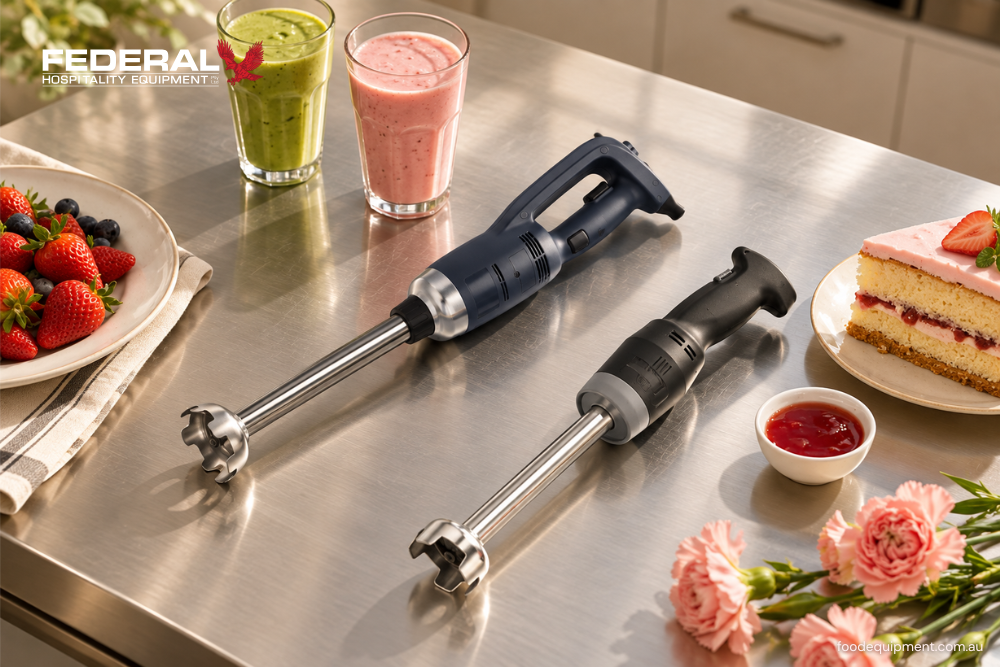
A commercial stick blender is designed for professional kitchens that need to blend, puree, mix or emulsify ingredients repeatedly throughout the working day. Restaurants, cafés, hotels, bakeries, caterers, aged-care kitchens and other foodservice businesses may use stick blenders for everything from soups and sauces to purees, dressings and other prepared foods.
Unlike a domestic hand blender, commercial equipment needs to cope with larger batches, more frequent use and the demands of a busy kitchen environment. The most powerful model is not automatically the best choice. The right machine is the one that provides enough performance for your ingredients and batch sizes while remaining practical for staff to control, clean and use safely.
When choosing a commercial stick blender in Australia, important features include motor power, variable speed, shaft length, blade design, stainless-steel construction, ergonomics, safety controls and ease of cleaning.
Federal Hospitality Equipment Australia offers professional stick blenders from brands including Yasaki and Dito Sama, with different shaft lengths and configurations to suit varied commercial preparation requirements.
Choose a commercial stick blender according to the food you prepare, your normal batch size and how frequently the machine will be used. Look for suitable motor power, variable-speed control, the correct shaft length, durable construction, an effective blade system, safe controls, comfortable handling and a design that can be cleaned efficiently.
What Are the Most Important Commercial Stick Blender Features?
The best features are those that directly support the way your kitchen actually prepares food.
A powerful motor can help process demanding mixtures, but power alone does not determine performance. Shaft length affects which pots and containers the blender can reach into, while speed control influences how much control the operator has over texture. Blade design, construction and ergonomics can also make a substantial difference during daily use.
| Feature | Why It Matters in a Commercial Kitchen |
|---|---|
| Motor Power | Helps the blender handle larger quantities and demanding ingredients. |
| Variable Speed | Provides greater control over texture and blending intensity. |
| Shaft Length | Determines how easily the blender can reach into different pots and containers. |
| Stainless-Steel Construction | Provides durable food-contact components suited to regular commercial use and cleaning. |
| Blade Design | Influences ingredient circulation, blending performance and finished texture. |
| Ergonomic Design | Helps operators control the equipment more comfortably during repeated use. |
| Safety Controls | Can help reduce accidental operation and support safer use. |
| Easy Cleaning | Detachable or accessible components can simplify cleaning and maintenance. |
How Important Is Motor Power in a Commercial Stick Blender?
Motor power is one of the first specifications many buyers look at, and it is important. Professional kitchens often prepare greater quantities and denser mixtures than domestic kitchens, so the blender needs sufficient power for the intended workload.
A stronger motor can be useful when preparing thick soups, sauces, purees and other dense mixtures. However, wattage should not be considered in isolation.
Blade design, shaft construction, operating speed and the amount of food being processed all influence real-world performance.
A kitchen preparing small batches of light sauces may not need the same motor specification as a catering operation blending large volumes of thick soup several times each day.
Does a More Powerful Stick Blender Always Perform Better?
No. More power can provide additional capacity, but the most powerful machine is not automatically the best equipment for every business.
If a blender is unnecessarily heavy or difficult for staff to manoeuvre, the extra power may offer little practical benefit for a café preparing relatively small batches.
Commercial kitchens should balance:
- motor output;
- batch volume;
- ingredient density;
- blade performance;
- shaft length;
- machine weight;
- operator comfort; and
- frequency of use.
The source article makes the same distinction: power needs to be considered alongside blade design, shaft construction and speed control rather than treated as the only measure of performance.
Why Is Variable Speed Important?
Variable-speed control gives kitchen staff more flexibility when working with different ingredients and desired textures.
Not every recipe should be blended at maximum speed. A lower setting can give the operator greater control when beginning a mixture, while higher speeds may help create smoother textures where appropriate.
This makes variable speed particularly useful when preparing:
- soups;
- sauces;
- purees;
- dressings;
- emulsions;
- dips; and
- other blended preparations.
A variable-speed model can also reduce the need for separate blending equipment for different tasks because staff can adjust the same machine according to the preparation requirement.
For many professional kitchens, yes. Variable speed allows staff to start blending more gently when required and increase speed for smoother textures. It gives one machine more flexibility across soups, sauces, purees, dressings and other preparations.
What Shaft Length Should You Choose?
Shaft length is particularly important in a professional kitchen because stick blenders are often used directly inside cooking pots and large containers.
A shaft that is too short may not reach comfortably into a deep stockpot. A shaft that is unnecessarily long can make the machine more cumbersome when preparing smaller batches.
Before purchasing, measure the depth of the main pots, containers and vessels where the blender will be used.
The goal is to select enough reach for safe, practical blending without choosing a longer shaft than the kitchen actually requires.
What Size Stick Blender Shaft Is Best for Your Kitchen?
There is no single shaft length that suits every foodservice operation.
| Typical Requirement | Shaft Consideration |
|---|---|
| Small batches | A shorter shaft can be easier to handle in smaller pots and containers. |
| Medium preparation volume | A mid-length shaft can provide versatility across several vessel sizes. |
| Deep stockpots | A longer shaft may be necessary for adequate reach. |
| Large catering batches | Longer commercial shafts can suit deep containers and higher-volume preparation. |
The current Federal Hospitality Equipment Australia range illustrates this flexibility. Yasaki variable-speed commercial stick blenders are available with shaft lengths including 225 mm, 350 mm, 450 mm and 550 mm, allowing kitchens to choose according to vessel depth and production requirements.
Yasaki Commercial Stick Blenders
Yasaki offers variable-speed commercial stick blenders in different shaft lengths, making the range relevant to businesses that need to match equipment reach to different preparation volumes.
Current options listed by Federal Hospitality Equipment Australia include:
- Yasaki ISB160V – 225 mm shaft;
- Yasaki ISB350V – 350 mm shaft;
- Yasaki ISB450V – 450 mm shaft; and
- Yasaki ISB550V – 550 mm shaft.
The different shaft sizes provide options for cafés and restaurants preparing smaller batches through to foodservice operations working with deeper pots and larger volumes.
Dito Sama Commercial Stick Blenders
Dito Sama also provides commercial stick blender configurations within the Federal Hospitality Equipment range.
The current category includes models such as:
- Dito Sama MS200 with a 20 cm tube;
- Dito Sama MS250 with a 25 cm stainless tube;
- Dito Sama BM435 with a 350 mm tube for larger preparation applications;
- Dito Sama BM545 with a 45 cm tube;
- Dito Sama BM755 with a 55 cm tube; and
- BM765 with a 65 cm tube for high-volume preparation.
These options demonstrate why shaft length and production capacity should be considered together rather than choosing a stick blender on motor specifications alone.
Yasaki vs Dito Sama Stick Blenders: Which Should You Choose?
There is no universal winner because the correct model depends on your preparation volume, container depth and operating requirements.
Yasaki provides variable-speed options across several shaft lengths, while Dito Sama includes compact and longer-tube commercial models for different preparation capacities.
Instead of selecting by brand name alone, compare:
- shaft length;
- batch size;
- motor specifications;
- speed control;
- maximum intended preparation volume;
- equipment weight;
- cleaning requirements; and
- how frequently the blender will be used.
Why Is Stainless-Steel Construction Important?
Commercial kitchens need equipment that can tolerate regular food contact, cleaning and repeated handling.
Stainless steel is commonly used for blending shafts and other food-contact components because it provides a durable professional surface suitable for food-preparation environments.
When comparing models, look carefully at the construction of the:
- blending shaft;
- blade assembly;
- protective blade guard;
- attachment points; and
- components most frequently exposed to food and cleaning.
A detachable stainless-steel shaft can also make cleaning and maintenance more practical depending on the machine design.
How Does Blade Design Affect Stick Blender Performance?
The blade assembly plays an important role in how effectively ingredients move through the blending area.
A commercial stick blender should not simply spin inside the food. Its blade system needs to help circulate the mixture so ingredients are processed more consistently.
This is particularly important when texture matters, such as with:
- smooth soups;
- purees;
- sauces;
- dressings; and
- emulsions.
For larger batches, consider blade performance together with the effective blending area and motor capacity.
Blade design influences how ingredients circulate around the blender and how quickly a consistent texture develops. A suitable commercial blade system should process the mixture effectively rather than simply moving through it.
Should a Commercial Stick Blender Have a Detachable Shaft?
A detachable shaft can be useful because it can make cleaning and maintenance easier on suitable models.
Instead of trying to clean the entire machine as one assembly, staff may be able to remove the shaft according to the manufacturer's instructions and clean the food-contact components more conveniently.
However, detachable does not automatically mean better in every application. The attachment system should be secure during operation and designed for commercial use.
How Easy Should a Commercial Stick Blender Be to Clean?
Ease of cleaning should be treated as a core purchasing consideration rather than an afterthought.
Stick blenders work directly inside food, so the shaft, blade guard and other food-contact surfaces need to be cleaned effectively between appropriate tasks and at the end of service.
Look for:
- smooth, accessible surfaces;
- a practical blade-guard design;
- removable components where provided;
- minimal areas where residue can accumulate; and
- clear manufacturer cleaning instructions.
Australian food businesses should always follow their own food-safety procedures as well as the cleaning requirements specified for the individual machine.
What Safety Features Should You Look for?
Commercial stick blenders combine powerful motors with rapidly rotating blades, making safe operation an important consideration.
Depending on the model, useful features may include:
- accessible power controls;
- safety switches;
- secure shaft or attachment mechanisms;
- controls intended to reduce accidental activation; and
- guards around the blade assembly.
Equipment design alone does not replace staff training. Operators should understand how to hold and position the blender correctly, how to start and stop it, and how to follow the manufacturer's operating and cleaning instructions.
Why Does Ergonomic Design Matter?
A commercial blender may be used repeatedly throughout a kitchen shift, making weight, balance and handle design important.
An ergonomic handle can provide better control, while sensible weight distribution can make the machine easier to manoeuvre inside pots and containers.
Powerful equipment can become impractical if staff struggle to hold or control it safely during normal preparation.
The best choice therefore combines adequate motor performance with manageable weight and comfortable operation.
What Can You Make with a Commercial Stick Blender?
A professional stick blender can support a broad range of food-preparation tasks depending on the model, blade system and ingredients.
Common applications include:
- soups;
- sauces;
- purees;
- dressings;
- emulsions;
- dips;
- smooth fillings;
- other blended preparations; and
- large-volume recipes prepared directly in suitable pots or containers.
The exact applications should always be checked against the manufacturer's recommendations for the individual machine.
Are Commercial Stick Blenders Good for Soup?
Yes. Soup preparation is one of the applications where a commercial stick blender can be particularly practical because staff may be able to blend directly in the cooking vessel.
For large soup batches, the main considerations are:
- motor capacity;
- shaft reach;
- pot depth;
- blade performance;
- blender weight; and
- safe operator control.
Restaurants, hotels, caterers and institutional kitchens preparing large volumes should give particular attention to shaft length.
Are Stick Blenders Suitable for Sauces and Purees?
Yes. Sauces and purees can benefit from variable-speed operation and effective blade circulation because texture is often important.
Lower speeds may provide greater control at the beginning of blending, while higher speeds may help produce smoother finishes where the recipe requires them.
The correct machine should provide enough control to suit the consistency your kitchen is trying to achieve.
What Commercial Stick Blender Is Best for a Café?
A café often benefits from a relatively compact, manageable stick blender if its batches are smaller than those produced by a hotel or high-volume caterer.
Important considerations can include:
- manageable shaft length;
- variable-speed operation;
- easy handling;
- convenient storage;
- easy cleaning; and
- enough power for the café's sauces, soups or other preparations.
There is little benefit in purchasing a very long industrial model if staff mainly work with shallow containers and small batches.
What Commercial Stick Blender Is Best for a Restaurant?
A restaurant should select capacity around the actual preparation workload.
A kitchen producing several batches of soups, sauces and purees throughout the day may need a more robust commercial machine than a small café using a blender occasionally.
Restaurants should compare:
- daily frequency of use;
- typical batch volume;
- pot depth;
- ingredient density;
- required textures; and
- operator comfort.
What Commercial Stick Blender Is Best for Catering?
Catering businesses can have particularly varied preparation requirements because batch sizes may change according to the event.
Durable construction, sufficient motor capacity, variable speed and an appropriate shaft length can therefore be valuable.
Large-event catering may also require longer-shaft equipment capable of reaching into deeper containers.
What Commercial Stick Blender Is Best for Hotels or Aged-Care Kitchens?
Hotels and institutional kitchens can prepare relatively large batches of soups, sauces and pureed foods, making capacity and shaft reach particularly important.
Where pureed foods are produced frequently, texture consistency may also make variable speed and blade performance important selection criteria.
The machine should be chosen according to actual batch volume and food-preparation procedures rather than venue size alone.
Which Features Should You Prioritise?
| Kitchen Requirement | Features to Prioritise |
|---|---|
| Large Batches of Soup | Suitable motor power, long shaft and durable construction |
| Sauces & Purees | Variable speed and effective blade design |
| Café Preparation | Compact design, manageable shaft and ergonomic handling |
| Catering | Durable construction, versatile speed control and appropriate reach |
| Frequent Daily Use | Commercial motor, robust shaft and practical maintenance |
| Different Batch Sizes | Variable speed and appropriate shaft length |
How Do You Choose a Commercial Stick Blender in Three Steps?
1. Identify What You Blend
Start with the recipes. Thick soups and dense purees may require different performance from light dressings or smaller sauce batches.
2. Measure Your Pots and Batch Sizes
Check the depth of the containers used most frequently. This helps determine the required shaft length and prevents purchasing equipment that is either too short or unnecessarily cumbersome.
3. Match Performance to Frequency of Use
Consider how many times the machine will operate during a normal day. Occasional café preparation can place different demands on equipment from a busy hotel, caterer or production kitchen.
There is no single best model for every kitchen. The right commercial stick blender is the one with suitable power, speed control, shaft reach, blade performance and ergonomics for your recipes, batch sizes and frequency of use.
What Should You Check Before Buying a Commercial Stick Blender?
- What foods will you blend?
- How dense are the ingredients?
- What is your normal batch size?
- What is the largest regular batch?
- How deep are your pots and containers?
- What shaft length is required?
- How powerful does the motor need to be?
- Does the blender offer variable speed?
- How effective is the blade design?
- Which components are stainless steel?
- Is the shaft detachable?
- How easy is the blender to clean?
- What safety controls are included?
- How much does the unit weigh?
- Is the handle comfortable to use?
- How frequently will staff use the machine?
- Where will the stick blender be stored?
- What manufacturer's maintenance instructions apply?
- What warranty and servicing support is available?
Common Mistakes When Choosing a Commercial Stick Blender
1. Choosing by Wattage Alone
Motor power matters, but blade design, shaft configuration, control and intended workload also affect performance.
2. Ignoring Shaft Length
A powerful blender is of limited use if its shaft cannot comfortably reach the ingredients in your normal cooking vessels.
3. Buying the Longest Shaft Available
Extra reach can be helpful for large pots, but an unnecessarily long blender may be less comfortable when handling smaller batches.
4. Ignoring Machine Weight
A powerful industrial blender can become tiring or difficult to control if it is heavier than the operator comfortably needs.
5. Overlooking Cleaning
Commercial food-preparation equipment needs to be cleaned frequently. Accessibility of the shaft and blade area should be considered before purchase.
6. Choosing One Fixed Speed for Varied Recipes
Where the kitchen prepares products with different texture requirements, variable speed can provide greater versatility.
7. Ignoring Safety and Staff Training
Safe operation depends on both machine design and staff understanding of correct use.
8. Buying More Machine Than the Kitchen Needs
The highest specifications are not automatically the best value if the machine is oversized for the actual workload.
Why Buy a Commercial Stick Blender from Federal Hospitality Equipment Australia?
Federal Hospitality Equipment Australia supplies commercial food-preparation equipment for restaurants, cafés, bakeries, hotels, catering businesses and other professional kitchens.
The current commercial stick blender category includes equipment from Yasaki and Dito Sama, with shaft sizes and commercial configurations designed around different preparation volumes.
The wider Federal Hospitality Equipment food-preparation range also includes commercial food processors, mixers, slicers, vegetable preparation equipment, vacuum packers and other professional kitchen machinery.
When choosing a stick blender, compare the individual model against your real preparation requirements rather than selecting equipment solely on price, motor wattage or shaft length.
Conclusion: What Features Should You Look for in a Commercial Stick Blender?
Choosing a commercial stick blender in Australia should start with your actual preparation requirements.
Consider what you blend, how much you prepare, how deep your cooking vessels are and how frequently the machine will be used.
Motor power matters, but it is only one part of the decision. Variable-speed control can provide greater flexibility across different recipes, while shaft length determines whether the blender can comfortably reach ingredients in your pots and containers. Blade design affects ingredient circulation and texture, while stainless-steel construction, safety controls and easy cleaning can support everyday commercial use.
Ergonomics should also be considered. A high-powered blender that is unnecessarily heavy or difficult for staff to control may not be the most practical choice for the operation.
Federal Hospitality Equipment Australia offers commercial stick blender options from Yasaki and Dito Sama, including different shaft lengths for cafés, restaurants, hotels, caterers and other professional foodservice businesses.
The best commercial stick blender is therefore not automatically the model with the highest wattage or longest shaft. It is the machine whose power, speed control, reach, blade design, construction and handling match the kitchen's actual preparation process.
Frequently Asked Questions
What is a commercial stick blender?
A commercial stick blender is a professional food-preparation machine designed for repeated blending, pureeing, mixing and emulsifying tasks in restaurants, cafés, hotels, catering kitchens and other foodservice operations.
What should I look for in a commercial stick blender?
Look at motor power, variable-speed control, shaft length, blade design, construction, ergonomics, safety controls and ease of cleaning.
How powerful should a commercial stick blender be?
The required power depends on your ingredients, batch size and frequency of use. Dense mixtures and larger batches can require more motor capacity, but wattage should be considered alongside blade design and shaft configuration.
Is variable speed important on a stick blender?
Variable speed can be useful because different recipes and textures may require different blending intensities.
What shaft length should I choose?
Choose according to the depth of the pots and containers you use regularly. A shorter shaft can suit smaller batches, while deeper vessels may require a longer shaft.
What Yasaki stick blender shaft sizes are available?
Federal Hospitality Equipment Australia's current range includes Yasaki variable-speed options with approximately 225 mm, 350 mm, 450 mm and 550 mm shafts.
Does Federal Hospitality Equipment sell Dito Sama stick blenders?
Yes. The current category includes several Dito Sama commercial stick blender configurations for different preparation capacities.
Are stainless-steel shafts better for commercial stick blenders?
Stainless steel is commonly used for commercial blending shafts because it provides durable food-contact construction suitable for professional preparation and regular cleaning.
Why does blade design matter?
The blade system influences ingredient circulation, blending performance and the texture of the finished preparation.
Can commercial stick blenders make soup?
Yes. They can be particularly useful for blending soups directly in suitable cooking pots, provided the machine and shaft length are appropriate for the batch.
Can stick blenders make sauces and purees?
Yes. Variable-speed commercial models can be particularly useful where kitchens need greater control over the texture of sauces and purees.
Are commercial stick blenders suitable for cafés?
Yes. Compact commercial models can suit cafés preparing soups, sauces, dips, dressings and other blended foods.
What stick blender is suitable for large batches?
Large-batch preparation generally requires an appropriately powerful commercial motor, sufficient shaft length, robust construction and a blade system designed for the required volume.
Is a longer stick blender shaft always better?
No. Longer shafts are useful for deep pots, but they can be unnecessarily difficult to handle when the kitchen mainly uses shallow containers or smaller batches.
Should a commercial stick blender have a detachable shaft?
A detachable shaft can make cleaning and maintenance more convenient, depending on the model, but it should attach securely and be used according to the manufacturer's instructions.
How should a commercial stick blender be cleaned?
Follow the manufacturer's cleaning instructions and your business's food-safety procedures. Food-contact surfaces, the shaft and blade area should be cleaned effectively between appropriate tasks and after use.
What safety features should a stick blender have?
Depending on the model, useful features can include accessible power controls, safety switches, secure attachments and mechanisms designed to reduce accidental activation.
Does the weight of a stick blender matter?
Yes. Commercial stick blenders may be used repeatedly, so the weight, balance and handle design can affect operator comfort and control.
Which commercial stick blender brand should I choose?
Federal Hospitality Equipment Australia currently offers options from Yasaki and Dito Sama. Choose the individual model according to your batch size, shaft-length requirement, motor performance and frequency of use rather than brand name alone.