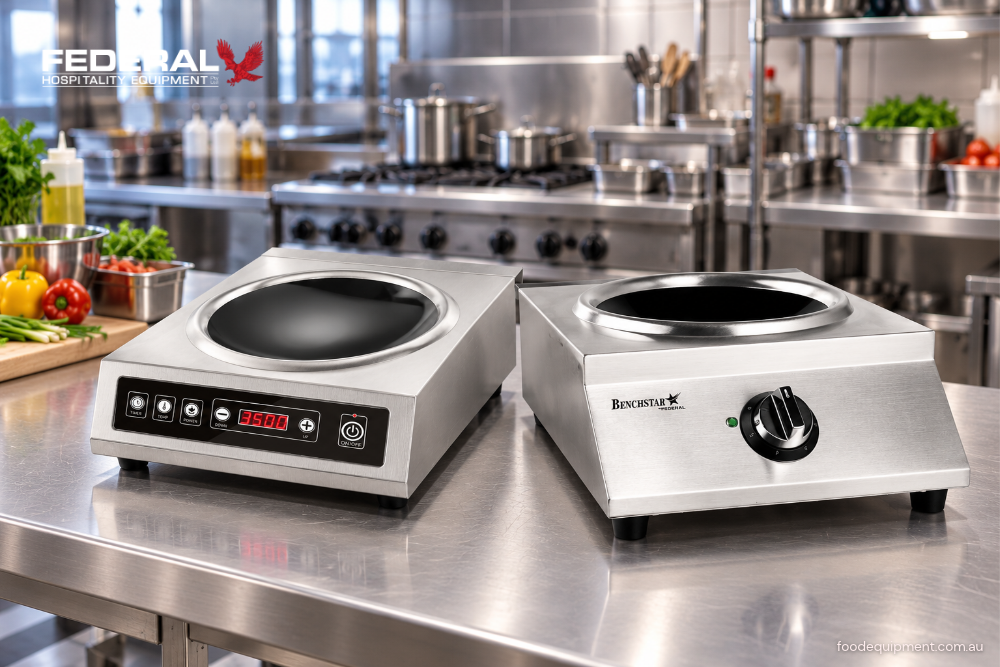
Commercial kitchens across Australia are constantly looking for practical ways to improve cooking speed, maintain consistent food quality and make better use of available workspace. Whether you operate a busy restaurant, café, hotel, catering business, takeaway shop or food truck, the equipment you choose can influence daily productivity, staff comfort and operating costs.
Commercial induction cooking equipment has become an increasingly useful option for professional kitchens that need responsive heating without relying on an open gas flame. Unlike conventional electric cooktops, which heat an element before transferring heat to cookware, induction technology uses electromagnetic energy to generate heat directly within compatible pots and pans.
This direct heating method allows chefs to adjust cooking power quickly, making induction particularly useful for boiling, simmering, preparing sauces, heating soups and handling smaller cooking tasks during busy service periods.
For Australian hospitality businesses, induction also offers practical advantages in kitchens where space is limited, temperature control is important and operators want to reduce unnecessary heat around the cooking station.
Federal Hospitality Equipment Australia supplies commercial induction cooking equipment as part of its benchtop cooking range, including induction plates, electromagnetic cookers and induction wok units. Relevant brands include Benchstar and Yasaki, with product examples such as the EIC350M-1, BH3500C, IW350 and IW500.
Commercial induction cooking equipment offers fast and responsive heating, precise power control, efficient energy transfer, less direct heat released into the surrounding kitchen, compact benchtop installation, no open gas flame and easier cleaning on suitable ceramic-glass models. These advantages make induction useful for restaurants, cafés, catering businesses and commercial kitchens that need flexible cooking capacity. However, cookware compatibility, electrical supply and production requirements must be checked before purchasing.
How Does Induction Cooking Work in a Commercial Kitchen?
Induction cooking uses electromagnetic energy to heat suitable cookware directly. When a compatible pot or pan is placed on the induction surface, the appliance generates an electromagnetic field that produces heat within the cookware.
The cookware then transfers that heat to the food or liquid being prepared.
This is different from a conventional electric cooktop, where a heating element becomes hot before transferring heat to the pan. It also differs from gas cooking, where an open flame heats the cookware.
Because induction produces heat directly within the cookware, chefs can often respond more quickly to changes in power settings.
For example, when a sauce begins to simmer too rapidly, the chef can reduce the induction power without waiting for a conventional electric element to cool down.
Induction vs Gas vs Conventional Electric Cooking
| Cooking Method | How Heat Is Produced | Key Characteristic | Typical Consideration |
|---|---|---|---|
| Gas | An open flame heats cookware | Visible flame and responsive heat adjustment | Requires suitable gas supply and ventilation |
| Conventional Electric | A heating element transfers heat to cookware | Familiar electric cooking method | Heating and cooling response depends on element design |
| Induction | Electromagnetic energy heats compatible cookware directly | Fast, responsive heating with no open flame | Requires compatible cookware and suitable electrical supply |
No single cooking method is automatically the best choice for every commercial kitchen. The right option depends on the menu, required output, available utilities, cookware, workspace and preferred cooking methods.
1. Faster and More Responsive Cooking
One of the most important benefits of commercial induction cooking equipment is its fast response to power adjustments.
Speed matters in a busy kitchen. During breakfast, lunch and dinner service, chefs may need to prepare several dishes simultaneously while maintaining consistent cooking times.
Induction equipment can help operators move between different cooking stages without waiting for a traditional heating element to become hot or cool down.
This responsiveness is particularly useful for tasks such as:
- Boiling water for food preparation.
- Heating soups and stocks.
- Preparing sauces and reductions.
- Simmering smaller batches of food.
- Cooking individual menu items.
- Reheating suitable prepared dishes.
- Managing multiple cooking tasks during busy service periods.
Why Does Fast Heat Response Matter During Service?
Commercial kitchens rely on timing. A delay at one cooking station can affect the preparation of several dishes, especially when different menu components must be ready together.
Responsive heating allows chefs to increase or reduce power quickly as cooking requirements change.
For example, a restaurant preparing sauces to order may need rapid initial heating followed by controlled simmering. An induction cooker can provide both functions within a compact cooking station.
Actual cooking speed still depends on the appliance's power rating, cookware, food quantity and cooking technique.
2. Precise Temperature and Power Control
Consistent food preparation is essential in professional kitchens. Customers expect the same dish to be prepared to a similar standard each time they order it.
Commercial induction equipment allows chefs to adjust heating power or select temperature settings, depending on the model.
This makes it easier to respond to different cooking requirements without relying on a continuously exposed flame or a slower-reacting traditional electric element.
Federal Hospitality Equipment Australia's range includes induction equipment with adjustable heating controls.
For example, the BH3500C electromagnetic cooker and IW350 induction wok are listed with temperature settings ranging from 60°C to 240°C.
These controls can be useful when switching between gentle heating and higher-temperature cooking tasks.
| Kitchen Task | How Induction Can Help |
|---|---|
| Sauce preparation | Allows responsive adjustment during heating and simmering |
| Soup preparation | Supports controlled heating of suitable pots |
| Boiling | Provides rapid heat application with appropriate cookware |
| Wok cooking | Allows quick changes in heating power |
| Small-batch cooking | Provides a compact and controllable cooking station |
| Menu preparation | Supports repeatable cooking procedures when used consistently |
Does Induction Maintain an Exact Pan Temperature?
Some induction cookers display temperature settings, but the selected temperature should not automatically be treated as an exact measurement of the food or cookware temperature.
Actual temperatures can vary according to the appliance, pan material, cookware dimensions and cooking conditions.
For food safety and recipes requiring accurate temperatures, use appropriate food thermometers and follow established kitchen procedures.
3. Better Energy Use and Efficient Heat Transfer
Energy efficiency is an important consideration for Australian hospitality businesses, particularly those operating cooking equipment for extended periods.
Induction technology transfers energy directly into compatible cookware rather than first heating an exposed flame or conventional heating element.
As a result, less energy may be lost to the surrounding environment during suitable cooking tasks.
This can make induction a practical option for kitchens looking to use energy more efficiently.
However, energy savings should not be treated as guaranteed. Actual consumption depends on:
- The induction cooker's rated power.
- How long the appliance operates.
- The selected power setting.
- The size and material of the cookware.
- The quantity of food being prepared.
- The cooking method.
- How frequently the equipment is used.
- The business's electricity tariff.
Does Induction Cooking Reduce Electricity Bills?
Induction can offer efficient energy transfer, but lower electricity bills are not guaranteed in every kitchen.
A commercial kitchen should compare the energy used for its actual cooking tasks rather than relying only on an appliance's advertised efficiency.
For example, a compact induction plate used for occasional sauce preparation may have different operating costs from a high-powered induction wok operating continuously during service.
The most useful comparison considers cooking time, power consumption, output and the business's electricity charges.
4. A Cooler and More Comfortable Working Environment
Commercial kitchens can become extremely hot, particularly during Australian summer months or when several cooking appliances operate simultaneously.
Gas burners and conventional electric heating systems release heat into the surrounding cooking area.
Induction cooking generates heat directly within compatible cookware, reducing the need for an exposed flame or continuously heated element.
This can help reduce unnecessary heat around the cooking station and may contribute to a more comfortable working environment.
Why Does Kitchen Heat Matter?
Excessive heat can make commercial kitchen work physically demanding, particularly during long service periods.
High kitchen temperatures may also place additional demands on ventilation and air-conditioning systems.
By concentrating heating into cookware, induction can be useful in kitchens where reducing surrounding heat is a priority.
However, the cookware and food still become hot, and cooking processes can produce steam, smoke and grease-laden vapours.
Commercial ventilation and extraction requirements still apply where relevant.
5. Compact Benchtop Design and Better Space Utilisation
Kitchen space is valuable, especially in smaller cafés, takeaway shops, food trucks and catering operations.
Not every venue has room for a large commercial cooking range or an additional full-size cooking line.
Compact induction equipment can provide a practical cooking station on a suitable benchtop.
This allows operators to add heating capacity without necessarily installing another large floor-standing appliance.
Federal Hospitality Equipment Australia's induction range includes compact commercial models designed for benchtop applications.
Benchstar EIC350M-1 Commercial Induction Plate
The Benchstar EIC350M-1 is a compact commercial induction cooker with a heat-resistant ceramic-glass plate.
Its published specifications include:
- Dimensions of 339 × 430 × 119 mm.
- 240V electrical supply.
- 3.5kW rated power.
- 15A electrical requirement.
- Adjustable power from 500W to 3500W.
- Single-knob control.
- Electronic overheating protection.
- Compatibility with suitable flat-bottom induction cookware.
Its compact footprint makes it relevant for commercial kitchens requiring supplementary cooking capacity.
BH3500C Electromagnetic Cooker
The BH3500C is another compact commercial induction cooking option.
Published specifications include:
- Dimensions of 327 × 420 × 100 mm.
- 240V electrical supply.
- 3.5kW rated power.
- 15A electrical requirement.
- Temperature setting range of 60°C to 240°C.
This model can be considered for controlled benchtop cooking applications where available space is limited.
Why Is Benchtop Induction Useful for Smaller Kitchens?
A compact induction cooker may provide additional cooking capacity for a café preparing sauces, a restaurant needing a supplementary station or a catering business handling smaller batches.
It can also help separate particular cooking tasks from the main production line.
Before installation, confirm the required bench strength, ventilation clearance, electrical supply and safe working space around the appliance.
6. Fewer Open-Flame Concerns
Induction cooking does not rely on an open gas flame.
This can be useful in busy commercial preparation areas where operators want to reduce the presence of exposed flames.
Induction also avoids the need for a gas connection at the individual cooking station.
Some commercial induction models include additional safety features such as:
- Electronic overheating protection.
- Dry-heating protection.
- Cookware detection.
- Automatic shut-off functions.
- Temperature or power controls.
These features vary between products and should be confirmed against the individual manufacturer's specifications.
Is Induction Cooking Completely Safe?
No cooking equipment is completely risk-free.
Although induction does not use an open flame, cookware can become extremely hot, hot food can spill, and ceramic-glass surfaces may retain heat after use.
Staff should follow the manufacturer's operating instructions, use suitable cookware and maintain appropriate workplace safety procedures.
7. Easier Surface Cleaning and Daily Maintenance
Cleaning is an important part of commercial kitchen operations. Equipment that is difficult to clean can add unnecessary labour to already demanding service routines.
Many induction cookers feature smooth ceramic-glass surfaces without exposed gas burners, trivets or multiple removable burner components.
This can make routine wiping and cleaning more straightforward.
For example, a benchtop induction plate with a flat ceramic-glass surface can generally be cleaned without dismantling burner assemblies.
However, staff should still follow the manufacturer's cleaning instructions and avoid using unsuitable abrasive products that could damage the surface.
How Should Commercial Induction Equipment Be Cleaned?
Good cleaning practices include:
- Switching off the appliance before cleaning.
- Allowing the surface to cool as instructed.
- Removing spills using approved cleaning methods.
- Avoiding abrasive materials that could scratch ceramic glass.
- Keeping ventilation openings free from obstruction.
- Checking the appliance for visible damage.
- Following the manufacturer's maintenance recommendations.
Routine cleaning helps maintain the appliance's condition and keeps the cooking station ready for service.
What Commercial Induction Cooking Brands Does Federal Hospitality Equipment Australia Offer?
Federal Hospitality Equipment Australia's induction cooking range includes products associated with Benchstar and Yasaki.
The available equipment covers general-purpose benchtop induction cooking and specialised induction wok applications.
Benchstar Commercial Induction Cooking Equipment
Benchstar is represented by the EIC350M-1 commercial induction plate, which features adjustable power settings and a heat-resistant ceramic-glass cooking surface.
It is relevant for operators seeking compact, controllable electric cooking equipment for suitable pots and pans.
Yasaki Commercial Induction Cooking Equipment
Yasaki has been featured in Federal Hospitality Equipment Australia's published induction cooking range, including benchtop induction and induction wok equipment.
Relevant model references include the EIC350M-1, IW350 and IW500 in Federal's promotional material. Brand and model availability should be checked against the current product listing before purchase.
The important consideration is choosing equipment that suits the intended cooking task, electrical infrastructure and cookware requirements rather than selecting by brand name alone.
Which Commercial Induction Cooking Models Are Available?
Federal Hospitality Equipment Australia's published induction range includes several models suited to different cooking applications.
| Model | Equipment Type | Key Specification | Potential Application |
|---|---|---|---|
| EIC350M-1 | Commercial induction plate | 500–3500W adjustable power; ceramic-glass plate | General benchtop cooking |
| BH3500C | Electromagnetic cooker | 60–240°C setting range | Controlled heating and small-batch preparation |
| IW350 | Commercial induction wok | 3.5kW; 60–240°C setting range | Wok-based food preparation |
| IW500 | Higher-powered induction wok | 5kW; 415V three-phase supply | Higher-powered wok cooking |
These examples show why induction equipment should be selected according to its intended application. A general-purpose induction plate and a dedicated induction wok are designed for different cookware and cooking methods.
What Is the Difference Between an Induction Plate and an Induction Wok?
A commercial induction plate is generally designed for compatible flat-bottom cookware, while an induction wok cooker is designed for a suitable wok and its corresponding cooking surface.
Induction plates can be useful for:
- Heating sauces.
- Boiling liquids.
- Preparing soups.
- Cooking smaller portions.
- Supplementary kitchen preparation.
Induction wok equipment is intended for wok-based cooking applications where the cookware and appliance are designed to work together.
Before purchasing an induction wok, check that the chosen wok is compatible with the specific model.
What Are the Benefits of Commercial Induction Wok Cooking?
Wok cooking often requires responsive heating because ingredients are added and moved quickly during preparation.
Commercial induction woks can provide controlled electric heating without an open gas flame.
Federal Hospitality Equipment Australia's published range includes the IW350 and IW500 induction wok models.
IW350 Commercial Induction Wok
The IW350 is a 3.5kW commercial induction wok with a published temperature setting range of 60°C to 240°C.
Its listed dimensions are approximately 340 × 430 × 135 mm, with a 240V, 15A electrical requirement.
This makes it relevant for businesses seeking a compact induction wok station.
IW500 Commercial Induction Wok
The IW500 is a higher-powered induction wok with a 5kW rating and 415V three-phase electrical requirement.
It is intended for applications where the additional power and suitable electrical infrastructure are available.
Because it requires three-phase hard wiring, installation planning is particularly important.
Do Commercial Induction Woks Need Special Cookware?
Yes. Induction wok equipment must be used with compatible cookware designed for the appliance.
Federal Hospitality Equipment Australia also lists induction-ready stainless-steel wok accessories, including 360mm models.
Relevant product references include:
- IW-Wok36: 360mm induction-ready stainless-steel wok.
- IW-WokLid36: 360mm induction-ready stainless-steel wok with lid.
Always confirm compatibility between the wok and the selected induction cooking unit.
What Cookware Works with Commercial Induction Equipment?
Induction equipment requires cookware with suitable magnetic properties.
Common compatible materials can include:
- Cast iron.
- Magnetic stainless steel.
- Enamelled iron.
- Suitable induction-ready steel cookware.
Not every stainless-steel pan is induction-compatible, and ordinary aluminium, copper or glass cookware may not work unless specifically designed for induction.
How Can You Check Whether a Pan Is Induction-Compatible?
Look for the induction-compatible symbol or manufacturer's cookware specifications.
A simple preliminary check is whether a magnet attaches firmly to the cookware base. However, this does not replace checking the appliance's stated cookware requirements.
For example, the Benchstar EIC350M-1 specifies compatible flat-bottom cookware within a particular base-diameter range.
Is Induction Cooking Suitable for Every Commercial Kitchen?
Induction offers several practical advantages, but it is not automatically suitable for every cooking application.
The best choice depends on the kitchen's menu, production requirements, cookware, available power and installation space.
For example, a café needing a supplementary heating station may benefit from a compact benchtop induction plate. A restaurant preparing frequent wok dishes may require a dedicated induction wok.
A high-volume kitchen may need multiple cooking zones or larger equipment rather than relying on one compact induction cooker.
What Electrical Supply Does Commercial Induction Equipment Need?
Electrical requirements are especially important when selecting commercial induction equipment.
Some compact commercial induction models use 240V electrical supply but still require a dedicated 15A connection.
Higher-powered equipment may require three-phase electricity and professional hard wiring.
| Model | Voltage | Rated Power | Electrical Requirement |
|---|---|---|---|
| EIC350M-1 | 240V | 3.5kW | 15A |
| BH3500C | 240V | 3.5kW | 15A |
| IW350 | 240V | 3.5kW | 15A |
| IW500 | 415V | 5kW | Three-phase hard wiring |
These are published model specifications and should be reconfirmed before purchase and installation.
A standard domestic-style power outlet should not be assumed suitable for a 15A commercial appliance.
Where electrical work is required, consult a licensed electrician to confirm the available circuit capacity and applicable installation requirements.
Can Induction Cooking Equipment Be Used in a Food Truck?
Compact induction cooking equipment may be suitable for some food trucks and mobile catering operations.
Its benchtop design and lack of an open gas flame can be useful where space is limited.
However, the available electrical supply must be capable of supporting the appliance's power requirements.
Food truck operators should also consider:
- Generator or external power capacity.
- Other appliances operating simultaneously.
- Bench stability.
- Ventilation requirements.
- Cookware compatibility.
- Available preparation space.
- Safe equipment installation.
Induction should be selected only after confirming that the mobile kitchen can safely support the electrical load.
Is Induction Cooking Suitable for Restaurants?
Yes. Induction can be useful in restaurants that require responsive heating, compact supplementary cooking stations or controlled preparation of smaller menu components.
Potential applications include sauce preparation, stock heating, boiling and selected wok-based cooking tasks.
Restaurants should consider whether induction will serve as the primary cooking method or complement existing gas and electric equipment.
Is Induction Cooking Suitable for Cafés?
Commercial induction cooking can be particularly relevant for cafés with limited kitchen space.
A compact induction cooker may support:
- Soup preparation.
- Sauce heating.
- Small-batch cooking.
- Breakfast preparation.
- Supplementary heating tasks.
Its compact design can provide additional flexibility without necessarily requiring a full-size cooking range.
Is Induction Cooking Suitable for Catering Businesses?
Catering businesses often need flexible cooking arrangements that can accommodate different menus and preparation volumes.
Portable benchtop induction equipment may be useful for suitable preparation tasks, provided the site has adequate electrical supply and safe installation conditions.
It can also help create supplementary cooking stations during larger preparation periods.
However, equipment capacity must still match the quantity of food being prepared.
Is Induction Cooking Suitable for Hotels?
Hotels may benefit from induction equipment in smaller preparation areas, supplementary cooking stations or kitchens where controlled heating is important.
For example, a hotel kitchen may use a compact induction plate for sauces or smaller batches while retaining larger equipment for its main production line.
The suitability of induction depends on the hotel's menu, service volume and kitchen infrastructure.
Can Induction Replace Gas Cooking Completely?
Induction can replace gas for many suitable cooking tasks, but complete replacement is not always practical or necessary.
Some commercial kitchens use induction alongside existing gas or electric cooking equipment.
This approach allows operators to select the most suitable heating method for each application.
Before replacing gas equipment, consider cookware compatibility, cooking techniques, production volume, electrical infrastructure and installation costs.
How Do You Choose the Right Commercial Induction Cooker?
Choosing the right induction equipment requires more than comparing wattage or purchase price.
Start by identifying the cooking tasks the appliance will perform.
1. Identify the Intended Cooking Application
Determine whether the equipment will be used for boiling, simmering, sauce preparation, wok cooking or general benchtop heating.
2. Check the Required Power
Compare the rated power with the quantity of food being prepared and the required cooking speed.
3. Confirm Electrical Compatibility
Check whether the model requires 15A power or three-phase hard wiring.
4. Check Cookware Compatibility
Ensure existing pots, pans or woks are suitable for the appliance.
5. Measure Available Bench Space
Allow for the appliance dimensions, required clearances and safe working space.
6. Compare Temperature and Power Controls
Choose a model with controls suited to the intended cooking tasks.
7. Review Safety Features
Check the manufacturer's information for overheating protection, pan detection and other model-specific features.
8. Consider Cleaning Requirements
Review the cooking surface, accessible components and cleaning instructions.
9. Check Warranty and Service Support
Consider product warranty, spare parts and suitable service arrangements.
10. Match the Equipment to Production Volume
A compact cooker may be suitable for supplementary cooking but insufficient for a high-volume primary cooking station.
What Are the Common Mistakes When Buying Commercial Induction Equipment?
Choosing Equipment Without Checking Electrical Supply
A 3.5kW induction cooker may require a 15A connection, while a higher-powered wok may require three-phase power.
Assuming All Cookware Is Compatible
Induction requires suitable cookware. Existing pans may need to be checked or replaced.
Buying Only According to Wattage
Power is important, but cookware, controls, cooking surface and intended application also matter.
Ignoring Production Requirements
A compact induction plate may not provide enough capacity for a high-volume cooking operation.
Overlooking Bench Space and Ventilation
Equipment must be installed with suitable clearances and airflow.
Assuming Induction Requires No Safety Procedures
Cookware and food still become hot, and safe commercial kitchen procedures remain essential.
Expecting Guaranteed Energy Savings
Energy use depends on the appliance, cookware, operating time and cooking workload.
Choosing the Wrong Wok
Dedicated induction wok equipment requires compatible cookware designed for the appliance.
Commercial Induction Cooking Equipment Buying Checklist
- What cooking tasks will the appliance perform?
- Will it be used as primary or supplementary equipment?
- Is a flat induction plate or induction wok required?
- What power rating is appropriate?
- Is a 15A electrical connection available?
- Does the selected model require three-phase power?
- Is the existing cookware induction-compatible?
- Are special induction woks required?
- Does the appliance fit the available bench space?
- Are suitable ventilation clearances available?
- Are the controls appropriate for the intended cooking tasks?
- Does the model offer the required temperature or power range?
- What safety features are included?
- How easy is the cooking surface to clean?
- What warranty applies?
- Are service and spare parts available?
- Does the equipment suit expected production volume?
- Will it improve the kitchen's existing workflow?
Why Buy Commercial Induction Cooking Equipment from Federal Hospitality Equipment Australia?
Federal Hospitality Equipment Australia supplies commercial cooking equipment for Australian restaurants, cafés, hotels, takeaway businesses, catering operations and other hospitality venues.
Its benchtop induction cooking range includes compact induction plates and dedicated induction wok equipment, with relevant products associated with Benchstar and Yasaki.
Examples include the EIC350M-1 commercial induction plate, BH3500C electromagnetic cooker, IW350 induction wok and higher-powered IW500 induction wok.
These products provide different options for businesses considering controlled electric heating, supplementary cooking capacity and compact kitchen equipment.
When comparing models, review the individual product specifications, cookware requirements and available electrical supply.
Explore the commercial induction cooking equipment range at Federal Hospitality Equipment Australia.
Conclusion: Are Commercial Induction Cookers Worth Considering?
Commercial induction cooking equipment offers several practical benefits for Australian hospitality kitchens.
Its direct heating method provides fast and responsive cooking, while adjustable power settings can help chefs manage different preparation tasks more effectively.
Induction can also offer efficient energy transfer, reduce unnecessary heat around the cooking station and provide a compact alternative where available kitchen space is limited.
The absence of an open gas flame and the smooth ceramic-glass surfaces found on many models can provide additional advantages for suitable commercial applications.
However, induction is not automatically the right choice for every kitchen. The equipment must be matched to the menu, cookware, electrical infrastructure, available space and required production volume.
Federal Hospitality Equipment Australia's published induction range includes options such as the Benchstar EIC350M-1, BH3500C, IW350 and IW500, with relevant induction equipment also represented under the Yasaki brand.
For cafés, restaurants, catering businesses, hotels and takeaway venues seeking greater cooking flexibility, induction can be a valuable addition to a well-planned commercial kitchen.
Frequently Asked Questions
What are the benefits of induction cooking equipment in commercial kitchens?
Commercial induction equipment offers fast heating response, precise power adjustment, efficient heat transfer, reduced surrounding heat, compact benchtop design, no open gas flame and easier cleaning on suitable models.
How does commercial induction cooking work?
Induction uses electromagnetic energy to generate heat directly within compatible cookware rather than heating a conventional element or using an open flame.
Is induction cooking faster than conventional electric cooking?
Induction often provides faster heat response because compatible cookware is heated directly. Actual cooking speed depends on the appliance, cookware and cooking task.
Is induction better than gas for commercial kitchens?
Induction can offer responsive heating, efficient energy transfer and no open flame. Gas may still suit certain cooking methods and kitchen configurations. The better option depends on the application.
Does induction cooking save energy?
Induction can transfer energy efficiently into cookware, but actual energy savings depend on the equipment, power setting, cookware, cooking time and electricity costs.
Does induction cooking reduce kitchen heat?
Induction can reduce unnecessary heat released around the cooking station because it heats compatible cookware directly. Cooking still produces heat, steam and vapours.
Does induction cooking require ventilation?
Ventilation may still be required because cooking processes can produce steam, smoke, heat and grease-laden vapours.
Is induction cooking safer than gas?
Induction does not use an open gas flame, which can reduce some flame-related concerns. However, hot cookware, spills and electrical equipment still require appropriate safety procedures.
Is commercial induction equipment easy to clean?
Many models feature smooth ceramic-glass surfaces that are relatively straightforward to wipe down. Always follow the manufacturer's cleaning instructions.
What cookware works with commercial induction cookers?
Compatible cookware generally includes suitable cast iron, magnetic stainless steel and induction-ready steel or enamelled iron products.
Can ordinary stainless-steel pans be used on induction?
Some stainless-steel cookware is compatible, but not all. Check the induction symbol or manufacturer's specifications.
Can aluminium cookware be used on induction?
Ordinary aluminium cookware is generally unsuitable unless it has an induction-compatible base or construction.
What is a commercial benchtop induction cooker?
It is a compact commercial appliance designed to heat compatible cookware using electromagnetic energy on a suitable benchtop.
What is the Benchstar EIC350M-1?
The Benchstar EIC350M-1 is a 3.5kW commercial induction plate with adjustable power from 500W to 3500W and a heat-resistant ceramic-glass cooking surface.
What is the BH3500C electromagnetic cooker?
The BH3500C is a compact 3.5kW commercial induction cooker with a published temperature setting range of 60°C to 240°C.
What is the IW350 induction wok?
The IW350 is a 3.5kW commercial induction wok with a published temperature setting range of 60°C to 240°C.
What is the IW500 induction wok?
The IW500 is a higher-powered 5kW commercial induction wok requiring a 415V three-phase electrical supply.
What is the difference between an induction plate and induction wok?
An induction plate is generally designed for suitable flat-bottom cookware, while a dedicated induction wok is designed for compatible wok cookware and wok-based cooking.
Does an induction wok need a special wok?
Yes. Dedicated induction wok equipment requires compatible cookware designed for the appliance.
Does Federal Hospitality Equipment Australia sell induction-ready woks?
Federal's published range includes 360mm induction-ready stainless-steel wok accessories, including models with and without lids.
Do commercial induction cookers need 15A power?
Some commercial models, including the EIC350M-1, BH3500C and IW350, have published 15A electrical requirements. Always check the individual product specifications.
Do commercial induction woks need three-phase power?
Some higher-powered models do. The IW500 is listed with a 415V three-phase hard-wiring requirement.
Can commercial induction equipment be used in cafés?
Yes. Compact induction equipment can suit cafés requiring supplementary heating for soups, sauces and smaller cooking tasks.
Can commercial induction equipment be used in restaurants?
Yes. Restaurants may use induction for controlled preparation, boiling, sauce heating and suitable wok-based cooking.
Is induction cooking suitable for food trucks?
It can be suitable where the vehicle has adequate electrical capacity, safe installation conditions and appropriate ventilation.
Can induction replace a commercial gas cooktop?
Induction can replace gas for many suitable cooking tasks, but the decision depends on the menu, cookware, production volume and electrical infrastructure.
Which induction cooking brands are relevant at Federal Hospitality Equipment Australia?
Relevant brands in Federal's published induction cooking material include Benchstar and Yasaki. Confirm current branding and model availability when selecting equipment.
How do I choose the right commercial induction cooker?
Compare cooking applications, power rating, electrical requirements, cookware compatibility, temperature or power controls, dimensions, safety features, cleaning requirements and production volume.
Where can I buy commercial induction cooking equipment in Australia?
Federal Hospitality Equipment Australia offers commercial induction cooking equipment, including benchtop induction plates and induction wok models for suitable hospitality applications.