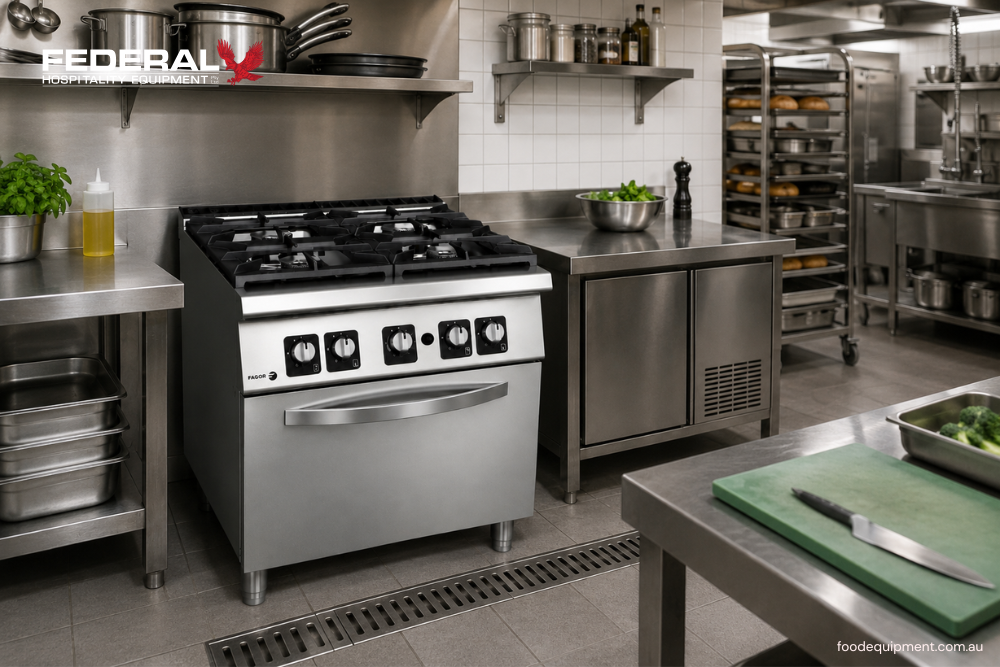
A successful commercial kitchen depends on much more than experienced chefs and a well-designed menu. The cooking equipment installed behind the scenes directly affects service speed, food consistency, staff workflow, energy consumption, maintenance costs, safety, and the kitchen’s ability to perform during peak trading periods.
Across Australia, restaurants, hotels, cafés, clubs, catering businesses, healthcare facilities, educational kitchens, and institutional foodservice operations are under increasing pressure to produce more with limited labour while controlling utility costs and meeting strict safety requirements. In this environment, choosing heavy-duty cooking equipment is not simply a purchasing decision. It is a long-term operational investment.
The Fagor 900 Kore Series is designed for professional kitchens that require durability, high output, modular flexibility, and reliable performance. With a 900mm-depth format and a broad selection of cooking appliances, the range allows businesses to create a coordinated cooking line suited to their menu, production volume, kitchen footprint, and future growth plans.
For Federal Hospitality Equipment Australia customers, the value of the Fagor 900 Kore Series is not limited to individual features. Its strongest advantage is the way its construction, burner performance, modular design, safety systems, and energy-efficient engineering work together to support demanding commercial operations.
What Is the Fagor 900 Kore Series?
The Fagor 900 Kore Series is a range of heavy-duty commercial cooking equipment designed for professional foodservice environments. The range uses a 900mm-depth format, a common footprint for high-output commercial kitchen suites, allowing appliances to be installed as individual units or combined into a coordinated cooking line.
The series includes cooking equipment such as:
- Gas cooktops and ranges.
- Electric cooktops.
- Commercial ovens.
- Fryers.
- Griddles.
- Bratt pans.
- Boiling pans.
- Modular work units.
- Specialised cooking appliances.
This modular approach allows operators to build a cooking suite around their actual production needs instead of adapting their workflow to a fixed equipment package. A hotel kitchen may require multiple high-output burners, a griddle, fryer, and oven, while a catering operation may prioritise bratt pans, bulk-cooking equipment, and flexible preparation space.
What Are the Main Reasons Australian Businesses Choose the Fagor 900 Kore Series?
| Key Feature | Why It Matters? | Commercial Benefit |
|---|---|---|
| 304-grade stainless steel | Provides stronger resistance to corrosion, rust, moisture, and intensive cleaning. | Supports durability and longer service life. |
| 900mm-depth format | Provides the footprint and working depth required for heavy-duty production. | Supports larger cookware and high-volume cooking. |
| High-output burners | Selected burners can deliver up to approximately 6.5kW. | Faster heating, boiling, and temperature recovery. |
| Oven temperatures up to 300°C | Offers a broader cooking range than many entry-level ovens. | Improved versatility for roasting and baking. |
| Fully modular design | Allows individual appliances to be combined into a customised line. | Supports workflow planning and future expansion. |
| Energy-efficient engineering | Improved burner design and insulation can reduce heat loss. | May lower long-term utility costs. |
| Flame failure protection | Automatically interrupts gas flow if the flame is unexpectedly extinguished. | Supports safer operation. |
| AGA-approved gas models | Supports compliance with applicable Australian gas-appliance requirements. | Provides greater confidence during specification and installation. |
Why Is 304-Grade Stainless Steel Important in a Commercial Kitchen?
The quality of stainless steel affects how well cooking equipment handles moisture, salt, grease, cleaning chemicals, heat, impact, and continuous daily use. The Fagor 900 Kore Series is manufactured using 304-grade stainless steel, which generally contains more nickel than 430-grade stainless steel and offers stronger corrosion resistance.
This matters in commercial kitchens because surfaces are exposed to:
- Steam and condensation.
- Food acids.
- Salt and brines.
- Grease and cooking residues.
- Frequent washing.
- Commercial cleaning products.
- High heat.
- Physical impact from cookware and utensils.
For hospitality businesses operating near Australian coastal areas, corrosion resistance becomes especially important. Humidity and salt-laden air can accelerate deterioration in lower-grade metals. Equipment built from 304-grade stainless steel can offer stronger long-term protection in these environments.
How Does the Fagor 900 Kore Series Compare with Standard Commercial Equipment?
| Feature | Fagor 900 Kore Series | Typical Standard Equipment | Operational Difference |
|---|---|---|---|
| Gas burner output | Up to approximately 6.5kW on selected models. | Often around 4–5kW. | Faster heating and improved recovery. |
| Maximum oven temperature | Up to approximately 300°C. | Often around 250–270°C. | Greater cooking flexibility. |
| Construction | 304-grade stainless steel. | May use 430-grade stainless steel or mixed construction. | Improved corrosion resistance. |
| Configuration | Fully modular. | May offer limited modularity. | Easier kitchen expansion and reconfiguration. |
| Safety systems | Flame failure device on gas appliances. | May vary by model. | Stronger gas safety support. |
| Target operating environment | Medium- and high-volume professional kitchens. | May be intended for lighter-duty operation. | Better suited to sustained production. |
How Do High-Output Burners Improve Kitchen Productivity?
Burner output affects how quickly cookware heats, how efficiently liquids reach boiling point, and how rapidly the cooking surface recovers after food is added. In a high-volume kitchen, these differences can accumulate across hundreds of orders.
Higher-output burners can assist with:
- Faster boiling of large stock pots.
- Quicker sautéing and searing.
- Improved recovery after cold ingredients are added.
- More consistent results during peak periods.
- Reduced waiting between cooking stages.
- Higher hourly production capacity.
Selected models, such as the Fagor C-G941 gas range, combine strong burner output with heavy-duty construction for kitchens requiring continuous cooking performance. Buyers can obtain further information from the top Fagor 900 Kore Series suppliers and manufacturers near them.
Why Does Heat Recovery Matter During Peak Service?
Heat recovery describes how quickly an appliance returns to its target temperature after a load is introduced. When cold ingredients are placed into a pan, fryer, oven, or onto a griddle, the cooking surface loses heat. Equipment with slow recovery can lead to longer cooking times and inconsistent food quality.
| Slow Recovery Can Cause | Strong Recovery Can Support |
|---|---|
| Longer ticket times. | Faster service. |
| Uneven browning. | More consistent colour. |
| Reduced searing performance. | Stronger caramelisation and texture. |
| Lower hourly output. | Higher production capacity. |
| Greater staff pressure. | Smoother workflow during rush periods. |
For restaurants, clubs, hotels, and institutional kitchens regularly serving large numbers of customers within short meal periods, recovery performance can be more important than the appliance’s advertised maximum temperature.
How Does the 300°C Oven Capability Improve Menu Flexibility?
Selected ovens within the Fagor 900 Kore Series can reach temperatures of up to approximately 300°C. This gives chefs greater flexibility across different cooking processes, including roasting, finishing, baking, and high-temperature production.
A broader temperature range can support:
- Faster roasting.
- High-temperature finishing.
- Improved browning.
- Different bakery and pastry applications.
- Menu diversification.
- Greater control over production schedules.
Insulated oven cavities also help retain heat and reduce unnecessary energy loss. This can improve temperature stability while reducing how frequently heating elements or burners need to cycle.
How Does Modular Design Support Better Kitchen Planning?
The modular structure of the Fagor 900 Kore Series allows operators to select individual appliances and arrange them in a way that supports production flow. Rather than purchasing a fixed suite, the kitchen can be built around its actual menu and operational needs.
A modular cooking line might combine:
- A gas range.
- A smooth or ribbed griddle.
- A fryer.
- A boiling pan.
- A bratt pan.
- An oven.
- A neutral work module.
This flexibility allows restaurants and institutions to place related appliances together. For example, a grill, fryer, and finishing station may be positioned in sequence, reducing unnecessary staff movement and making the line easier to manage during peak service.
How Can Modular Equipment Reduce Future Capital Expenditure?
Hospitality businesses often change their menu, service volume, seating capacity, or production methods over time. A fixed cooking suite may become restrictive if the business expands or introduces new menu categories.
Modular equipment allows an operator to add or replace individual units without necessarily rebuilding the entire cooking line. This can reduce the cost and disruption associated with future upgrades.
| Business Change | Possible Modular Response |
|---|---|
| Higher fried-food demand | Add or upgrade fryer capacity. |
| Expanded grilled menu | Add a larger or additional griddle. |
| More bulk production | Add a bratt pan or boiling pan. |
| Increased oven use | Expand oven capacity. |
| Revised kitchen workflow | Rearrange individual modules during a refurbishment. |
| New venue concept | Reuse suitable modules in a redesigned line. |
How Does the Fagor 900 Kore Series Improve Staff Workflow?
Kitchen productivity is influenced by how many steps staff take, how easily they can access equipment, and whether the cooking line follows the sequence of the menu.
A well-planned modular suite can support a workflow such as:
- Ingredient preparation.
- Primary cooking.
- Frying or grilling.
- Finishing.
- Plating.
- Pass and service.
Positioning appliances in sequence reduces crossing, congestion, and repeated movement. It can also help separate incompatible tasks, improve communication, and create clearer responsibility across the cooking line.
How Can the Fagor 900 Kore Series Reduce Operating Costs?
Energy-efficient cooking equipment can reduce utility use across its working life. This is increasingly important for Australian hospitality businesses facing rising gas and electricity expenses.
| Equipment Type | Efficiency Feature | Potential Operational Benefit |
|---|---|---|
| Gas range | High-efficiency burner design. | May reduce gas consumption while maintaining strong output. |
| Electric oven | Insulated cooking cavity. | Reduces heat loss and unnecessary cycling. |
| Griddle | Rapid heat-up technology. | Shorter preheating and reduced idle energy. |
| Modular line | Equipment selected for actual menu demand. | Reduces the need to operate unnecessary appliances. |
| Heavy-duty construction | Longer service potential. | May reduce replacement frequency. |
The source material indicates that selected efficient gas-range configurations may offer gas-use reductions of approximately 15–20% compared with less efficient alternatives, though actual results depend on the appliance, operating pattern, maintenance, cookware, ventilation, and staff practices.
What Is the Difference Between Purchase Price and Total Ownership Cost?
The initial equipment price is only one part of the investment. Businesses should also consider installation, energy, maintenance, repairs, downtime, cleaning labour, service life, and future expansion.
| Ownership Cost | What It Includes? |
|---|---|
| Purchase | Equipment price and optional accessories. |
| Delivery | Freight, lifting, and site access requirements. |
| Installation | Gas, electrical, ventilation, positioning, and commissioning. |
| Energy | Gas or electricity consumed throughout the appliance’s life. |
| Maintenance | Cleaning, calibration, servicing, and replacement parts. |
| Downtime | Lost production or reduced menu capacity during faults. |
| Replacement | Future cost when equipment reaches the end of its service life. |
| Expansion | Cost of modifying or extending the cooking line. |
Why Are Australian Gas Certifications Important?
Gas appliances used in commercial kitchens must be appropriately certified and installed according to applicable Australian requirements. Gas models within the Fagor 900 Kore Series are described as carrying Australian Gas Association approval, supporting specification for the Australian market.
Installation should also consider requirements under AS/NZS 5601, which governs gas installations and appliance safety.
Qualified installation is important because it helps confirm:
- Correct gas type.
- Suitable gas pressure.
- Safe appliance connection.
- Appropriate ventilation.
- Required clearances.
- Safe shut-off access.
- Correct commissioning.
How Does a Flame Failure Device Improve Safety?
A flame failure device monitors whether the burner flame remains active. If the flame is unexpectedly extinguished, the device interrupts the gas supply to reduce the risk of uncontrolled gas flow.
This feature is especially valuable in busy kitchens where flames may be affected by spills, draughts, cleaning, or accidental interruption.
Safety devices should still be checked during scheduled servicing. No safety component should be assumed to function indefinitely without inspection and maintenance.
Who Is the Fagor 900 Kore Series Best Suited For?
| Business Type | Why the Series May Suit It? |
|---|---|
| Busy restaurants | Supports sustained cooking volume and flexible menu production. |
| Hotels | Suitable for breakfast, banqueting, room service, and restaurant operations. |
| Clubs and pubs | Helps manage high-volume service and broad menus. |
| Catering facilities | Supports batch production and varied event requirements. |
| Hospitals | Provides durable equipment for structured, high-volume meal production. |
| Educational institutions | Suitable for canteens, boarding facilities, and campus foodservice. |
| Large cafés | Supports expanded hot-food menus and sustained service. |
| Central production kitchens | Provides modular capacity for bulk preparation and distribution. |
Products offered by leading Fagor 900 Kore Series dealers and distributors are generally best suited to medium- and high-volume operations where equipment durability and continuous production are priorities.
Is the Fagor 900 Kore Series Suitable for Smaller Kitchens?
The modular design allows operators to select only the appliances required for their menu, which can make the range suitable for some smaller professional kitchens. However, the 900mm-depth format is designed for heavy-duty operation and may require more space than lighter-duty equipment.
Before purchasing, check:
- Available floor area.
- Cook-line depth.
- Staff circulation space.
- Door and corridor access.
- Ventilation capacity.
- Gas and electrical connections.
- Service access.
How Does the Fagor 900 Kore Series Compare with the Fagor 700 Kore Series?
The Fagor 700 Kore Series and Fagor 900 Kore Series both provide modular professional cooking solutions, but they are designed for different kitchen scales and production requirements.
| Consideration | Fagor 700 Kore Series | Fagor 900 Kore Series |
|---|---|---|
| Depth | More compact format. | Deeper 900mm heavy-duty format. |
| Best suited for | Smaller to medium commercial kitchens. | Medium- to high-volume professional kitchens. |
| Cookware capacity | Suitable for moderate production. | Better suited to larger cookware and sustained demand. |
| Kitchen footprint | Requires less depth. | Requires more space but provides heavier-duty capability. |
| Production focus | Flexible compact cooking line. | Continuous, high-output production. |
The choice should be based on service volume, available space, menu complexity, cookware size, and future growth.
How Does the Series Compare with the Gasmax 650 Series?
The source document references both Fagor burners and the Gasmax 650 Series as modular options that can improve workflow. However, they generally suit different operating scales.
The Gasmax 650 Series may suit businesses requiring a more compact cooking line, while the Fagor 900 Kore Series is designed around a deeper, heavier-duty footprint for higher-volume production.
Businesses should compare:
- Available kitchen depth.
- Peak service volume.
- Cookware dimensions.
- Burner output.
- Required appliance range.
- Budget.
- Expansion plans.
What Should Businesses Consider Before Buying the Fagor 900 Kore Series Online?
Before you buy Fagor 900 Kore Series online, review more than the product specification. Commercial cooking equipment must fit the site, utilities, ventilation, menu, and workflow.
| Buying Question | What Should Be Confirmed? |
|---|---|
| What is the peak production requirement? | Estimate covers, batch volume, and busiest service periods. |
| Which appliances are essential? | Select only units directly supporting the menu and workflow. |
| Is the 900mm depth suitable? | Measure the line, aisles, and staff working clearances. |
| What utilities are available? | Confirm gas type, power supply, drainage, and ventilation. |
| Can the site accept delivery? | Measure doors, corridors, lifts, loading areas, and turns. |
| Who will install the equipment? | Use qualified gas, electrical, and ventilation professionals. |
| What service support is available? | Check technicians, parts, warranty, and response times. |
| Can the line expand later? | Plan spare capacity and future module positions. |
What Are the Main Pros and Considerations?
| Advantages | Considerations |
|---|---|
| Durable 304-grade stainless steel. | Premium equipment requires a higher initial investment. |
| High-output burners improve production. | Professional installation is recommended. |
| Modular design supports future expansion. | The 900mm depth requires adequate kitchen space. |
| Energy-efficient engineering may lower operating costs. | Planned maintenance is required. |
| Strong safety features support professional use. | Best value is generally achieved in medium- and high-volume operations. |
| Coordinated cooking line improves workflow. | The kitchen layout should be designed before ordering. |
What Maintenance Helps Protect Fagor 900 Kore Equipment?
| Maintenance Task | Recommended Action | Why It Matters? |
|---|---|---|
| Burner cleaning | Remove food residue and grease regularly. | Supports flame quality and heating efficiency. |
| Griddle cleaning | Clean the surface after service using suitable procedures. | Maintains heat transfer and cooking consistency. |
| Oven inspection | Check seals, controls, doors, and heat performance. | Supports temperature stability. |
| Flame failure testing | Have qualified technicians inspect gas safety systems. | Protects safe operation. |
| Ventilation cleaning | Keep extraction systems and surrounding areas maintained. | Supports safety and equipment performance. |
| Stainless steel care | Use suitable cleaning agents and wipe with the grain. | Protects finish and corrosion resistance. |
| Professional servicing | Schedule preventative maintenance. | Reduces breakdown risk and extends equipment life. |
What Are the Most Common Buying Mistakes?
| Mistake | Potential Problem | Better Approach |
|---|---|---|
| Choosing based only on price | The equipment may not suit the production requirement. | Compare output, build quality, service life, and operating cost. |
| Ignoring future growth | The cooking line may become inadequate too quickly. | Plan for realistic five-year demand. |
| Over-specifying equipment | Capital and energy may be wasted. | Select appliances based on actual menu needs. |
| Ignoring kitchen depth | The 900mm line may restrict movement. | Measure aisle and working clearances carefully. |
| Buying before checking utilities | Unexpected installation costs and delays may follow. | Confirm gas, electrical, ventilation, and drainage first. |
| Poor workflow planning | Staff may take unnecessary steps during service. | Arrange modules according to the cooking sequence. |
| Not checking local service support | Repairs may take longer. | Confirm genuine parts and qualified technicians. |
What Should Be on a Fagor 900 Kore Series Buyer Checklist?
- Define your current menu and future menu plans.
- Calculate peak-hour production volume.
- Estimate growth over the next five years.
- Choose only the modules required for your operation.
- Measure the complete cooking-line area.
- Confirm the 900mm depth suits the kitchen.
- Allow safe staff movement and service access.
- Check delivery doors, corridors, lifts, and loading access.
- Confirm natural gas, LPG, or electrical requirements.
- Review ventilation and exhaust capacity.
- Compare burner output and heat recovery.
- Review oven temperature range and insulation.
- Check Australian certification and installation requirements.
- Confirm flame failure protection on gas appliances.
- Review cleaning and maintenance access.
- Compare energy consumption and operating costs.
- Confirm warranty conditions.
- Check genuine spare-parts availability.
- Plan professional installation and commissioning.
- Choose an experienced Australian hospitality equipment supplier.
Why Choose Federal Hospitality Equipment Australia?
Federal Hospitality Equipment Australia supplies professional cooking equipment for restaurants, hotels, clubs, cafés, catering facilities, healthcare kitchens, educational institutions, central production kitchens, and foodservice businesses across Australia.
Selecting equipment from the Fagor 900 Kore Series requires careful planning. The right configuration depends on menu requirements, service volume, kitchen dimensions, utilities, workflow, energy use, maintenance access, and future expansion.
Federal Hospitality Equipment Australia can help operators compare suitable Fagor cooking modules and supporting equipment based on the demands of their kitchen rather than simply choosing individual appliances in isolation.
For hospitality businesses seeking a coordinated professional cooking line, the Fagor 900 Kore Series can be considered alongside complementary commercial solutions, including selected equipment from the Electmax range where appropriate.
Conclusion
The Fagor 900 Kore Series stands out because it combines heavy-duty engineering, modular flexibility, high-output cooking, energy-efficient design, and Australian-market safety features in one professional cooking platform.
Its 304-grade stainless steel construction supports durability and corrosion resistance. High-output burners and ovens capable of reaching approximately 300°C provide the performance required for demanding service. Modular configurations allow businesses to build a line around their workflow and expand it as operational requirements change.
The series is particularly well suited to medium- and high-volume restaurants, hotels, clubs, catering facilities, hospitals, educational kitchens, and central production operations where equipment must perform reliably every day.
The strongest return comes from selecting the correct modules, planning the kitchen layout carefully, using qualified installation professionals, and following a structured maintenance program throughout the equipment’s life.
Frequently Asked Questions
1. What is the Fagor 900 Kore Series?
It is a modular range of heavy-duty commercial cooking equipment designed for professional kitchens requiring high output, durability, and operational flexibility.
2. Why is it called the 900 Kore Series?
The name refers in part to the 900mm-depth professional cooking format used across the range.
3. What appliances are available in the series?
The range includes gas and electric cooking equipment, ovens, fryers, griddles, bratt pans, boiling pans, and modular cooking-line components.
4. Is the Fagor 900 Kore Series suitable for restaurants?
Yes. It is particularly suited to medium- and high-volume restaurants requiring continuous cooking performance.
5. Is it suitable for hotels?
Yes. The modular design can support hotel restaurants, breakfast service, banqueting, room service, and bulk production.
6. Is the range suitable for smaller kitchens?
It can suit some smaller professional kitchens, but the 900mm depth and heavy-duty format require careful space planning.
7. What stainless steel is used?
The source describes the Fagor 900 Kore Series as using durable 304-grade stainless steel.
8. Why is 304-grade stainless steel beneficial?
It offers stronger corrosion resistance than many lower-grade alternatives and suits demanding commercial cleaning environments.
9. What burner output is available?
Selected gas burners may provide output of up to approximately 6.5kW.
10. How hot can the ovens operate?
Selected ovens may reach temperatures of up to approximately 300°C.
11. What does modular design mean?
It means individual appliances can be selected and combined into a cooking line based on the kitchen’s menu and workflow.
12. Can the cooking line be expanded later?
Yes. Modular design can make it easier to add or change individual appliances as the business grows.
13. Are the gas models approved for Australia?
The source states that gas models within the range are approved by the Australian Gas Association.
14. What is a flame failure device?
It is a safety system that shuts off gas flow if the burner flame is unexpectedly extinguished.
15. Does professional installation matter?
Yes. Qualified installation supports compliance, safety, correct operation, and warranty protection.
16. Are spare parts available in Australia?
Authorised Australian suppliers commonly provide access to genuine parts and technical support, subject to model and stock availability.
17. Can the Fagor 900 Kore Series reduce energy costs?
Efficient burners, insulated ovens, and rapid heat-up technology may reduce operating costs compared with less efficient equipment.
18. How often should the equipment be serviced?
Servicing should follow manufacturer guidance, with gas safety systems and major components checked by qualified technicians.
19. What is the difference between the Fagor 700 and 900 Kore Series?
The 700 Series uses a more compact depth, while the 900 Series is designed as a deeper, heavier-duty platform for higher-volume kitchens.
20. Why buy from Federal Hospitality Equipment Australia?
Federal Hospitality Equipment Australia supplies professional commercial cooking equipment and can help businesses compare Fagor configurations, installation requirements, and operational needs before purchasing.