For an Australian café, restaurant or hospitality business, a commercial coffee machine can represent a significant part of the beverage equipment budget. But there is no single price that applies to every business.
As a broad guide, commercial coffee machines in Australia can range from around $2,500 to more than $30,000, depending on the type of machine, number of groups, brewing capacity, automation, boiler configuration, features and brand. Professional espresso machines designed for busy cafés and high-volume hospitality venues commonly sit at the higher end of this range, while automatic and lower-volume commercial systems can cost considerably less.
The more useful question is not simply “How much does a commercial coffee machine cost?” It is “What type of coffee machine does my business need, and what should I budget for the complete coffee station?”
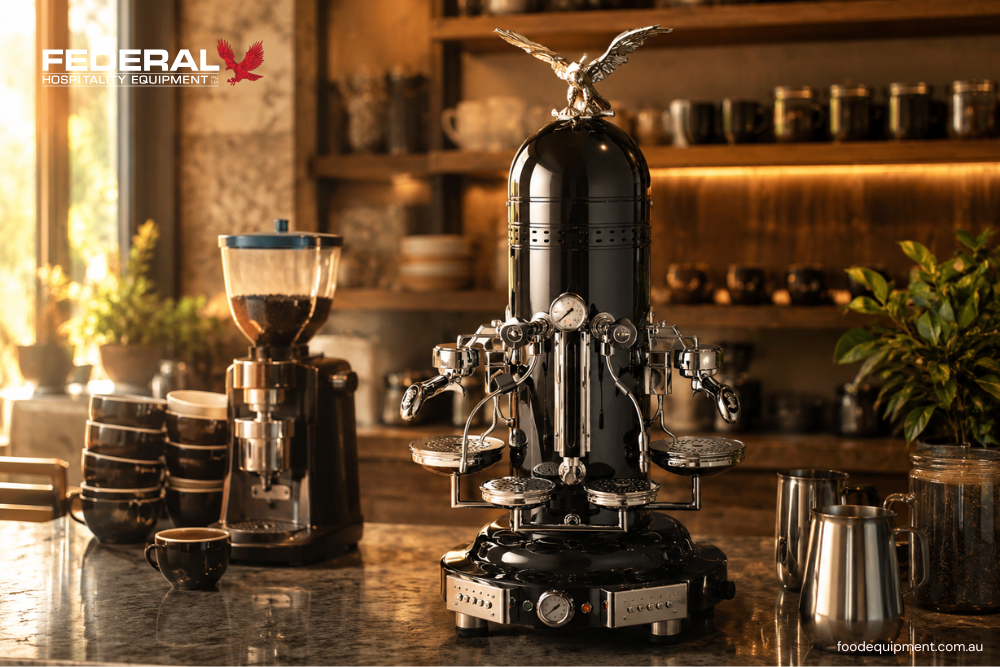
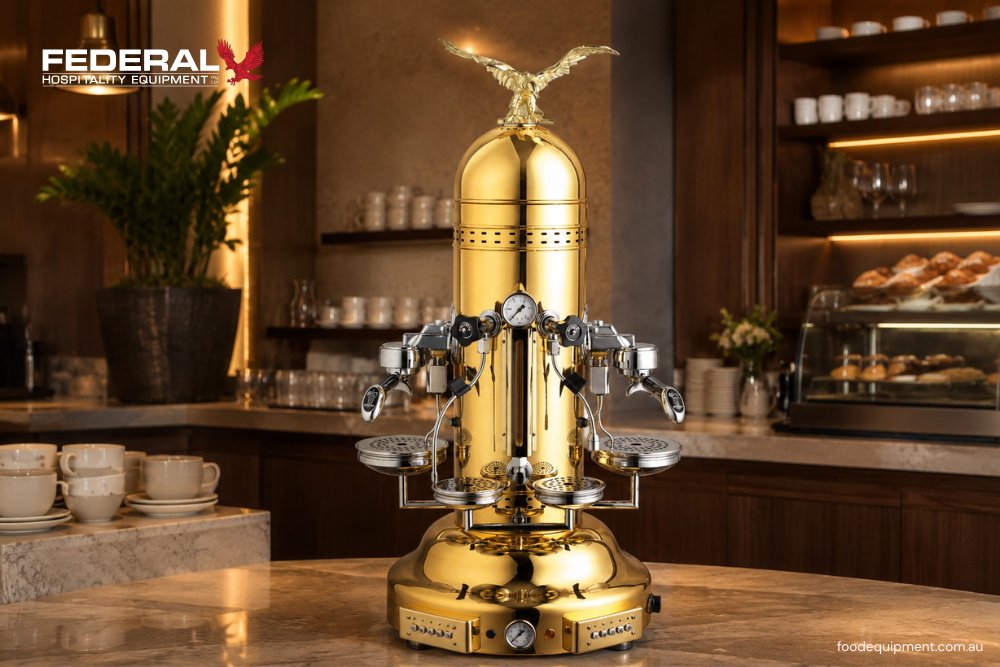
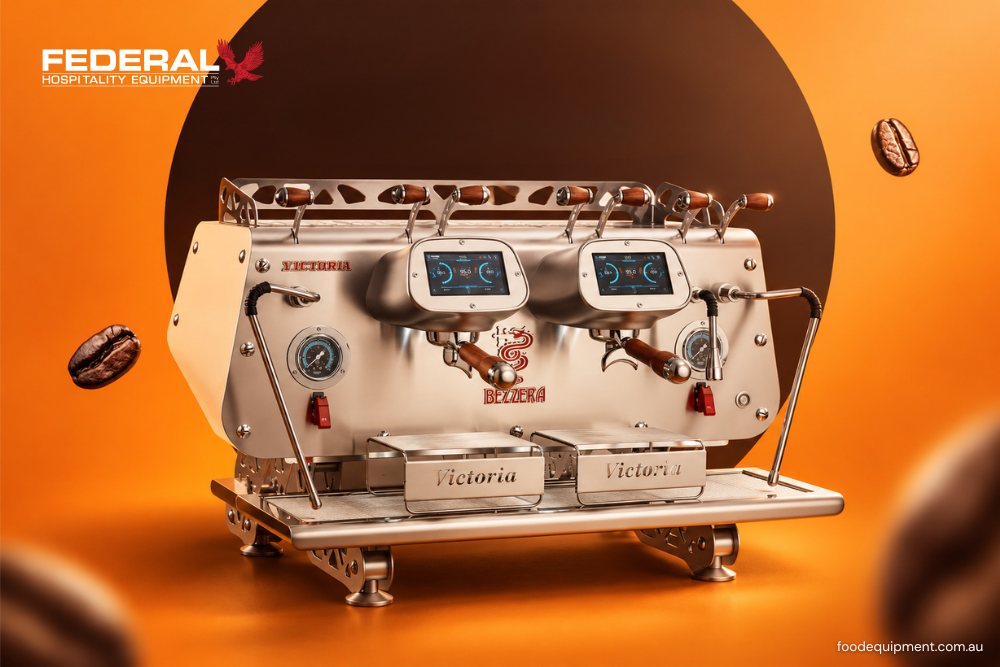
At Federal Hospitality Equipment Australia, businesses can compare commercial coffee and espresso equipment for different service requirements, including professional Bezzera espresso machines, alongside grinders and supporting coffee equipment.
A commercial coffee machine in Australia may cost approximately $2,500 to $35,000+, depending on its capacity, number of groups, level of automation and features. For many cafés looking for a professional espresso setup, the machine itself may fall around the $9,000–$25,000 range, while premium high-capacity equipment can cost more. Remember to budget separately for a grinder, water filtration, installation and accessories.
Commercial Coffee Machine Prices in Australia
The price of a commercial coffee machine should be considered in relation to the workload it needs to handle.
A small office, restaurant or low-volume venue does not necessarily need the same equipment as a busy café producing a large number of espresso-based drinks during the morning rush. Likewise, investing in a machine that cannot keep up with peak demand can create a bottleneck at the coffee station.
| Commercial Coffee Machine Type | Indicative Australian Price | Generally Suited To |
|---|---|---|
| Entry-level commercial / automatic | $2,500–$6,000 | Offices, smaller venues and lower-volume service |
| Mid-range professional espresso | $7,000–$15,000 | Cafés, restaurants and bakeries |
| Premium 2-group espresso | $15,000–$25,000 | Busy cafés and hospitality venues |
| Premium 3-group espresso | $25,000–$35,000+ | High-volume cafés and larger venues |
| Fully automatic systems | $2,500–$10,000+ | Businesses prioritising automated beverage preparation |
These figures are indicative rather than fixed. A complete commercial coffee setup may also require a grinder, water filtration, installation, plumbing or electrical work, cleaning products and other accessories.
Why Do Commercial Coffee Machine Prices Vary So Much?
Two machines may both be described as commercial coffee machines while being designed for completely different workloads.
One may be intended for automated coffee preparation in a lower-volume environment, while another may be a multi-group professional espresso machine designed for repeated brewing and steaming throughout a busy trading day.
Several factors can influence the purchase price.
Number of Groups
The number of groups is one of the most important differences between traditional commercial espresso machines.
A 2-group commercial coffee machine can allow a barista to prepare multiple espresso shots at the same time and is commonly considered for cafés, restaurants and other hospitality businesses requiring regular coffee production.
A 3-group espresso machine provides additional brewing capacity and may be more appropriate where high peak-period throughput justifies the extra capacity.
More groups do not automatically make a machine the better choice. The additional capacity should match actual customer demand.
Boiler Capacity and Configuration
Boiler design can also influence both price and performance.
Larger boiler capacity can support higher-volume operation, while multi-boiler configurations can provide greater control when brewing coffee and steaming milk during busy service.
For a café preparing a high proportion of milk-based drinks, steam performance may be particularly important during peak periods.
PID Temperature Control
Some professional espresso machines incorporate PID temperature control, which can help maintain more precise brewing temperatures.
This type of technology can contribute to repeatability and temperature stability, but it can also increase the cost of the equipment.
Automation and Programmable Functions
Automation can change both the price of a coffee machine and the way staff interact with it.
Programmable functions can support repeatable beverage preparation and simplify parts of the workflow, while fully automatic machines can automate considerably more of the coffee-making process.
The right level of automation depends on your service model, staffing, menu and expected beverage volume.
Commercial Construction
A machine designed for repeated hospitality use needs to cope with a very different workload from a domestic coffee maker.
Construction, internal components, controls, boilers, steam systems and other commercial features can all contribute to the cost of professional equipment.
How Much Does a Professional Espresso Machine Cost?
For many Australian cafés, the espresso machine will be the central piece of equipment at the coffee station.
Professional espresso machines generally cost more because they are designed to handle repeated beverage orders while maintaining brewing temperature and providing the steam performance required for milk-based drinks.
The current Federal Hospitality Equipment range includes professional espresso machines in different 2-group and 3-group configurations, giving Australian hospitality businesses a choice according to capacity, workflow and available bench space.
Rather than selecting a machine purely by price, compare its capabilities with the number of drinks your business expects to produce.
A café serving a moderate number of coffees has different requirements from a busy venue that experiences intense morning demand.
Bezzera Commercial Coffee Machines
Bezzera is particularly relevant when comparing professional espresso machines within the Federal Hospitality Equipment range.
Current options include professional models such as the Bezzera Moda DE PID, Bezzera Moda DE, Bezzera Otto DE and other configurations across 2-group and 3-group formats.
The benefit of having different configurations is choice. Instead of treating every café as though it needs the same machine, businesses can compare group capacity, physical dimensions, controls, automation and other specifications against their actual service requirements.
For a smaller or moderate-volume operation, a suitable 2-group configuration may provide the required capacity without unnecessarily moving to a larger machine. A higher-volume operation may have different priorities.
2-Group vs 3-Group Coffee Machine: Which Do You Need?
The number of groups should be selected according to expected workload rather than the assumption that bigger is always better.
| Consideration | 2-Group Espresso Machine | 3-Group Espresso Machine |
|---|---|---|
| Brewing Capacity | Suitable for many professional café operations | Greater simultaneous brewing capacity |
| Bench Space | Generally requires less space | Typically requires more bench space |
| Peak Demand | Can suit moderate to busy service depending on model | Better considered where higher throughput requires additional capacity |
| Purchase Budget | Generally lower than comparable 3-group equipment | Generally higher |
| Best Selection Approach | Match to actual drink volume | Choose when additional capacity can be justified |
A small café may achieve better value from a suitable 2-group machine than from buying a premium 3-group system that significantly exceeds daily demand.
Conversely, insufficient capacity can become a problem when a busy café cannot keep pace with customer orders during its busiest periods.
A 2-group machine can suit many cafés and hospitality venues, while a 3-group machine may be appropriate for businesses with higher peak-period coffee volumes. Base the decision on expected drink volume, barista workflow, available bench space and the machine's actual specifications rather than group count alone.
Automatic vs Traditional Espresso Machines
Another important decision is whether your business needs a traditional barista-operated espresso machine or a more automated system.
Traditional professional espresso machines provide the barista with greater involvement in coffee preparation and are commonly associated with café-style espresso service.
Automatic or bean-to-cup systems can make sense where ease of operation, repeatability and reduced manual preparation are higher priorities.
Neither format is automatically right for every business.
A café built around barista-made espresso may have different requirements from an office, self-service environment or venue where coffee is an additional offering rather than the central product.
Do You Need a Commercial Coffee Grinder?
For a traditional espresso setup, the coffee machine should not be considered in isolation.
A commercial coffee grinder is another important part of the beverage station because grind consistency directly affects espresso extraction.
Federal Hospitality Equipment's coffee category also includes professional grinder options, including Mazzer Grinders alongside other supporting coffee equipment.
When budgeting for a coffee station, consider the machine and grinder as parts of the same workflow.
Why Does the Coffee Grinder Matter?
Even an expensive espresso machine cannot compensate for every inconsistency introduced before brewing.
A commercial grinder needs to produce an appropriate and repeatable grind for the coffee being prepared. Changes in grind can affect extraction, which in turn influences the final espresso.
The grinder should therefore be selected according to expected workload, the espresso setup and the operating requirements of the business.
What Other Costs Should You Budget For?
The advertised price of a commercial coffee machine is not necessarily the total cost of getting the coffee station ready for service.
Depending on the venue and equipment, additional costs can include:
| Cost Component | What to Consider |
|---|---|
| Coffee Machine | Main equipment investment |
| Commercial Grinder | Required for freshly ground coffee in a traditional espresso setup |
| Water Filtration | Helps manage water quality and scale |
| Installation | May involve plumbing and electrical requirements |
| Electrical Work | Larger machines may require specific electrical capacity |
| Accessories | Tampers, milk equipment and other barista tools |
| Cleaning Products | Required for regular equipment care |
| Servicing | Preventative maintenance, labour and replacement parts |
Water Filtration
Water filtration deserves particular attention because scale can affect beverage equipment.
The filtration system should be selected according to the equipment and local water conditions, and businesses should follow the machine manufacturer's requirements regarding water quality and maintenance.
Installation
Commercial espresso machines may have plumbing and electrical requirements that need to be addressed before installation.
This is especially important when replacing a smaller machine with higher-capacity equipment. Larger commercial machines may have higher electrical requirements, so businesses should confirm compatibility with the existing café fit-out before purchasing.
Is an Expensive Commercial Coffee Machine Worth It?
A more expensive coffee machine can be worthwhile when the additional capacity and features solve a genuine operational requirement.
That does not mean the highest-priced machine automatically represents the best investment.
For example, paying for additional group capacity that is rarely used may provide little operational benefit to a small café. On the other hand, choosing a machine that struggles during peak service can affect workflow and the number of beverages staff can prepare efficiently.
The goal should be to match the machine to:
- expected daily coffee volume;
- peak-period demand;
- menu;
- proportion of milk-based beverages;
- number of staff or baristas using the machine;
- available bench space;
- electrical and plumbing infrastructure;
- preferred level of automation; and
- future but realistic business requirements.
How Much Should a Café Budget for a Commercial Coffee Machine?
For many Australian cafés, a realistic machine budget is around $9,000–$25,000 for a professional espresso setup, with premium 3-group equipment potentially costing considerably more.
Smaller businesses and lower-volume operations may find automatic commercial options from around $2,500.
However, the machine budget should not be viewed separately from the rest of the coffee station.
For planning purposes, consider:
Coffee machine + grinder + water filtration + installation + accessories + cleaning + servicing.
This gives a more realistic picture of the investment required to establish and maintain a professional beverage setup.
How Do You Choose the Right Commercial Coffee Machine?
1. Estimate Your Daily Coffee Volume
Consider both the total number of beverages and how concentrated orders are during peak periods.
2. Look at Your Coffee Menu
A business producing a large number of milk-based drinks may place greater importance on steam capacity and workflow than a venue with a smaller espresso menu.
3. Consider Peak Service, Not Just Daily Totals
Two cafés can sell the same number of coffees per day but require different equipment if one receives most of its orders within a short morning rush.
4. Decide How Much Automation You Need
Consider whether your service model requires traditional barista preparation, programmable functionality or a more automated coffee-making process.
5. Check Your Available Bench Space
Measure the installation area before selecting the machine. Remember that the coffee station may also need space for the grinder and other equipment.
6. Confirm Utilities
Check electrical, plumbing, drainage and water-filtration requirements for the individual machine before purchasing.
7. Consider the Complete Cost
Compare the machine price alongside the grinder, installation, filtration, accessories and ongoing maintenance rather than making a decision based solely on the advertised equipment price.
Common Mistakes When Budgeting for a Commercial Coffee Machine
Choosing Only by Price
The cheapest machine is not necessarily economical if it cannot support the required workload.
Buying More Capacity Than Needed
A premium 3-group machine may be unnecessary for a venue with modest coffee demand.
Ignoring Peak Service
Daily coffee volume can look manageable while a concentrated morning rush places far greater pressure on the machine.
Forgetting the Grinder
A professional espresso setup should include a suitable grinder as part of the overall equipment budget.
Ignoring Installation Requirements
Commercial coffee machines can have specific electrical, plumbing and water-filtration requirements.
Looking Only at the Coffee Machine
The complete cost includes filtration, installation, accessories, cleaning and servicing.
What Should You Check Before Buying?
- What type of machine does the business need?
- Is a 2-group or 3-group configuration appropriate?
- What is the expected daily beverage volume?
- What is the peak-period demand?
- What boiler configuration does the machine use?
- How important is steam capacity?
- Does the model offer PID temperature control?
- What programmable or automatic functions are included?
- Will the machine fit the available bench space?
- What electrical supply is required?
- What plumbing and drainage requirements apply?
- What water filtration is recommended?
- Which commercial grinder suits the setup?
- What accessories are required?
- What cleaning and maintenance procedures apply?
- What warranty and servicing support is available?
- What is the total cost of the complete coffee station?
Why Buy Commercial Coffee Equipment from Federal Hospitality Equipment Australia?
Federal Hospitality Equipment Australia supplies commercial food, catering and restaurant equipment to Australian hospitality businesses, with a coffee equipment range covering professional espresso machines, grinders and supporting equipment.
Relevant brands within the coffee category include Bezzera, F.H.E. and Mazzer Grinders.
For cafés, restaurants, bakeries and other hospitality venues, having multiple configurations available makes it possible to compare equipment according to actual operational requirements rather than relying on a one-size-fits-all approach.
When selecting your coffee equipment, consider the complete beverage station and how the coffee machine, grinder, filtration, available utilities, barista workflow and expected service volume work together.
Conclusion: How Much Does a Commercial Coffee Machine Cost in Australia?
A broad indicative range is approximately $2,500 to $35,000+, while many professional café espresso machines may fall around $9,000 to $25,000, depending on capacity, technology, group configuration, features and brand.
Price, however, should not be the only deciding factor.
A correctly selected commercial coffee machine should match the venue's beverage volume, peak demand, menu, available space and operating requirements. Businesses should also consider the cost of the grinder, water filtration, installation, electrical requirements, accessories and ongoing servicing when establishing the real equipment budget.
For Australian hospitality businesses comparing professional espresso machines and supporting coffee equipment, Federal Hospitality Equipment Australia provides options across different capacities and configurations, including relevant equipment from Bezzera and Mazzer Grinders.
Frequently Asked Questions
How much does a commercial coffee machine cost in Australia?
Commercial coffee machines can broadly range from around $2,500 to $35,000+, depending on the machine type, number of groups, capacity, automation, technology and brand.
How much should I spend on a coffee machine for a café?
A realistic professional espresso-machine budget for many cafés may be around $9,000–$25,000, although premium high-capacity equipment can cost more.
What makes a commercial coffee machine more expensive?
Important factors include the number of groups, boiler capacity, multi-boiler technology, PID temperature control, programmable functions, automation and commercial construction.
Is a 2-group coffee machine enough for a café?
A 2-group machine can suit many cafés, but capacity should be matched to peak-period beverage demand, not simply the size of the venue.
When should I consider a 3-group coffee machine?
A 3-group machine may be appropriate where a high-volume operation needs greater simultaneous brewing capacity. Consider workload, available space and workflow before moving to a larger configuration.
What is the difference between an automatic coffee machine and a traditional espresso machine?
Traditional professional espresso machines involve greater barista participation in preparation, while more automated systems can perform more stages of beverage preparation automatically.
Do I need a commercial coffee grinder?
For a traditional espresso setup using whole coffee beans, a suitable commercial grinder is an important part of the station because grind consistency directly affects extraction.
Which coffee machine brands does Federal Hospitality Equipment Australia offer?
Relevant brands in the current coffee equipment category include Bezzera, F.H.E. and Mazzer Grinders.
Does a commercial coffee machine need water filtration?
Water filtration may be required or recommended depending on the equipment and water conditions. Always follow the requirements specified for the individual machine.
Does the coffee machine price include installation?
Not necessarily. Installation can be a separate cost and may involve plumbing, electrical work and other site requirements.
What other equipment does a café coffee station need?
Depending on the setup, a commercial coffee station may require a grinder, filtration system, tampers, milk equipment, cleaning products and other accessories in addition to the coffee machine.
Does a larger coffee machine always make better coffee?
No. Group count and physical size primarily relate to capacity and workflow. Coffee results also depend on the beans, grind, extraction settings, equipment setup and barista process.
Is the most expensive commercial coffee machine always the best choice?
No. The most appropriate machine is one that matches the business's beverage volume, peak-period workload, menu, available space and operational requirements.
Should I choose a coffee machine based on daily sales or peak demand?
Both matter, but peak demand is particularly important. A machine may have enough capacity for the day's total coffee sales but still create a bottleneck if a large proportion of those orders arrive within a short period.
What should I check before buying a commercial coffee machine online?
Check the machine's group configuration, capacity, boiler system, dimensions, electrical requirements, plumbing and filtration requirements, installation conditions, warranty and suitability for your expected workload.