Food preparation can take up a large part of the working day in a busy Australian commercial kitchen. Tasks such as slicing onions, cutting potatoes, shredding cabbage, grating carrots and preparing vegetables for salads may seem simple, but they become time-consuming when staff need to repeat them in large quantities.
A commercial vegetable cutter and slicer can reduce this preparation time by automating repetitive cutting tasks, producing more consistent results and allowing staff to process larger quantities with less manual cutting.
For restaurants, cafés, hotels, pubs, catering businesses, hospitals, aged-care kitchens and other foodservice operations, this can help move more work into the mise en place stage and reduce preparation bottlenecks before busy service periods.
Federal Hospitality Equipment Australia supplies commercial vegetable preparation equipment from brands including Dito Sama and Yasaki, with options ranging from compact dedicated slicers to multifunction cutter/slicer machines for higher-volume production.
A commercial vegetable cutter saves time by automating repetitive slicing, grating, shredding and other cutting tasks. Instead of staff making hundreds of individual knife cuts, suitable machines can process batches more quickly and consistently, helping reduce manual preparation and making mise en place easier to organise.
Why Does Manual Vegetable Preparation Take So Much Time?
Manual vegetable preparation usually involves several separate steps. Staff may need to wash and trim produce, select the appropriate knife or hand tool, cut each item, check the size and consistency, sort irregular pieces and then clean the work area.
For a few portions, this may not take long. For hundreds of meals, however, the same repetitive actions can consume a significant amount of labour.
Preparation delays can also affect other parts of the kitchen. If vegetables are not ready when cooks need them, staff may have to stop cooking or assembly work to complete extra chopping and slicing.
| Preparation Task | Manual Method | Commercial Machine Approach |
|---|---|---|
| Slicing Onions | Repeated knife cutting | Rapid machine slicing with a suitable disc |
| Preparing Carrots | Manual slicing or grating | Consistent machine slicing or grating |
| Cutting Potatoes | Knife preparation | Suitable cutting, slicing or dicing attachment |
| Shredding Cabbage | Repeated knife work | Dedicated shredding disc |
| Preparing Salads | Several separate manual steps | Faster batch preparation using appropriate discs |
How Does a Vegetable Cutter Increase Preparation Speed?
The largest time-saving benefit comes from automation.
Instead of a staff member repeating the same knife movement many times, the machine performs the repetitive cutting action while the operator feeds appropriately prepared produce through the equipment.
For example, a café preparing salads, sandwiches or wraps may need large quantities of cucumber, carrot, onion and cabbage each morning. A suitable commercial slicer can help process those ingredients faster, allowing staff to complete mise en place sooner and move on to cooking, assembly or service tasks.
This principle becomes even more valuable as preparation volume increases.
Does Consistent Cutting Also Save Time?
Yes. Preparation speed is only one part of the benefit.
Consistent cutting can reduce additional work later in the kitchen. When ingredients are processed to more uniform sizes, they can be easier to portion, cook and assemble.
Staff may spend less time correcting irregular cuts, separating oversized pieces or trying to standardise portions after preparation.
| Consistent Preparation | Potential Time-Saving Effect |
|---|---|
| Uniform Slices | Less sorting and correction |
| Consistent Grated Vegetables | Faster portioning and assembly |
| Standardised Cuts | Easier batch production |
| Repeatable Results | Less dependence on individual knife technique |
This can be particularly useful for commercial kitchens preparing standardised menu items where consistency in appearance and portioning matters.
Can a Commercial Vegetable Cutter Improve Cooking Consistency?
It can support more consistent preparation by producing pieces of similar dimensions.
When vegetables are cut more evenly, they may cook more predictably than a batch containing a mixture of very large and very small pieces.
This is especially useful for menus where vegetables are roasted, fried, steamed or assembled in standard portions.
The machine does not replace recipe control or proper cooking technique, but it can provide a more consistent starting point.
What Cutting Tasks Can a Commercial Vegetable Prep Machine Perform?
The exact functions depend on the machine and the discs or attachments fitted to it.
Commercial vegetable preparation machines may support tasks such as:
- slicing;
- grating;
- shredding;
- julienning;
- dicing;
- preparing salad vegetables;
- processing potatoes;
- preparing cabbage;
- grating carrots; and
- other menu-specific cutting requirements.
Some machines are dedicated slicers, while others can perform several different preparation functions by changing discs or attachments.
Can One Machine Perform Multiple Preparation Tasks?
Yes. Some commercial vegetable cutters are designed to accept interchangeable discs or attachments for different cutting styles.
This can be particularly useful for kitchens with varied menus because one machine may be able to slice one ingredient, grate another and shred a third without requiring separate manual tools for each task.
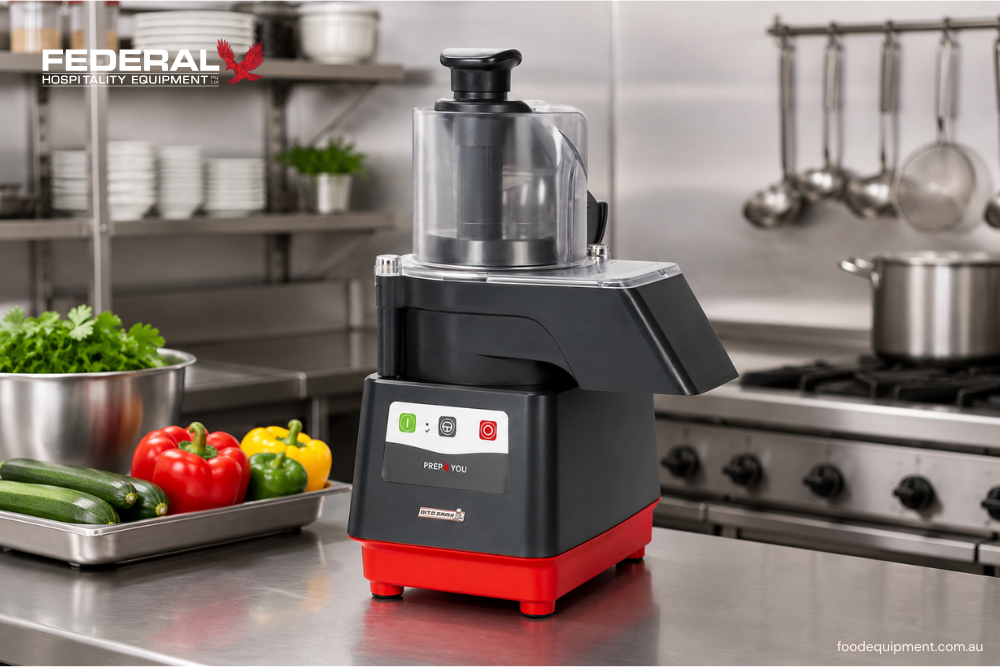
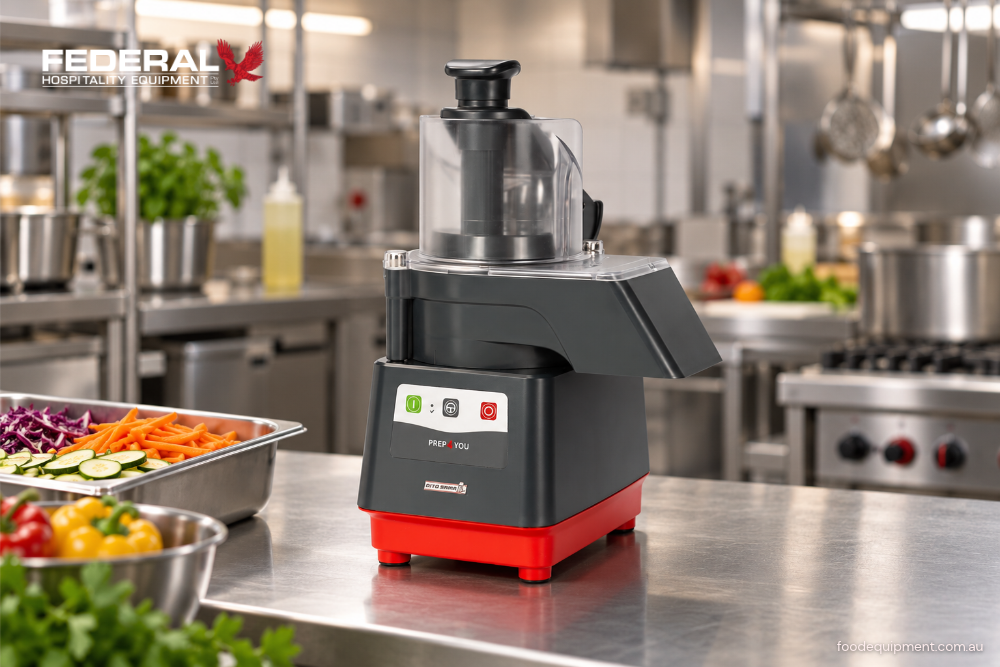
The original source highlights the Dito Sama PREP4YOU P4U-CS as a vegetable slicer supplied with discs, while the PREP4YOU P4U-PV201S combines cutting and vegetable slicing functionality with a 2.6-litre stainless-steel bowl and multiple speeds.
What Is the Dito Sama PREP4YOU Vegetable Slicer?
The Dito Sama PREP4YOU P4U-CS is a commercial vegetable slicer designed for professional food preparation.
Federal Hospitality Equipment currently lists this model with discs included, making it relevant for kitchens that need repeatable commercial slicing without relying on manual knife preparation.
It can suit restaurants, cafés, catering operations and institutional kitchens where vegetable preparation forms a regular part of daily production.
What Is the Dito Sama PREP4YOU P4U-PV201S?
The Dito Sama PREP4YOU P4U-PV201S combines cutter and vegetable slicer functionality in one commercial machine.
It uses a 2.6-litre stainless-steel bowl and nine-speed operation, providing a more versatile preparation solution for kitchens that need both cutting and slicing functionality.
This type of combination equipment can be useful where bench space is limited but the kitchen still needs multiple preparation functions.
What Is the Dito Sama Minigreen Vegetable Slicer?
The Dito Sama Minigreen is a compact commercial vegetable slicer designed for businesses that need a dedicated slicing solution.
Federal Hospitality Equipment currently lists it as a 250W single-speed model.
A compact dedicated slicer can suit cafés, smaller restaurants or other commercial kitchens where vegetable slicing is frequent enough to justify a machine but a larger multifunction unit is unnecessary.
What Is the Dito Sama TRS-500?
The Dito Sama TRS-500 is another commercial vegetable slicing option in the current FHE range.
The listed model is a single-phase, single-speed 500W vegetable slicer intended for commercial preparation.
Compared with a smaller dedicated slicer, a higher-capacity machine may make more sense where vegetable preparation volumes are greater.
What Yasaki Vegetable Preparation Machines Are Available?
Yasaki is another relevant food-preparation brand in Federal Hospitality Equipment Australia's current range.
FHE's current vegetable prep and food processor ranges position Yasaki as a practical commercial option for kitchens looking for straightforward, robust preparation equipment.
The current FHE price guide also lists Yasaki vegetable cutter models including the VC55MF and VC65MS, along with compatible vegetable cutting discs for different preparation styles.
Dito Sama vs Yasaki Vegetable Cutters: Which Should You Choose?
The right choice depends on preparation volume, menu variety, available bench space and the cutting styles required.
| Consideration | Dito Sama | Yasaki |
|---|---|---|
| Product Range | Dedicated slicers, combination machines and PREP4YOU configurations | Practical commercial vegetable cutters and general food-preparation machines |
| Kitchen Type | Suitable from smaller venues through to high-volume operations depending on model | Suitable for commercial kitchens seeking straightforward vegetable preparation |
| Functionality | Options range from dedicated slicing to multifunction cutting and processing | Available with commercial cutting discs and preparation configurations |
| Selection Approach | Choose according to required functions and workload | Choose according to capacity, disc options and daily preparation needs |
Neither brand should be selected on name alone. Compare the specific machine, available discs, processing capacity and physical footprint against the way your kitchen prepares food.
How Does a Vegetable Cutter Help During Peak Service?
Preparation delays can affect the entire kitchen.
If salad ingredients, garnishes, sandwich fillings or cooking vegetables are not ready before service, cooks may have to stop what they are doing to complete additional preparation.
A commercial vegetable cutter helps shift more of this repetitive work into the mise en place period before service.
Once vegetables are processed, they can be stored appropriately according to the kitchen's food-safety procedures so staff can focus on cooking, plating and assembly during busy periods.
It allows more repetitive cutting to be completed before service. By preparing sliced, grated or shredded vegetables in advance, kitchen staff can spend peak periods cooking, assembling and plating rather than stopping to repeat basic cutting tasks.
Does a Commercial Vegetable Cutter Reduce Labour Effort?
It can reduce the amount of repetitive manual cutting required from kitchen staff.
This does not mean the machine removes the need for employees. Staff still need to prepare ingredients, operate the equipment correctly, change discs where required, manage food safety and clean the machine.
The benefit is that employees can spend less time repeating simple knife movements and more time on tasks that require attention, organisation and cooking skill.
This can be particularly valuable in kitchens operating with tight rosters.
Can a Vegetable Cutter Replace Knife Skills?
No. Commercial vegetable cutters do not remove the need for trained kitchen staff or knives.
Some preparation tasks will still be more suitable for manual cutting, particularly small quantities, delicate garnishes or irregular produce.
The machine is most valuable for repetitive work where standardised cuts and larger batches justify mechanical preparation.
What Vegetable Cutter Is Best for a Café?
A café may benefit from a compact dedicated slicer if it regularly prepares vegetables for sandwiches, salads, wraps, garnishes and other menu items.
The main considerations are:
- daily preparation volume;
- available bench space;
- required cutting styles;
- ease of operation;
- cleaning requirements; and
- whether a dedicated or multifunction machine is more appropriate.
A compact machine may provide enough output without occupying unnecessary bench space.
What Vegetable Cutter Is Best for a Restaurant?
A restaurant with a varied menu may benefit from a machine that supports several cutting styles.
If the kitchen regularly slices onions, shreds cabbage, grates carrots, prepares potatoes and processes salad vegetables, interchangeable discs can provide useful flexibility.
The machine should still be sized according to realistic daily workload rather than simply choosing the largest available model.
What Vegetable Cutter Is Best for Catering?
Catering operations often prepare larger quantities before events, making batch efficiency especially important.
A higher-output or multifunction vegetable cutter can help process larger quantities more consistently and reduce repetitive manual preparation.
For catering, pay particular attention to:
- continuous processing capability;
- disc selection;
- production capacity;
- durability;
- cleaning speed; and
- available preparation space.
What Vegetable Cutter Is Best for Hospitals and Aged-Care Kitchens?
Institutional kitchens often need repeatable preparation across large meal volumes.
Consistent cuts can support standardised portions and batch cooking, while mechanical preparation can reduce the amount of repetitive knife work required.
Equipment should be selected according to the kitchen's food-production plan, dietary requirements, preparation volumes and cleaning procedures.
Can a Vegetable Cutter Help with Portion Consistency?
Yes. More uniform cutting can make portioning easier because staff are working with ingredients of more consistent size.
This can be particularly useful for:
- salad portions;
- sandwich fillings;
- garnishes;
- side dishes;
- vegetable mixes; and
- batch-prepared meals.
Consistency does not automatically guarantee exact portion control, but it can make portioning more repeatable.
Why Are Interchangeable Cutting Discs Useful?
Cutting discs allow the same machine to produce different results depending on the menu.
Available disc styles can include slicing, grating, shredding, julienne and dicing configurations, depending on the machine.
The current Dito Sama range includes a variety of dedicated preparation discs, while the FHE price guide also lists Yasaki vegetable cutting discs in several sizes and styles.
This versatility can reduce the need for multiple standalone preparation tools.
Does a Multifunction Cutter Save More Time Than a Dedicated Slicer?
Not always.
A multifunction machine can be valuable where the kitchen performs many different preparation tasks, but a dedicated slicer may be simpler and faster if slicing is the main requirement.
| Kitchen Requirement | Suitable Machine Approach |
|---|---|
| Occasional Vegetable Slicing | Compact dedicated slicer |
| Regular Salad Preparation | Vegetable cutter with suitable discs |
| Multiple Cutting Styles | Multifunction cutter/slicer |
| High-Volume Preparation | Commercial machine matched to workload |
| Limited Bench Space | Compact benchtop model |
The goal is to choose the machine that removes the most repetitive work from your actual preparation routine.
How Can Kitchens Get the Maximum Time Saving?
Buying the machine is only part of the process. The equipment needs to be integrated into the kitchen's normal preparation workflow.
Group Ingredients by Cutting Requirement
Process ingredients requiring the same disc or cut together where practical. This can reduce unnecessary attachment changes.
Prepare Discs Before Starting
Have the required slicing, grating or shredding discs ready before beginning a preparation session.
Process Suitable Batches
Where appropriate, prepare larger batches rather than repeatedly setting up the machine for very small quantities.
Organise Mise en Place
Use the machine before peak service so prepared ingredients are ready when cooks and assembly staff need them.
Include Cleaning in the Workflow
Food-contact components should be cleaned according to the manufacturer's instructions after use so the machine is ready for the next preparation session.
Why Is Cleaning Important for Vegetable Preparation Machines?
A machine only saves time if it remains practical to clean and reuse.
Vegetable cutters come into direct contact with food, so discs, feeding components and other food-contact parts need to be cleaned effectively.
When comparing models, consider:
- how easily the discs can be removed;
- whether food-contact components are accessible;
- how long cleaning typically takes;
- whether components are suitable for the manufacturer's recommended cleaning method; and
- how quickly the machine can be returned to service.
The current FHE vegetable prep category specifically highlights hygiene-friendly, removable and dishwasher-safe components on suitable machines.
What Safety Features Should You Consider?
Commercial cutting equipment contains rapidly moving blades and discs, so safe operation is essential.
Depending on the model, consider features such as:
- safety interlocks;
- secure lids or feed assemblies;
- protected blade areas;
- stable machine construction;
- safe disc-changing procedures; and
- clear operating controls.
Staff training remains important regardless of machine design. Employees should follow the manufacturer's operating and cleaning instructions.
Does Bench Space Matter?
Yes. A preparation machine that saves cutting time but blocks a valuable work area may create another workflow problem.
Measure the available bench space before purchasing and allow room for:
- ingredient containers;
- processed-food containers;
- safe feeding of produce;
- disc changes;
- cleaning access; and
- staff movement around the prep station.
Compact machines can be particularly useful in cafés and smaller kitchens where preparation space is limited.
Which Features Should You Prioritise?
| If Your Priority Is... | Focus On... |
|---|---|
| Faster Salad Preparation | Slicing, shredding and grating disc options |
| High-Volume Production | Commercial processing capacity and continuous-feed design where applicable |
| Multiple Cutting Styles | Interchangeable discs or multifunction cutter/slicer |
| Limited Bench Space | Compact benchtop footprint |
| Consistent Portions | Repeatable cutting dimensions |
| Frequent Daily Use | Durable commercial construction and practical cleaning |
How Do You Choose a Commercial Vegetable Cutter in Five Steps?
1. List Your Most Repetitive Preparation Tasks
Identify which vegetables are sliced, grated, shredded or diced most often.
2. Calculate Daily Preparation Volume
Estimate the amount of produce processed on a normal day and during the busiest preparation periods.
3. Decide Which Cutting Styles You Need
Check whether the machine and available discs can produce the cuts required by your menu.
4. Measure the Available Workspace
Make sure there is enough room not only for the machine but also for feeding ingredients, collecting prepared food and cleaning.
5. Compare Cleaning and Operation
Choose equipment that staff can operate and clean efficiently within the normal preparation routine.
There is no single best model for every kitchen. A smaller café may only need a compact dedicated slicer, while a restaurant, catering business or institutional kitchen may benefit from a multifunction or higher-capacity machine. Choose according to your menu, preparation volume, cutting styles and available space.
What Should You Check Before Buying a Vegetable Cutter and Slicer?
- Which vegetables do you prepare most frequently?
- How much produce is processed each day?
- What is the busiest preparation period?
- Do you need slicing, grating, shredding, julienne or dicing?
- Which discs are supplied with the machine?
- Which additional discs are available?
- Is a dedicated slicer enough?
- Would a combination cutter/slicer be more useful?
- What motor and processing capacity does the machine provide?
- Will it fit the available bench space?
- How are ingredients fed into the machine?
- How are processed vegetables collected?
- What safety controls are included?
- How easy are the discs and food-contact components to remove?
- How long does cleaning take?
- How frequently will the machine be used?
- What warranty and service support is available?
Common Mistakes When Choosing a Commercial Vegetable Cutter
1. Buying More Capacity Than You Need
A large machine can occupy unnecessary bench space if preparation volume is relatively low.
2. Choosing Only by Motor Power
Motor power matters, but disc selection, processing design and suitability for the required cuts are equally important.
3. Ignoring the Cost and Availability of Discs
The usefulness of the machine depends heavily on whether the required slicing, grating or dicing discs are available.
4. Choosing a Dedicated Slicer for a Highly Varied Menu
A multifunction machine may offer better value if the kitchen regularly performs several different preparation tasks.
5. Buying a Multifunction Machine When Only One Task Is Needed
If the kitchen mainly slices vegetables, a simpler dedicated machine may be more practical.
6. Forgetting Cleaning Time
Preparation speed should be considered together with cleaning and setup time.
7. Ignoring Bench Space
The machine needs enough surrounding area for safe feeding, collection and operation.
8. Assuming the Machine Eliminates Staff
The equipment reduces repetitive manual preparation, but trained staff are still needed to operate, clean and manage the process.
Why Choose Dito Sama and Yasaki Vegetable Preparation Equipment?
Dito Sama offers a broad commercial food-preparation range including dedicated vegetable slicers, PREP4YOU cutter/slicer models and higher-capacity machines designed for professional kitchens. Federal Hospitality Equipment identifies Dito Sama as a core food-preparation brand for restaurants, catering operations, aged-care facilities, hospitals and other high-output environments.
Yasaki provides commercial vegetable preparation and food-processing equipment positioned as a practical option for kitchens seeking dependable performance and straightforward operation. Current FHE ranges include Yasaki vegetable cutter models and compatible commercial cutting discs.
The right choice depends on the model rather than the brand alone. Compare capacity, required discs, operating speed, footprint, cleaning and the tasks your staff perform most often.
Why Buy a Commercial Vegetable Cutter from Federal Hospitality Equipment Australia?
Federal Hospitality Equipment Australia supplies commercial food-preparation equipment for restaurants, cafés, hotels, caterers, healthcare kitchens, aged-care facilities and other Australian foodservice operations.
The current vegetable preparation range includes machines from Dito Sama and Yasaki, covering compact benchtop options, dedicated slicers and multifunction cutter/slicer configurations.
When choosing equipment, focus on how much repetitive work the machine can remove from the daily preparation routine while still fitting the kitchen's available space, menu and workload.
Conclusion: How Does a Commercial Vegetable Cutter and Slicer Save Food Preparation Time?
A commercial vegetable cutter and slicer saves preparation time by automating repetitive cutting, improving consistency and helping staff process larger quantities more efficiently.
Instead of spending extended periods manually slicing onions, grating carrots, shredding cabbage or cutting potatoes, kitchen staff can use suitable commercial equipment to complete repetitive preparation more quickly.
The benefits go beyond cutting speed. More consistent pieces can reduce sorting and correction, make portioning easier and support more organised batch production.
For busy Australian kitchens, the greatest operational benefit is often better mise en place. When vegetables are prepared before service, cooks and assembly staff can focus more of their attention on cooking, plating and customer orders rather than returning to repetitive cutting tasks.
Federal Hospitality Equipment Australia's current range includes Dito Sama and Yasaki vegetable preparation solutions, ranging from dedicated slicers such as the Dito Sama Minigreen and PREP4YOU P4U-CS to combination machines such as the P4U-PV201S.
The key is choosing a machine that matches the kitchen's menu, preparation volume, available space and required cutting styles. That remains the central recommendation of the original source.
Frequently Asked Questions
How does a commercial vegetable cutter save time?
It automates repetitive slicing, grating, shredding and other preparation tasks, allowing staff to process larger batches more quickly than repeated manual knife work.
Does a vegetable cutter improve consistency?
Yes. Suitable machines can produce more uniform cuts, which can reduce sorting and correction and make portioning and batch preparation easier.
What can a commercial vegetable slicer cut?
Depending on the machine and discs, it may slice, grate, shred, julienne, dice or process vegetables in other ways suited to the menu.
Can one vegetable cutter perform several tasks?
Yes. Multifunction machines and interchangeable discs can allow one unit to perform several cutting and processing functions.
What is the Dito Sama Minigreen?
The Dito Sama Minigreen is a compact commercial vegetable slicer listed by Federal Hospitality Equipment as a 250W single-speed model.
What is the Dito Sama P4U-CS?
The PREP4YOU P4U-CS is a commercial vegetable slicer supplied with discs for professional preparation tasks.
What is the Dito Sama P4U-PV201S?
The P4U-PV201S is a PREP4YOU combination cutter and vegetable slicer with nine speeds and a 2.6-litre stainless-steel bowl.
Does Federal Hospitality Equipment sell Yasaki vegetable cutters?
Yes. The current FHE food-preparation range includes Yasaki commercial vegetable cutting and processing equipment.
Which brands of vegetable cutters does Federal Hospitality Equipment Australia offer?
The current relevant range includes commercial vegetable preparation equipment from Dito Sama and Yasaki.
What vegetable cutter is best for a café?
A compact dedicated slicer can suit cafés with moderate daily vegetable preparation, provided its available cuts match the menu.
What vegetable cutter is best for a restaurant?
A restaurant with a varied menu may benefit from a machine with interchangeable discs or multifunction cutting capability.
What vegetable cutter is best for catering?
Catering operations may benefit from a higher-output commercial machine with suitable cutting discs and capacity for batch preparation.
Does a commercial vegetable cutter reduce labour?
It can reduce repetitive manual cutting, allowing staff to spend more time on cooking, assembly, plating and other skilled tasks.
Can a vegetable cutter replace knives completely?
No. Knives and manual preparation remain useful for small quantities, delicate tasks and cuts that are not suited to the machine.
Why are cutting discs important?
The available discs determine which cuts the machine can produce, such as slicing, grating, shredding, julienne or dicing.
Should I choose a dedicated slicer or a combination cutter/slicer?
Choose a dedicated slicer if slicing is the main task. Consider a combination machine if your kitchen regularly needs several different preparation functions.
Does machine size matter?
Yes. The machine should provide enough capacity for the daily workload without taking more bench space than the kitchen can reasonably allocate.
How should a vegetable cutter be cleaned?
Follow the manufacturer's instructions and clean food-contact components, discs and removable parts after use according to the kitchen's food-safety procedures.
What should I check before buying a commercial vegetable cutter?
Check preparation volume, required cutting styles, supplied and optional discs, machine capacity, footprint, cleaning requirements, safety features and service support.
Is the largest commercial vegetable cutter always the best?
No. The best machine is one that matches the kitchen's menu, production volume, available space and required cutting styles without unnecessary capacity.