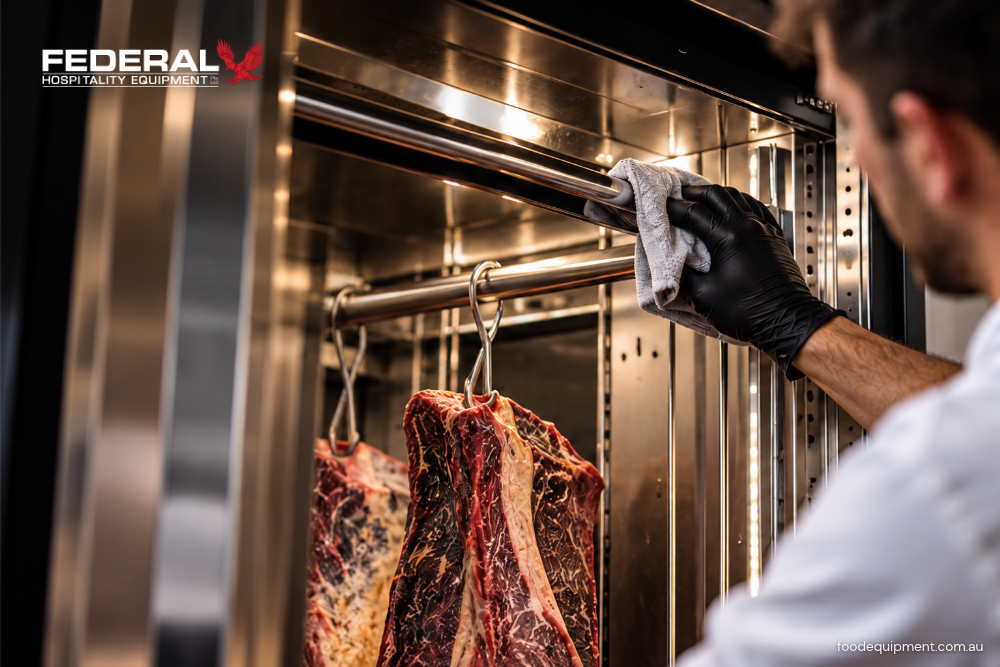
A commercial meat aging cabinet needs regular cleaning and ongoing maintenance to provide a stable environment for dry-aging meat. For Australian restaurants, steakhouses, butcher shops, hotels and premium foodservice businesses, cabinet hygiene is closely connected to equipment performance, temperature stability, humidity control and the consistency of the aging process.
Unlike a standard refrigerator, a dry-aging cabinet is designed to manage several conditions at once, including temperature, humidity, airflow and internal hygiene. That means cleaning should go beyond wiping the interior walls. Shelves, hangers, hooks, door seals, glass, drainage areas, air vents and refrigeration components all need attention.
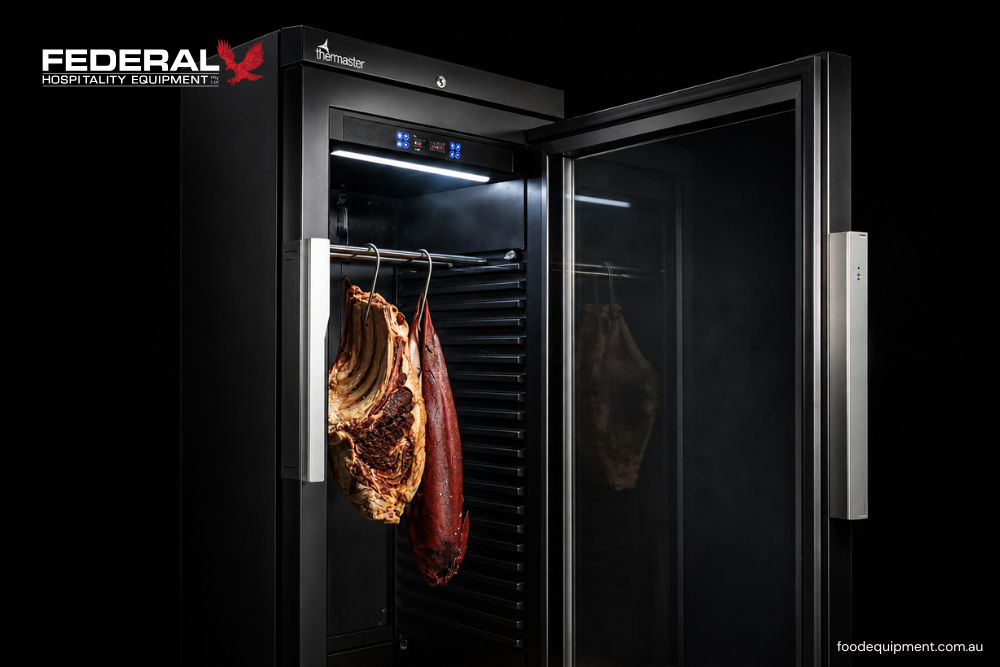
Federal Hospitality Equipment Australia currently offers commercial meat-aging solutions from Fagor and Thermaster. The range includes the Fagor FMD-2301A, FMD-2302A and Thermaster MA400, all designed around controlled maturation for professional foodservice use.
Keep the interior, shelves, hooks, hangers and trays clean; inspect the door gasket; monitor temperature and humidity; keep air vents unobstructed; check drainage or evaporation areas; clean the glass; and arrange professional servicing according to the manufacturer's recommendations. Always follow the cabinet manual and your business's food-safety procedures.
Why Is Cleaning a Meat Aging Cabinet Important?
Dry aging takes place over an extended period, so the cabinet needs to remain clean and stable throughout the maturation process.
During aging, meat loses moisture and develops flavour while remaining inside a controlled environment. Any residue, moisture build-up or hygiene issue inside the cabinet can interfere with the working environment and make it harder to maintain consistent conditions.
Regular cleaning can also help staff identify early warning signs such as damaged seals, unusual moisture, airflow problems or excessive residue before they become larger maintenance issues.
Commercial meat-aging cabinets can operate continuously, which makes preventive maintenance especially important in restaurants, steakhouses and butcher shops.
What Parts of a Meat Aging Cabinet Should Be Cleaned?
| Cabinet Area | What to Check | Maintenance Approach |
|---|---|---|
| Interior Walls | Residue, moisture and general surface condition | Clean and sanitise with suitable products |
| Shelves | Meat residue and build-up | Remove, clean, sanitise and dry |
| Hangers & Hooks | Residue and cleanliness | Remove and clean according to instructions |
| Salt Tray | Salt and moisture accumulation | Empty and clean as required |
| Door Gasket | Dirt, cracks or deterioration | Clean and inspect regularly |
| Drainage / Evaporation Area | Water or residue | Check and clean as specified by the manufacturer |
| Air Vents | Dust and obstructions | Keep clear |
| Fans & Refrigeration Area | Dust, unusual noise or abnormal operation | Inspect and service as required |
| Glass Door | Condensation, fingerprints and marks | Clean with a suitable product |
How Often Should a Meat Aging Cabinet Be Cleaned?
There is no single cleaning interval that applies to every cabinet.
The appropriate schedule depends on:
- how frequently the cabinet is used;
- how much meat is being aged;
- the type of meat stored;
- visible residue or moisture;
- the cabinet design;
- the manufacturer's instructions; and
- the business's food-safety procedures.
Visible residue should be addressed promptly, while shelves, racks, hooks and other removable items should be cleaned according to the cabinet's use and the business's documented cleaning schedule.
| Maintenance Task | Suggested Frequency |
|---|---|
| Check Temperature | Daily or according to the food-safety plan |
| Check Cabinet Condition | Daily |
| Check Visible Moisture or Residue | Daily |
| Inspect Door Gasket | Regularly |
| Clean Shelves & Racks | As required |
| Inspect Drainage / Evaporation System | Regularly |
| Check Ventilation | Regularly |
| Clean Refrigeration Components | According to manufacturer instructions |
| Professional Servicing | According to manufacturer recommendations |
How Do You Clean the Interior of a Meat Aging Cabinet?
Before cleaning, remove the meat and place it in appropriate controlled storage so its temperature and food-safety conditions are maintained.
Follow the manufacturer's instructions before switching off or isolating the cabinet.
Then remove any components designed to be taken out, such as:
- shelves;
- hangers;
- hooks;
- trays; and
- other removable maturation accessories.
Clean these items separately using appropriate cleaning products. Where sanitising is required, follow the correct procedure and allow components to dry before returning them to the cabinet.
Clean the internal walls, corners and accessible surfaces carefully. Avoid harsh materials or chemicals that could damage stainless steel, seals, coatings, glass or electronic components.
How Should Meat-Aging Shelves and Hangers Be Cleaned?
Shelves, hangers and hooks deserve particular attention because they sit directly inside the maturation environment and may support or contact meat throughout the aging period.
Where the design allows removal:
- take the shelf or hanger out of the cabinet;
- remove visible residue;
- wash using suitable products;
- sanitise where required;
- allow the component to dry thoroughly; and
- replace it correctly before reloading the cabinet.
The Thermaster MA400, for example, includes adjustable stainless-steel shelving and can be configured with accessories such as hooks, hangers, a salt brick and salt tray.
How Do You Maintain Temperature and Humidity?
Temperature and humidity are central to dry-aging performance.
A cabinet can look perfectly clean but still deliver inconsistent results if the climate-control system is not operating correctly.
The Fagor FMD-2301A and FMD-2302A use digital temperature and humidity control with ventilated refrigeration, while the source specifies adjustable temperature and humidity ranges intended for controlled maturation.
The Thermaster MA400 also includes temperature control, humidity control, alarm functionality, UVC sterilisation and active-carbon air filtration. Its listed humidity adjustment range is 60% to 90%.
Temperature should be checked daily or according to the food-safety plan, while humidity and general cabinet condition should be monitored regularly. Unexpected changes should be investigated rather than repeatedly adjusting the settings without identifying the cause.
What Should You Do If Temperature Keeps Fluctuating?
Repeated temperature fluctuations can indicate more than an incorrect setting.
Possible causes may include:
- a door seal problem;
- frequent door opening;
- refrigeration issues;
- restricted airflow;
- heavy loading;
- poor ventilation around the cabinet; or
- a control or sensor issue.
If the cause is not obvious, arrange inspection by appropriately qualified service personnel rather than repeatedly changing the set point.
Why Is Airflow Important in a Meat Aging Cabinet?
Airflow supports even conditions throughout the cabinet.
If vents become blocked or the cabinet is overloaded, air may not circulate correctly around the stored meat. This can affect the consistency of temperature and moisture conditions within the cabinet.
Keep vents unobstructed and avoid arranging products in a way that interferes with designed airflow.
The Fagor Meat-Ager range uses ventilated refrigeration to help maintain more homogeneous internal conditions, while the Thermaster MA400 includes active air-management features as part of its maturation system.
How Should the Door Gasket Be Maintained?
The door gasket helps reduce unwanted air exchange between the cabinet and the surrounding kitchen.
Inspect the seal regularly for:
- food residue;
- dirt;
- cracks;
- deformation;
- loose sections; and
- areas where the door does not seal correctly.
A damaged gasket can make it more difficult for the refrigeration and humidity-control system to maintain programmed conditions.
How Should the Glass Door Be Cleaned?
Keeping the glass clean allows kitchen staff to observe the meat without opening the cabinet unnecessarily.
Use a suitable glass-cleaning product and avoid abrasive materials that could scratch or damage the surface.
Fagor meat-aging cabinets use double-layered glass with an air chamber, while the Thermaster MA400 uses an insulated tempered glass door with ultraviolet protection. The MA400 also includes transparent display-style visibility for monitoring the aging process.
Why Should You Avoid Opening the Door Unnecessarily?
Every door opening introduces outside air into the controlled maturation environment.
Frequent opening can make the refrigeration and humidity-control systems work harder to restore the programmed conditions.
Keeping the glass clean helps staff monitor the contents without repeatedly opening the door.
The Thermaster MA400 also includes an energy-saving control that stops the fan when the door opens.
What Does UVC Sterilisation Do?
Some commercial meat-aging cabinets include ultraviolet-based air-treatment systems as part of their hygiene management.
The Thermaster MA400 includes UVC sterilisation, while the Fagor FMD-2301A incorporates UV air sterilisation according to the source specifications.
These systems are part of the cabinet's environmental-control design, but they do not replace regular cleaning.
Interior surfaces, shelves, hooks, trays and seals still need to be maintained according to the manufacturer's instructions and the business's food-safety program.
What Does Active Carbon Air Filtration Do?
The Thermaster MA400 includes an active carbon air-filtration function.
Air-treatment components form part of the cabinet's overall maturation environment and should be maintained according to the manufacturer's recommendations.
Operators should not assume that filtration removes the need for cleaning or proper airflow management.
What Is the Role of a Salt Tray or Salt Brick?
Some meat-aging cabinets can be fitted with accessories such as salt bricks or salt trays.
The Thermaster MA400 offers optional accessories including a salt brick and stainless-steel salt tray.
Where these accessories are used, the tray should be inspected for moisture and residue and cleaned when required according to the cabinet instructions.
How Should Drainage and Defrost Systems Be Maintained?
Commercial maturation cabinets may include automatic defrosting or water-evaporation systems.
These areas should still be checked regularly because water accumulation, blocked drainage or residue can indicate a maintenance problem.
The Thermaster MA400 includes automatic defrosting and auto-evaporation functions.
If water begins accumulating where it normally should not, investigate promptly rather than allowing the issue to continue.
How Should Ventilation Around the Cabinet Be Maintained?
Ventilation is important both inside and around commercial refrigeration equipment.
Keep external air inlets and ventilation areas free from dust, boxes, packaging and other obstructions.
A cabinet that cannot reject heat effectively may work harder to maintain its programmed conditions.
Australian commercial kitchens can already place significant heat loads on refrigeration equipment, so appropriate clearance and airflow around the cabinet are important.
What Maintenance Problems Should Australian Operators Watch For?
| Warning Sign | What It May Indicate |
|---|---|
| Temperature Fluctuations | Refrigeration, seal or control issue |
| Excess Moisture | Humidity or condensation problem |
| Water Accumulation | Drainage or evaporation issue |
| Unusual Fan Noise | Fan or mechanical problem |
| Excessive Frost | Refrigeration or airflow issue |
| Door Not Sealing | Gasket problem |
| Unusual Odour | Cleaning or hygiene issue |
Technical refrigeration or electrical work should be left to appropriately qualified service personnel.
How Can Australian Kitchen Conditions Affect a Meat Aging Cabinet?
Commercial kitchens can place considerable demands on refrigeration equipment.
Factors such as:
- warm ambient conditions;
- frequent door opening;
- heavy cabinet loading;
- restricted external ventilation;
- nearby cooking equipment; and
- insufficient cleaning of ventilation areas
can all make the cabinet work harder.
Position the unit according to the manufacturer's clearance and environmental requirements rather than simply fitting it into the smallest available space.
How Do You Maintain a Fagor Meat Aging Cabinet?
Federal Hospitality Equipment Australia currently lists two Fagor meat-aging models:
- Fagor FMD-2301A – 1-door, 605-litre cabinet; and
- Fagor FMD-2302A – 2-door, 1230-litre cabinet.
These are commercial stainless-steel meat-aging cabinets designed for intensive professional use.
For ongoing care:
- keep stainless-steel internal surfaces clean;
- clean shelves and hanging equipment;
- monitor temperature and humidity;
- inspect door seals;
- keep ventilation areas clear;
- check the glass and condensation control;
- monitor the defrost-water system; and
- follow Fagor's servicing instructions.
How Do You Maintain a Thermaster MA400?
The Thermaster MA400 is a 400-litre dry-aging cabinet with adjustable stainless-steel shelves, temperature and humidity control, an alarm function, automatic defrost, automatic evaporation, UVC sterilisation and active-carbon air filtration.
Maintenance should include:
- cleaning the interior and shelves;
- keeping hooks, hangers and optional accessories clean;
- checking the salt tray where fitted;
- monitoring humidity and temperature;
- keeping the glass and gasket clean;
- checking ventilation;
- watching for unusual alarms or operating changes; and
- following the manufacturer’s servicing instructions.
Fagor vs Thermaster Meat Aging Cabinets: Does Maintenance Differ?
The basic maintenance principles are similar for both brands because both rely on a controlled maturation environment.
| Maintenance Area | Fagor | Thermaster |
|---|---|---|
| Interior Cleaning | Clean stainless-steel chamber and removable components | Clean food-grade interior, shelving and accessories |
| Temperature & Humidity | Monitor digital settings regularly | Monitor controller and alarm functions |
| Air Management | Keep ventilated refrigeration unobstructed | Maintain airflow, UVC and filtration systems as specified |
| Glass & Door | Clean glass and inspect seal | Clean insulated tempered glass and gasket |
| Accessories | Clean shelves and hanging equipment | Clean shelves, hooks, hangers, salt brick and tray where fitted |
The important point is to follow the maintenance instructions for the exact model rather than assuming one routine applies identically to every cabinet.
How Do You Create a Practical Meat Aging Cabinet Maintenance Routine?
1. Check the Cabinet Every Day
Look at temperature, moisture, residue, door condition and any alarms or unusual changes.
2. Keep Food-Contact Components Clean
Clean shelves, hooks, hangers and trays whenever required by the business's food-safety procedures.
3. Monitor Temperature and Humidity
Unexpected fluctuations should be investigated rather than ignored.
4. Keep Airflow Clear
Do not block vents or overload the cabinet in a way that prevents air circulation.
5. Inspect the Door Seal
Clean and check the gasket regularly for cracks, deformation or poor sealing.
6. Check Drainage and Evaporation
Investigate unexpected water accumulation promptly.
7. Arrange Preventive Servicing
Follow the manufacturer's service schedule and use appropriately qualified technicians for refrigeration and electrical work.
What Should You Avoid When Cleaning a Meat Aging Cabinet?
Avoid cleaning practices that could damage the cabinet or interfere with its controls.
Do not:
- use harsh abrasive materials on stainless steel or glass;
- use unsuitable chemicals on seals or coatings;
- allow water to enter electrical controls;
- scrape surfaces with damaging tools;
- return components while they are still dirty or wet;
- block air vents after cleaning;
- ignore damaged gaskets; or
- carry out refrigeration repairs without appropriate qualifications.
What Should You Check Before Reloading the Cabinet?
- Are the interior surfaces clean?
- Are shelves, hooks and hangers clean and dry?
- Is the salt tray clean where fitted?
- Is the door gasket clean and undamaged?
- Are the vents unobstructed?
- Is the drainage or evaporation area clear?
- Has the cabinet returned to the correct operating conditions?
- Are temperature and humidity stable?
- Are alarms or error codes absent?
- Are all removable components correctly installed?
Common Meat Aging Cabinet Maintenance Mistakes
1. Cleaning Only the Visible Interior
Shelves, hooks, seals, vents and drainage areas also need attention.
2. Ignoring Temperature or Humidity Changes
A clean cabinet can still perform poorly if its environmental controls are unstable.
3. Blocking the Airflow
Overloading the cabinet or obstructing vents can reduce even air circulation.
4. Ignoring Door Gasket Damage
A poor seal can allow unwanted air exchange and make controlled conditions harder to maintain.
5. Waiting for a Breakdown Before Servicing
Preventive maintenance can help identify issues earlier.
6. Using Harsh Cleaning Chemicals
Unsuitable products can damage stainless steel, seals, glass or electronic components.
7. Opening the Door More Than Necessary
Frequent door opening can disrupt the cabinet's internal conditions.
Why Choose Fagor and Thermaster Meat Aging Cabinets?
Federal Hospitality Equipment Australia's current dry-aging range includes Fagor and Thermaster.
Fagor offers larger professional meat-aging cabinets, including the 605-litre FMD-2301A and 1230-litre FMD-2302A, with stainless-steel construction suited to intensive commercial use.
Thermaster offers the 400-litre MA400, combining humidity and temperature control with adjustable shelving, UVC sterilisation, active-carbon filtration, automatic defrost and accessories for flexible maturation setups.
The right model should be selected according to required capacity, cabinet dimensions, maturation volume, internal configuration, environmental-control features and available space.
Why Buy Meat Aging Cabinets from Federal Hospitality Equipment Australia?
Federal Hospitality Equipment Australia supplies commercial refrigeration and foodservice equipment for Australian restaurants, hotels, butcher shops, steakhouses, catering businesses and other professional operators.
The current dry-aging cabinet range includes Fagor and Thermaster, giving businesses options across different capacities and commercial configurations.
When comparing models, consider not only capacity and appearance but also temperature control, humidity control, airflow, internal accessories, cleaning access, ventilation and ongoing servicing requirements.
Conclusion: How Do You Properly Clean and Maintain a Meat Aging Cabinet?
Cleaning and maintaining a meat aging cabinet involves much more than wiping the interior.
Australian foodservice businesses should regularly clean shelves and hanging equipment, inspect door seals, monitor temperature and humidity, keep ventilation unobstructed, check drainage or evaporation systems and follow the manufacturer's servicing recommendations.
Commercial meat-aging cabinets such as the Fagor FMD-2301A, FMD-2302A and Thermaster MA400 combine controlled refrigeration and maturation features with professional construction, but those systems still depend on appropriate cleaning and preventive maintenance.
The most effective approach is to treat maintenance as part of the dry-aging process itself. A clean, correctly operating cabinet is easier to monitor, more likely to maintain consistent conditions and better positioned to support a professional maturation workflow.
Frequently Asked Questions
How often should a meat aging cabinet be cleaned?
There is no universal interval. Cleaning frequency depends on cabinet usage, meat volume, visible residue and the manufacturer's recommendations. Temperature, cabinet condition and visible moisture should be checked regularly.
What parts of a meat aging cabinet need cleaning?
Clean the internal walls, shelves, hooks, hangers, trays, glass and accessible surfaces. Also inspect the door gasket, vents, drainage or evaporation areas and refrigeration components.
How do you clean meat-aging shelves?
Remove them where permitted, clean and sanitise them using suitable products, allow them to dry and reinstall them correctly.
Should meat be removed before cleaning?
Yes. Move the meat to appropriate controlled storage before cleaning and follow the manufacturer's instructions for isolating or switching off the cabinet.
Can you use strong chemicals inside a meat aging cabinet?
Use only cleaning products suitable for the cabinet materials and manufacturer instructions. Harsh chemicals or abrasives can damage stainless steel, seals, glass, coatings or electronic components.
How often should temperature be checked?
Temperature should generally be checked daily or according to the business's food-safety plan.
Why is humidity important in a meat aging cabinet?
Humidity forms part of the controlled maturation environment and should remain within the operating range specified for the cabinet and aging process.
What humidity range does the Thermaster MA400 use?
The Thermaster MA400 lists adjustable humidity control between 60% and 90%.
Why is airflow important in dry aging?
Airflow helps maintain more consistent conditions around the meat. Blocked vents or overloaded cabinets can interfere with circulation.
How do you maintain the door gasket?
Keep it clean and inspect it regularly for cracks, deformation or areas where the door is no longer sealing correctly.
Why should the cabinet glass be kept clean?
Clean glass lets staff monitor the aging process without opening the cabinet unnecessarily and disturbing the controlled environment.
What should I do if water accumulates inside the cabinet?
Check the drainage or evaporation system and investigate the cause promptly. If the issue persists, arrange qualified servicing.
What does UVC sterilisation do in a meat aging cabinet?
UVC is used as part of the cabinet's air-management and hygiene system, but it does not replace physical cleaning and sanitising.
Does Thermaster MA400 include UVC sterilisation?
Yes. The current MA400 specification includes UVC sterilisation and active-carbon air filtration.
What meat aging cabinet brands does Federal Hospitality Equipment Australia offer?
The current dry-aging cabinet range includes Fagor and Thermaster.
What is the Fagor FMD-2301A?
The FMD-2301A is a 1-door, 605-litre Fagor commercial meat-aging cabinet.
What is the Fagor FMD-2302A?
The FMD-2302A is a larger 2-door, 1230-litre Fagor commercial meat-aging cabinet.
What is the Thermaster MA400?
The MA400 is a 400-litre Thermaster dry-aging cabinet with temperature and humidity control, adjustable shelving, UVC sterilisation, active-carbon filtration and automatic defrost functions.
When should a meat aging cabinet be professionally serviced?
Follow the manufacturer's servicing recommendations and arrange qualified refrigeration or electrical technicians when technical problems arise.
What warning signs should I watch for?
Watch for temperature fluctuations, excess moisture, water accumulation, unusual fan noise, excessive frost, poor door sealing and unusual odours.