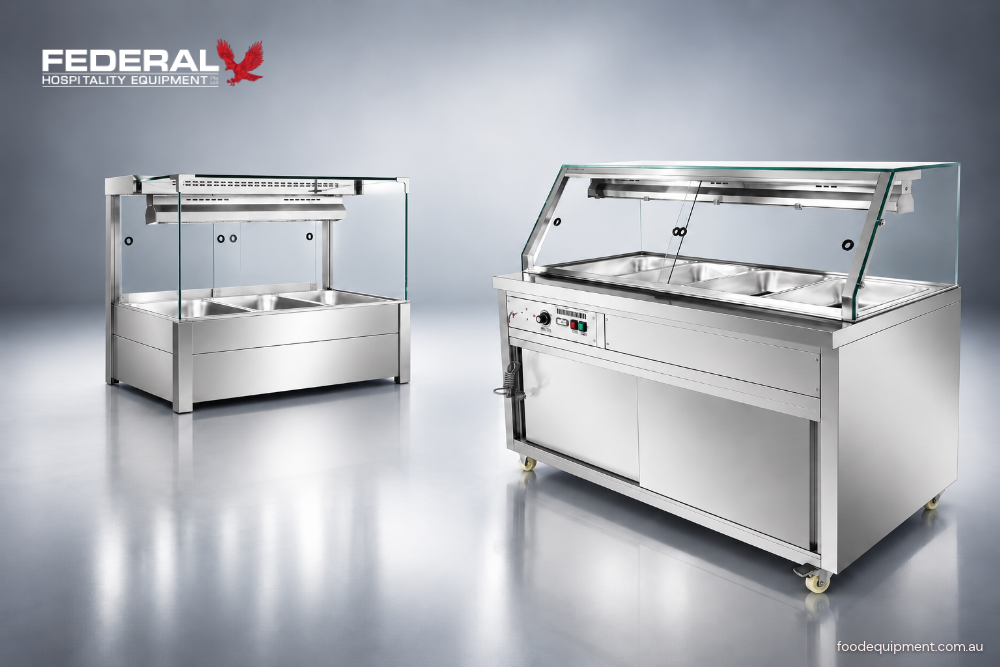
Choosing the right size commercial Bain Marie is an important part of planning an efficient Australian hospitality kitchen. Whether you operate a café, restaurant, takeaway shop, buffet, catering business, sporting club or foodservice counter, your equipment needs to accommodate the food you serve without taking up more space than necessary.
A Bain Marie that is too small may require constant refilling, interrupt service and leave staff struggling to keep enough dishes available during busy periods. On the other hand, an oversized unit can occupy valuable bench or floor space, increase equipment costs and use more resources than the business actually needs.
The right size is not determined by the appliance's external dimensions alone. You also need to consider food volume, menu variety, Gastronorm (GN) pan capacity, pan depth, available workspace, peak service periods and kitchen workflow.
Federal Hospitality Equipment Australia offers a range of Bain Marie and food display equipment, including Bonvue countertop wet-and-dry Bain Maries and Thermaster multi-pan foodservice units. Different configurations allow Australian hospitality businesses to select equipment according to their menu, service style and available installation space.
In this guide, we explain how to calculate the capacity your business needs, compare GN pan arrangements, assess countertop and larger models, and choose equipment that supports efficient foodservice without unnecessarily reducing your working space.
Choose a commercial Bain Marie based on the number of hot dishes and the quantity of food you need to hold at the same time during your busiest normal service period. A small café may need a compact countertop unit, while a busy takeaway or restaurant may benefit from a three- or four-pan configuration. Larger buffets and high-volume operations may require five or six GN 1/1 positions. Always consider pan depth, available space, service workflow and whether the equipment is designed for hot or cold food holding.
What Is a Commercial Bain Marie and Why Does Its Size Matter?
A commercial Bain Marie is foodservice equipment commonly used to provide gentle heating or maintain prepared food at a suitable holding temperature. Depending on the model, it may use a heated water bath or a dry-heating arrangement.
Bain Maries are commonly used in restaurants, takeaway stores, buffet counters, catering operations and other venues that need prepared dishes available throughout service.
Typical hot-food applications can include cooked vegetables, curries, soups, sauces, rice, pasta and other suitable prepared dishes.
Size matters because a Bain Marie is part of the service process. If there are too few pan positions, staff may struggle to present the required menu items simultaneously. If the pans cannot hold enough food, the team may need to replenish them too frequently.
However, purchasing a much larger unit than required can create its own problems. Extra equipment width may reduce preparation space, obstruct movement or make the service counter more difficult to manage.
The goal is to select enough capacity for your actual service requirements while maintaining a practical kitchen layout.
What Size Commercial Bain Marie Do You Need for Your Business?
The simplest starting point is to identify how many different dishes must be available at the same time during your busiest service period.
For example, a small café serving two or three hot menu items has different requirements from a buffet restaurant offering several main dishes, sides and sauces simultaneously.
Likewise, a takeaway business may serve a large number of customers throughout lunch but only need a few dishes available in its serving counter at any given moment.
Rather than selecting a Bain Marie based solely on the total number of customers served each day, focus on the food that needs to be held and accessed simultaneously.
| Business Type | Typical Foodservice Requirement | Suitable Sizing Approach |
|---|---|---|
| Small café | Limited selection of hot dishes | Compact countertop Bain Marie |
| Takeaway shop | Several ready-to-serve dishes | Medium-capacity multi-pan unit |
| Restaurant | Multiple mains, sides and sauces | Larger multi-pan configuration |
| Buffet service | Several dishes displayed simultaneously | Higher-capacity unit with multiple GN pans |
| Catering business | Variable quantities depending on event size | Capacity matched to event requirements and portability |
| Sporting club | Hot meals during concentrated service periods | Configuration based on peak meal demand |
These are planning guidelines rather than fixed rules. Two restaurants with similar seating capacities may require different Bain Marie sizes because their menus, preparation methods and service arrangements differ.
How Does GN Pan Capacity Affect Bain Marie Size?
One of the most useful ways to compare commercial Bain Maries is by their GN pan capacity.
GN stands for Gastronorm, a standardised system of food pan dimensions widely used in commercial kitchens.
Because GN pans follow standard dimensions, operators can organise different foods within a consistent service layout.
A full-size GN 1/1 pan measures approximately 530 × 325 mm. Smaller GN pans are available in fractional sizes, allowing different dishes to share the space occupied by a larger pan, provided the equipment supports the arrangement.
What Does 3 × GN 1/1 Capacity Mean?
A Bain Marie described as having 3 × GN 1/1 capacity is designed to accommodate the equivalent footprint of three full-size GN 1/1 pans.
Depending on the model and compatible pan dividers, operators may also be able to use smaller GN pans to create additional food compartments.
However, the number of GN positions does not automatically indicate how many litres of food the appliance can hold. Pan depth and fill level also affect usable capacity.
How Many GN Pans Should You Choose?
| GN Configuration | Typical Planning Application | Main Consideration |
|---|---|---|
| 3 × GN 1/1 | Smaller menus and lower-volume service | Compact arrangement for a limited number of dishes |
| 4 × GN 1/1 | Cafés, takeaways and moderate foodservice | Additional capacity or menu flexibility |
| 5 × GN 1/1 | Busier restaurants and larger menus | More dishes or greater simultaneous holding capacity |
| 6 × GN 1/1 | High-volume service and larger buffet operations | Greater food presentation and holding capacity |
Federal Hospitality Equipment Australia's wider range includes configurations with three, four, five and six GN 1/1 positions.
Always check whether the specific product is a hot-food Bain Marie or a cold Bain Marie display. The GN capacity may be similar, but the equipment serves a different purpose.
How Does GN Pan Depth Affect Bain Marie Capacity?
Pan depth is just as important as the number of pan positions.
Two Bain Maries may accommodate the same number of GN 1/1 pans but provide different practical food-holding volumes if their supported pan depths differ.
For example, a business holding large quantities of cooked vegetables, curry or pasta may benefit from deeper pans, while a venue offering several sauces or smaller side dishes may prefer shallower or divided pans.
Common GN pan depths include 65 mm, 100 mm and 150 mm, although not every Bain Marie supports every depth.
As an example, the Bonvue BM11SC countertop model is specified for compatible pans up to 100 mm deep, while certain Thermaster PG-series hot-food displays accept GN pans up to 150 mm deep.
These differences matter when calculating usable food capacity.
Are Deeper GN Pans Always Better?
Not necessarily. Deeper pans can accommodate more food, but they may also make portioning, replenishment and food rotation more difficult for certain menu items.
The right depth depends on how quickly the food is served, how often it is replenished and how the kitchen manages safe hot holding.
Should You Choose a Countertop or Larger Commercial Bain Marie?
Available space is another major factor when selecting commercial Bain Marie equipment.
Australian commercial kitchens often need to accommodate refrigeration, cooking appliances, preparation benches, sinks and other essential equipment within a limited footprint.
A countertop Bain Marie can be useful where the food-holding area needs to sit on an existing counter or bench.
Larger Bain Marie displays may be more suitable when hot-food holding is a central part of the service operation.
Countertop Bain Maries
Countertop models can suit cafés, takeaway stores, smaller restaurants and service counters where bench space is limited.
Federal Hospitality Equipment Australia offers Bonvue Square Countertop Wet and Dry Bain Marie models including:
- Bonvue BM11SC.
- Bonvue BM14SC.
- Bonvue BM17SC.
Its angled countertop range includes:
- Bonvue BM11TC.
- Bonvue BM14TC.
- Bonvue BM17TC.
These models offer different GN pan capacities and external dimensions, allowing operators to compare them according to the available counter space and number of dishes required.
Larger Bain Marie Displays
Larger foodservice operations may require a Bain Marie display with more GN pan positions and additional serving space.
Thermaster's PG-series wet-and-dry hot-food displays include models designed for four, five and six GN 1/1 pans.
These can be considered where hot-food presentation and holding are important parts of daily service.
Before choosing a larger model, measure the installation area and check access for staff, customers, cleaning and replenishment.
What Bonvue Bain Marie Sizes Are Available?
Bonvue offers countertop wet-and-dry Bain Maries in square-front and angled-front configurations.
The following published dimensions and capacities illustrate the differences between models.
| Bonvue Model | Front Design | GN 1/1 Capacity | Approx. Dimensions (W × D × H) |
|---|---|---|---|
| BM11SC | Square | 3 pans | 1055 × 624 × 720 mm |
| BM14SC | Square | 4 pans | 1388 × 624 × 720 mm |
| BM17SC | Square | 5 pans | 1721 × 624 × 720 mm |
| BM11TC | Angled | 3 pans | 1055 × 624 × 720 mm |
| BM14TC | Angled | 4 pans | 1388 × 624 × 720 mm |
| BM17TC | Angled | 5 pans | 1721 × 624 × 720 mm |
The main difference between the square and angled versions is the front presentation design. The choice should reflect the available space, intended display arrangement and service-counter layout.
Individual models may include features such as stainless-steel construction, overhead heating lamps, temperature controls, glass panels and compatible pan dividers.
Check the latest product specification for the exact model before ordering.
What Thermaster Bain Marie Configurations Are Available?
Thermaster provides several GN-based foodservice configurations within Federal Hospitality Equipment Australia's wider range.
It is important to distinguish between Thermaster's hot-food holding displays and its refrigerated cold Bain Marie trays.
Thermaster Hot-Food Bain Marie Displays
Examples of Thermaster wet-and-dry hot-food display models include:
- PG150FE-XG: 4 × GN 1/1 hot-food display.
- PG180FE-XG: 5 × GN 1/1 hot-food display.
- PG210FE-XG: 6 × GN 1/1 hot-food display.
These models are intended for holding appropriately prepared hot food and include features suited to foodservice presentation.
Thermaster Cold Bain Marie Trays
Federal Hospitality Equipment Australia also lists Thermaster refrigerated Bain Marie trays, including:
- GN3-VA: 3 × GN 1/1 ventilated static cold Bain Marie.
- GN4-VA: 4 × GN 1/1 ventilated static cold Bain Marie.
- GN5-VA: 5 × GN 1/1 ventilated static cold Bain Marie.
- GN6-VA: 6 × GN 1/1 ventilated static cold Bain Marie.
These refrigerated models are designed for cold-food applications, not for keeping cooked dishes hot.
Their GN capacities are useful for comparing physical food-display arrangements, but operators must choose the correct heating or cooling function for their menu.
How Much Food Should Your Bain Marie Hold?
A Bain Marie should provide enough capacity for the food you need available at the same time, rather than simply matching the total number of meals prepared during the day.
For example, a takeaway shop may serve hundreds of customers throughout lunch but only need several pans of food available at any given moment.
Conversely, a buffet restaurant may need many dishes displayed simultaneously because customers expect a broad selection.
To estimate the required capacity, start with the amount of each dish that must be held during peak service.
A Practical Bain Marie Capacity Calculation
Required holding capacity = peak simultaneous food volume + practical operating allowance.
The operating allowance provides flexibility during busy periods without forcing the kitchen to fill every available pan unnecessarily.
For example, imagine a takeaway venue that needs the following dishes ready at the same time:
- One pan of rice.
- One pan of curry.
- One pan of cooked vegetables.
- One smaller compartment for sauce or gravy.
Depending on portion sizes, pan depth and replenishment frequency, a three- or four-position arrangement may be worth assessing.
This is an illustrative example rather than a fixed recommendation. The actual requirement should be calculated from the business's portion sizes and expected service demand.
How Do You Calculate Peak Simultaneous Food Volume?
Peak simultaneous food volume is the quantity of prepared food that needs to be available for serving at one time.
To estimate it, consider:
- How many menu items require hot holding?
- How many portions of each item are typically sold during the busiest service period?
- How much food can be replenished from the kitchen during service?
- How frequently can staff safely replace or replenish the pans?
- What pan depth and arrangement are required for each dish?
A venue with rapid replenishment may need less holding capacity than one where food is prepared in larger batches.
The aim is to maintain enough food for efficient service without keeping unnecessarily large quantities on display.
Does Food Type Affect Bain Marie Size?
Yes. Different foods have different serving patterns, portion sizes and holding requirements.
For example, sauces and gravies may need relatively small compartments, while rice, pasta and cooked vegetables may require larger pans.
Buffet service may require more separate compartments because customers expect a range of dishes to be available simultaneously.
| Food Type | Sizing Consideration | Practical Approach |
|---|---|---|
| Soups | Volume and suitable container depth | Consider deeper or smaller compatible pans according to demand |
| Sauces and gravy | Smaller serving quantities | Use smaller compartments where supported |
| Cooked vegetables | Peak portion demand | Allow enough capacity for busy periods |
| Rice and pasta | Food volume and pan depth | Plan around serving quantity and safe holding practices |
| Meat-based dishes | Portion size and service frequency | Provide sufficient hot-holding capacity |
| Curries | Quantity and number of varieties | Balance pan size with the number of dishes offered |
| Buffet dishes | Menu variety | Multiple compartments may matter more than overall volume |
How Does Menu Variety Influence Bain Marie Size?
A Bain Marie holding three large dishes may have very different requirements from one presenting six smaller items.
For example, a restaurant offering rice, curry and cooked vegetables may be able to organise its service using a limited number of larger pans.
A buffet offering several curries, side dishes, vegetables and sauces may need more individual compartments, even if the total quantity of food is similar.
Therefore, menu variety should be considered alongside total food volume.
Where the equipment supports compatible GN pan dividers, smaller pans can provide flexibility for presenting multiple dishes within a larger GN footprint.
Wet or Dry Bain Marie: Does It Affect the Size You Need?
Wet and dry Bain Maries use different heating arrangements, and the correct choice depends on the food being held and the way the equipment will be operated.
Federal Hospitality Equipment Australia offers Bonvue countertop models designed for wet-and-dry operation.
Wet Bain Marie
A wet Bain Marie uses heated water as part of its heat-transfer system.
This method can provide gentle heating for suitable prepared foods and is commonly associated with traditional Bain Marie applications.
Operators must follow the manufacturer's instructions for water levels, heating controls and compatible pans.
Dry Bain Marie
A dry Bain Marie uses a heating arrangement that does not require a conventional heated water bath during dry operation.
Dry heating may suit certain service arrangements, but suitability depends on the model and the food being held.
Does Wet or Dry Heating Change Capacity?
The heating method does not automatically determine the number of GN pans a Bain Marie can accommodate.
However, it can influence the equipment's operation, pan requirements, maintenance and suitability for particular foods.
Compare the heating method alongside GN capacity, pan depth and available space rather than choosing based on external dimensions alone.
How Much Bench Space Does a Commercial Bain Marie Need?
Before ordering a countertop Bain Marie, measure the available width, depth and height of the installation area.
Also consider:
- Space required for food preparation.
- Access to nearby refrigeration.
- Clearance around sinks and other equipment.
- Staff access for serving and replenishment.
- Cleaning access.
- Electrical connections.
- Manufacturer-specified ventilation and safety clearances.
- The weight of the appliance and food when loaded.
A Bain Marie that technically fits on the bench may still be impractical if it leaves too little room for staff to work safely.
How Do You Choose the Right Bain Marie for a Small Café?
Small cafés generally benefit from compact equipment that provides enough food-holding capacity without taking up excessive counter space.
If the café serves only a few hot dishes, a smaller countertop configuration may be appropriate.
A Bonvue three-pan model such as the BM11SC or BM11TC may be worth comparing where the menu and available counter space support that arrangement.
However, the number of pans should be determined by the dishes offered and the quantity required during peak service.
What Size Bain Marie Is Suitable for a Takeaway Shop?
Takeaway shops often need several ready-to-serve dishes available during concentrated lunch and dinner periods.
A medium-capacity multi-pan Bain Marie may provide a useful balance between food variety and available service-counter space.
For example, a takeaway shop offering rice, curries and cooked vegetables may need separate compartments for each dish.
A three- or four-pan configuration can be a starting point for comparison, but actual requirements depend on the menu and replenishment schedule.
What Size Bain Marie Is Suitable for a Restaurant?
Restaurants may require a larger Bain Marie when several hot dishes, sides or sauces must remain available during service.
A four- or five-pan configuration may be useful where food holding forms a significant part of the kitchen workflow.
However, a restaurant preparing most dishes to order may need less holding capacity than a buffet-style venue of similar size.
Choose according to the number of dishes that need to be held simultaneously rather than restaurant seating capacity alone.
What Size Bain Marie Is Best for Buffet Service?
Buffet operations often need multiple dishes available at the same time.
Customers may expect a selection of mains, vegetables, rice, pasta and side dishes, so the number of separate pan positions can be particularly important.
Five- or six-pan configurations may be worth considering for larger buffet operations, depending on menu variety and expected demand.
Thermaster hot-food displays with five or six GN 1/1 positions provide examples of larger-capacity configurations.
Food presentation, staff access, customer movement and safe temperature management should also influence the final choice.
What Size Bain Marie Is Suitable for Catering Businesses?
Catering requirements can vary considerably between events.
A small private function may need only a limited number of hot dishes, while a larger event may require several service stations and more substantial holding capacity.
Caterers should consider the number of guests, menu variety, service duration, transport arrangements and access to power.
In some situations, multiple smaller units may provide greater flexibility than one large appliance.
Should You Choose One Large Bain Marie or Several Smaller Units?
The answer depends on the venue's layout and service process.
One larger Bain Marie may simplify food presentation and centralise service.
Several smaller units may be useful where food is served from different stations or where the available counter space is divided into separate areas.
For example, a catering operation with multiple buffet stations may prefer several appropriately sized units rather than one large central display.
When comparing these options, consider total GN capacity, staff access, electrical requirements, cleaning and available space.
Does Bain Marie Size Affect Service Speed?
Yes. The relationship between capacity and service speed is an important consideration.
If a Bain Marie is too small, staff may need to refill pans frequently during busy periods.
If the unit has too few compartments, employees may struggle to keep the full menu available at the same time.
However, a larger unit does not automatically improve service. If the layout is difficult to access or unnecessarily spread out, staff may spend more time moving between dishes.
The most effective arrangement keeps frequently served items within convenient reach while providing enough capacity for normal peak demand.
Why Is Food Safety Important When Choosing Bain Marie Capacity?
Commercial Bain Maries are commonly used to hold prepared food at serving temperatures.
They should not automatically be treated as appliances for cooking raw food or rapidly reheating chilled meals.
For potentially hazardous hot food in Australia, the usual hot-holding requirement is 60°C or above, unless a documented, compliant alternative time-and-temperature procedure applies.
The appliance's temperature setting is not necessarily the same as the actual food temperature.
Use suitable food thermometers and follow applicable food safety requirements.
Capacity planning also matters because overfilling pans, using unsuitable containers or repeatedly adding cooler food can make safe holding more difficult.
Cook or reheat food using appropriate equipment before transferring it into a hot-holding Bain Marie, following the manufacturer's instructions and food safety procedures.
Can an Oversized Bain Marie Increase Operating Costs?
An oversized Bain Marie may require more installation space and involve higher equipment costs.
Depending on the model and how it is operated, a larger heated unit may also consume more energy than a smaller appliance suited to the same workload.
However, running costs cannot be determined from physical size alone.
Power rating, heating method, operating hours, temperature settings and actual foodservice requirements all influence energy consumption.
Compare the total operating requirements of the available models rather than assuming the smallest unit is always the cheapest to operate.
What Other Features Should You Consider Besides Size?
Although capacity is the central consideration, several other features can influence how practical a Bain Marie is for daily commercial use.
Stainless-Steel Construction
Stainless-steel construction is common in commercial foodservice equipment because it provides a durable and practical surface for busy kitchen environments.
Temperature Controls
Check the available temperature settings and whether the controls suit the intended food-holding application.
Pan Compatibility
Confirm supported GN pan sizes, depths and divider arrangements.
Food Presentation
Glass panels, overhead lighting and serving access can be useful in customer-facing hot-food displays.
Cleaning Access
Consider how easily staff can remove pans, clean surfaces and maintain the equipment.
Electrical Requirements
Some larger countertop Bain Maries require higher-current electrical connections. Confirm the power supply before installation.
Mobility
Some larger units include castors, which can be useful where equipment needs to be repositioned for cleaning or service.
What Electrical Requirements Should You Check?
Electrical supply is an important part of Bain Marie selection.
For example, published specifications for the Bonvue countertop range include:
| Model Group | Rated Power | Electrical Requirement |
|---|---|---|
| BM11SC / BM11TC | 2194W | 240V, 10A |
| BM14SC / BM14TC | 3000W | 240V, 15A |
| BM17SC / BM17TC | 3301W | 240V, 15A |
These are published specifications and should be reconfirmed against the individual product before purchase.
Do not assume a standard 10A outlet is suitable for a model requiring 15A power.
Where electrical modifications are necessary, consult a licensed electrician.
How Do You Avoid Buying the Wrong Size Bain Marie?
Several common purchasing mistakes can lead to equipment that does not suit the kitchen's requirements.
1. Choosing Based Only on External Dimensions
A unit's width does not tell you how many GN pans it can hold or what pan depths are supported.
2. Ignoring Peak Service Demand
Calculate the amount of food required during the busiest normal service period, not just average daily sales.
3. Buying Too Few Pan Positions
A Bain Marie with insufficient compartments may make it difficult to present the full menu.
4. Buying Excessive Capacity
An unnecessarily large unit may consume valuable workspace without improving service.
5. Overlooking Pan Depth
Pan depth affects food volume and should be matched to the intended menu.
6. Ignoring Staff Workflow
Staff need enough room to serve, replenish and clean the Bain Marie safely.
7. Confusing Hot and Cold Bain Maries
Refrigerated cold Bain Marie trays are not substitutes for hot-food holding equipment.
8. Forgetting Electrical Requirements
Check whether the selected model requires 10A, 15A or another specified electrical connection.
9. Assuming a Bain Marie Is a Rapid Reheating Appliance
Use suitable cooking or reheating equipment before placing prepared food into a hot-holding unit.
10. Choosing Without Measuring the Installation Area
Allow space for the appliance, staff access, serving arrangements and manufacturer-required clearances.
Commercial Bain Marie Size Selection Checklist
- How many hot dishes need to be available simultaneously?
- What quantity of each dish is required during peak service?
- How frequently can staff replenish the pans?
- How many GN 1/1 positions are required?
- Would smaller GN pans or dividers improve the layout?
- What pan depths are suitable for the menu?
- Is a countertop or larger display unit more practical?
- What are the available installation dimensions?
- Is the bench suitable for the loaded equipment weight?
- Would a square-front or angled-front display suit the counter?
- Is wet or dry heating appropriate?
- Does the business need hot holding or cold display?
- Are temperature controls suitable for the intended application?
- Can staff access and replenish pans efficiently?
- Is there adequate space for cleaning?
- What electrical connection does the model require?
- Are the correct GN pans and dividers included or purchased separately?
- What warranty and servicing arrangements apply?
- Will the unit meet normal peak demand without excessive unused capacity?
Why Consider Bonvue and Thermaster Bain Marie Equipment?
Federal Hospitality Equipment Australia offers different foodservice configurations through Bonvue and Thermaster.
Bonvue's countertop wet-and-dry Bain Marie range includes square and angled designs with three, four and five GN 1/1 positions.
These models can suit businesses that need a defined hot-food display area within an existing counter or benchtop arrangement.
Thermaster offers larger wet-and-dry hot-food display models with four, five and six GN 1/1 positions, as well as separate refrigerated cold Bain Marie configurations.
This variety allows hospitality operators to compare equipment according to the number of dishes, required holding method and available service space.
Why Buy Commercial Bain Maries from Federal Hospitality Equipment Australia?
Federal Hospitality Equipment Australia supplies commercial kitchen, food display and catering equipment for Australian hospitality businesses.
Its Bain Marie range includes Bonvue countertop wet-and-dry models and Thermaster foodservice equipment with different GN pan capacities.
These options are relevant for cafés, takeaway stores, restaurants, clubs, buffet operations and catering businesses that need practical food-holding or display equipment.
Before selecting a model, compare its pan capacity, dimensions, heating or cooling function, electrical requirements and suitability for your menu.
Explore the commercial Bain Marie range at Federal Hospitality Equipment Australia.
Conclusion: How Do You Choose the Right Size Commercial Bain Marie?
The right commercial Bain Marie is the one that provides enough capacity for your busiest normal service while fitting comfortably into the available kitchen or serving area.
For a small café, a compact countertop Bain Marie may provide a practical balance between food capacity and workspace.
A takeaway shop or restaurant may benefit from a three- or four-pan configuration, depending on its menu and peak demand.
Buffet services and higher-volume catering operations may require five or six GN 1/1 positions to accommodate a broader range of dishes or larger quantities of prepared food.
However, there is no universal size that suits every Australian hospitality business.
Before purchasing, calculate your peak simultaneous food volume, identify the required GN pan arrangement, confirm pan depth and measure the installation area.
Also consider whether wet or dry heating is appropriate, how staff will access and replenish food, and whether the selected model is designed for hot-food holding or refrigerated display.
Federal Hospitality Equipment Australia's range includes Bonvue countertop Bain Maries and Thermaster multi-pan foodservice equipment, offering different configurations for different hospitality applications.
By choosing capacity around your actual menu, available space and service workflow, you can create a more efficient foodservice station without unnecessarily consuming valuable kitchen space.
Frequently Asked Questions
What size commercial Bain Marie do I need?
Choose a Bain Marie based on the number of dishes and quantity of food required simultaneously during your busiest normal service period. Also consider GN pan capacity, pan depth and available space.
How do I calculate Bain Marie capacity?
Estimate the peak simultaneous food volume for each menu item, then include a practical operating allowance for busy periods.
What does GN mean in a Bain Marie?
GN stands for Gastronorm, a standardised system of food pan dimensions used in commercial kitchens.
What size is a GN 1/1 pan?
A standard GN 1/1 pan measures approximately 530 × 325 mm. Pan depth varies.
What does 3 × GN 1/1 mean?
It means the equipment accommodates the equivalent footprint of three full-size GN 1/1 pans, subject to the manufacturer's specifications.
Is a three-pan Bain Marie suitable for a café?
A three-pan unit may suit a café with a limited hot-food menu, provided its capacity meets peak service demand.
Is a four-pan Bain Marie suitable for a takeaway shop?
A four-pan configuration can suit takeaways serving several ready-to-eat dishes simultaneously, depending on portion quantities and replenishment frequency.
When should I choose a five-pan Bain Marie?
A five-pan unit may be useful for larger menus, busier foodservice operations and situations where several dishes must be held at once.
When is a six-pan Bain Marie appropriate?
A six-pan configuration may suit larger buffet operations or high-volume service where more food-holding positions are required.
Does GN pan depth affect Bain Marie capacity?
Yes. Deeper compatible pans generally accommodate more food, but supported depths vary between appliances.
Are deeper GN pans always better?
No. Choose depth according to the food type, portion quantity, replenishment schedule and manufacturer's requirements.
What is the difference between a countertop and larger Bain Marie?
Countertop units fit on suitable benches, while larger foodservice displays may provide more pan positions and a greater serving footprint.
What is a wet Bain Marie?
A wet Bain Marie uses heated water as part of its heating system to provide gentle heat for suitable food-holding applications.
What is a dry Bain Marie?
A dry Bain Marie uses a heating arrangement that does not require a conventional heated water bath during dry operation.
Is wet or dry Bain Marie better?
The better option depends on the food being held, the model's design and the venue's service requirements.
What is the Bonvue BM11SC?
The BM11SC is a square-front countertop wet-and-dry Bain Marie with a published capacity of three GN 1/1 pans.
What is the Bonvue BM14SC?
The BM14SC is a square-front countertop wet-and-dry Bain Marie designed for four GN 1/1 pans.
What is the Bonvue BM17SC?
The BM17SC is a square-front countertop wet-and-dry Bain Marie designed for five GN 1/1 pans.
What is the difference between Bonvue SC and TC models?
The SC range has a square-front design, while the TC range has an angled-front design. Compare the individual models for capacity and dimensions.
Does Thermaster offer hot-food Bain Marie displays?
Yes. Thermaster's PG-series wet-and-dry hot-food displays include models designed for four, five and six GN 1/1 pans.
Does Thermaster also offer cold Bain Marie trays?
Yes. Thermaster offers refrigerated cold Bain Marie trays with different GN capacities. These are intended for cold-food applications rather than hot holding.
Can a cold Bain Marie be used to keep food hot?
No. Refrigerated cold Bain Marie equipment is designed for cold-food applications and should not be used as a substitute for a hot-food holding appliance.
Can a Bain Marie reheat cold food?
Hot-holding Bain Maries should not automatically be used for rapidly reheating chilled food. Use suitable reheating equipment and follow the manufacturer's instructions and food safety requirements.
What temperature should hot food be held at in Australia?
Potentially hazardous hot food is generally required to be held at 60°C or above unless an applicable compliant alternative time-and-temperature procedure is used.
Can I use smaller GN pans in a larger Bain Marie?
Some models support smaller GN pans using compatible dividers. Check the manufacturer's specified pan arrangements.
Does Bain Marie size affect running costs?
It can. Running costs depend on power rating, heating method, operating time and how the equipment is used, not just external size.
How much bench space does a Bain Marie need?
Allow for the appliance's width, depth and height, plus safe access, serving space, cleaning requirements and manufacturer-specified clearances.
Which Bain Marie brands does Federal Hospitality Equipment Australia offer?
Relevant brands in Federal Hospitality Equipment Australia's Bain Marie range include Bonvue and Thermaster.
Where can I buy a commercial Bain Marie in Australia?
Federal Hospitality Equipment Australia offers commercial Bain Marie and food display equipment for cafés, restaurants, takeaway stores, catering businesses and other hospitality operations.